2006/11/13

My Randying No. 2

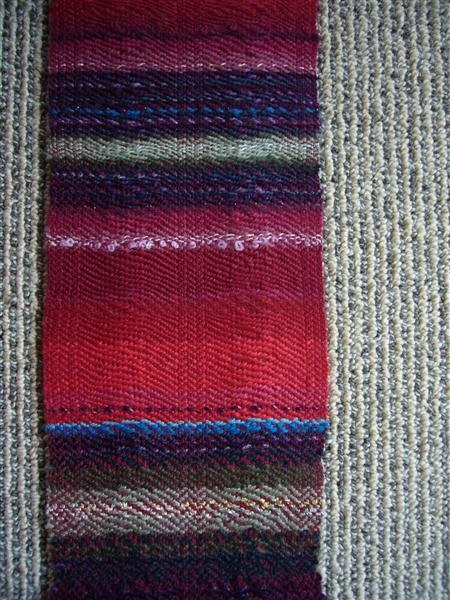
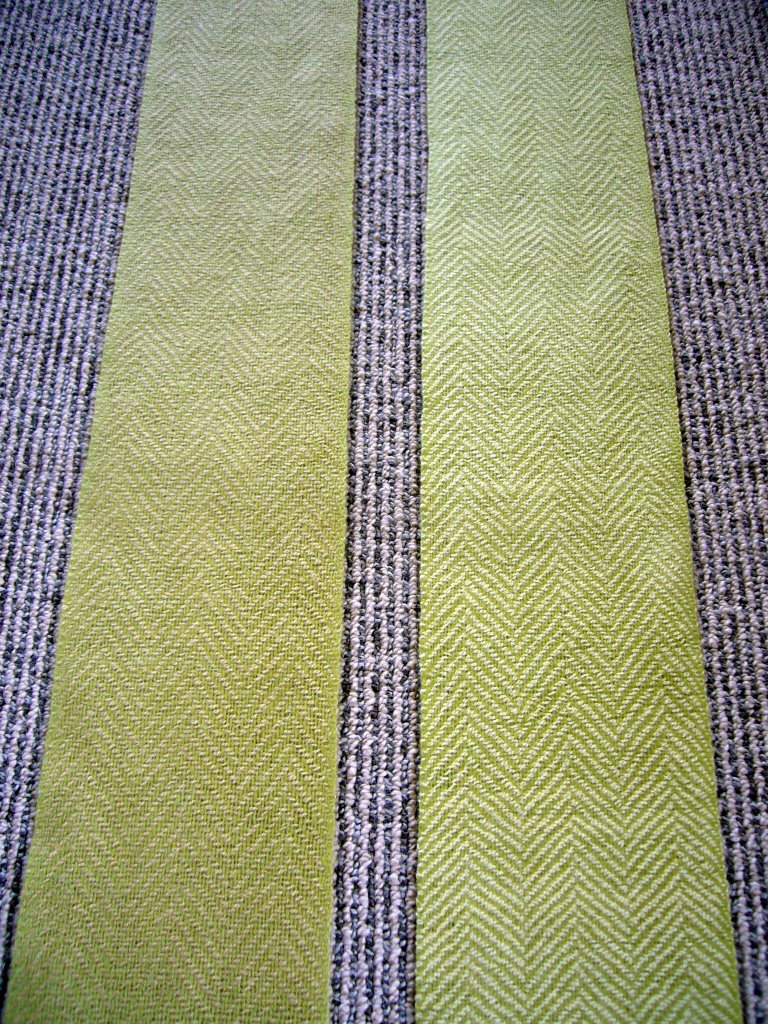
I needed to work on small cashmere scarves for a gallery, but after weaving two nice onces, I felt the urge to Randy, and here are sections of it. When I'm Random-Randying, I pay more attention to the "dynamic" transitions and the "proportion" becomes secondary; next time I'd like to plan the changes to some degree, so the scarf as a whole appears more coherent, though at this point, I'm not sure what that means.

2006/11/07

A Miserable Day

It's raining and gray and cold today, (what Nelsonians call a "miserable" day) which means it's a picture perfect day for being holed up in my studio. I've been blasting Andrea Boccelli all morning, weaving a series of narrow, short scarves in cashmere. The first two were in simple dornick in one color warp, one color weft, but with the third, I'm Randying and also changing the direction of the twill. And boy, is it slow. I don't think I'll be able to finish weaving 180cm in two days. Randying also requires/allows me to fiddle with the selvedge and feel the cloth more as I weave, not exactly a wise thing to do to maintain even tension, but for as a tactile experience, it's hard to beat.

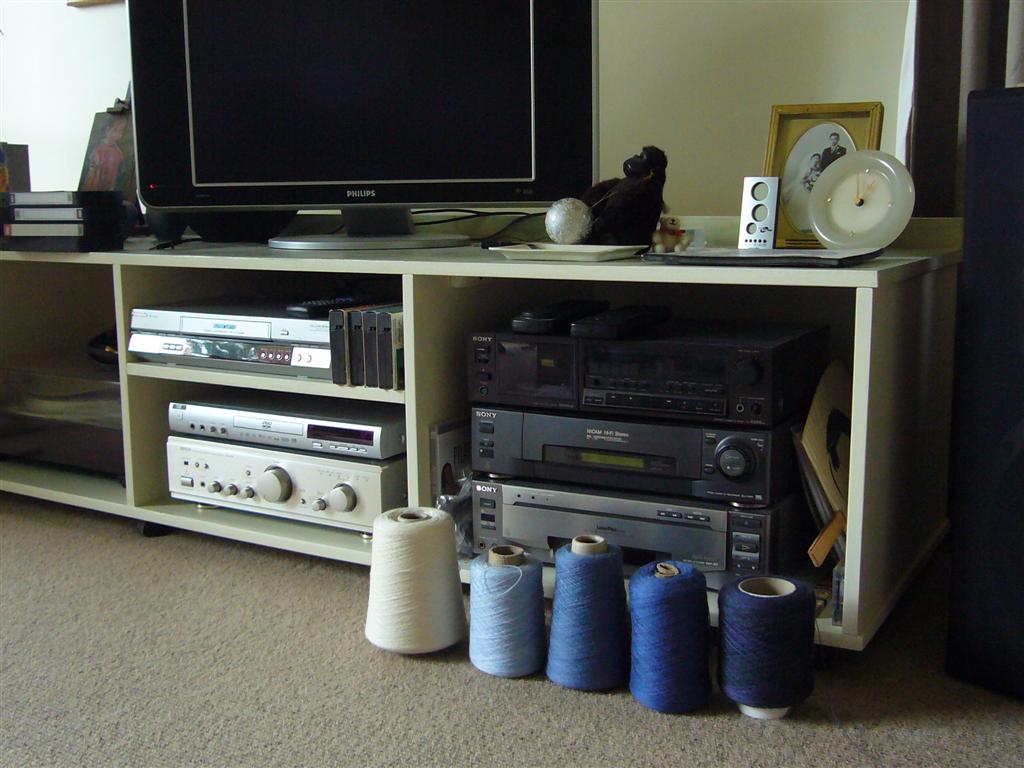
That is not to say that I have not started to panic, officially, about not really being in a panic. My Excel worksheet tells me I have 83 days before the opening of my mini solo exhibit, and all I have done has been to stare at the cones of blue merino yarns (conveniently placed in front of some of my favorite non-weaving equipment) and thinking vaguely about Fibonacci sequence.

Wisdom does not come with age automatically.

2006/11/04

Originality/Creativity

I'm starting to get a little greedy. I now want my weaving to show originality; something like a signature. Which is a funny thing to say right after all the oohing and aahing of Randy's textiles, and I still want Randy's mark on my weaving as well. But I want to be able to create something beyond that. And I'm looking for ways to include a point of difference. (Though I hate all these marketing talk.)

I am of the opinion, as are many weavers, that there is nothing new under the sun when it comes to weaving. We may have computerized looms and new fibers, but most everything we do today has been done before, and some of them quite a while ago on what we would think of as "crude" equipment, and maybe with the help of extra pairs of hands. So I don't claim to do anything new, and yet I want to show originality.

I'm from Japan, the greatest country and people for improving and fine-tuning skills and products someone else invented or discovered. Just about anything 'uniquely' Japanese can be traced back to China or Korea in the old days, or the US or Europe in the last few centuries. I was amazed at the similarity, for example, of Kabuki theater to Chinese operas, the gestures, the delivery. And try as I may, I am yet to come across anything in art or industry originating from Japan. In the eighth century, we literally kidnapped Korean potters so we can have a flourishing ceramic art, to the point it decimated Korean pottery. So it's not in my DNA to be original, and yet I want to explore my creativity.

I only got this far in thinking about originality and creativity. It's going to be a long apprenticeship.

2006/10/31

Bookbinding

I needed a catalyst to shove me beyond reminiscing about Randy's workshop, and I found it!

Bookbinding is something I've been interested in almost my entire life; it certainly predates weaving and floral arrangement, and possibly chocolate, but I kept putting it off. I finally went to a workshop this weekend, and had a great time, and it was oh-so-well-worth the wait.

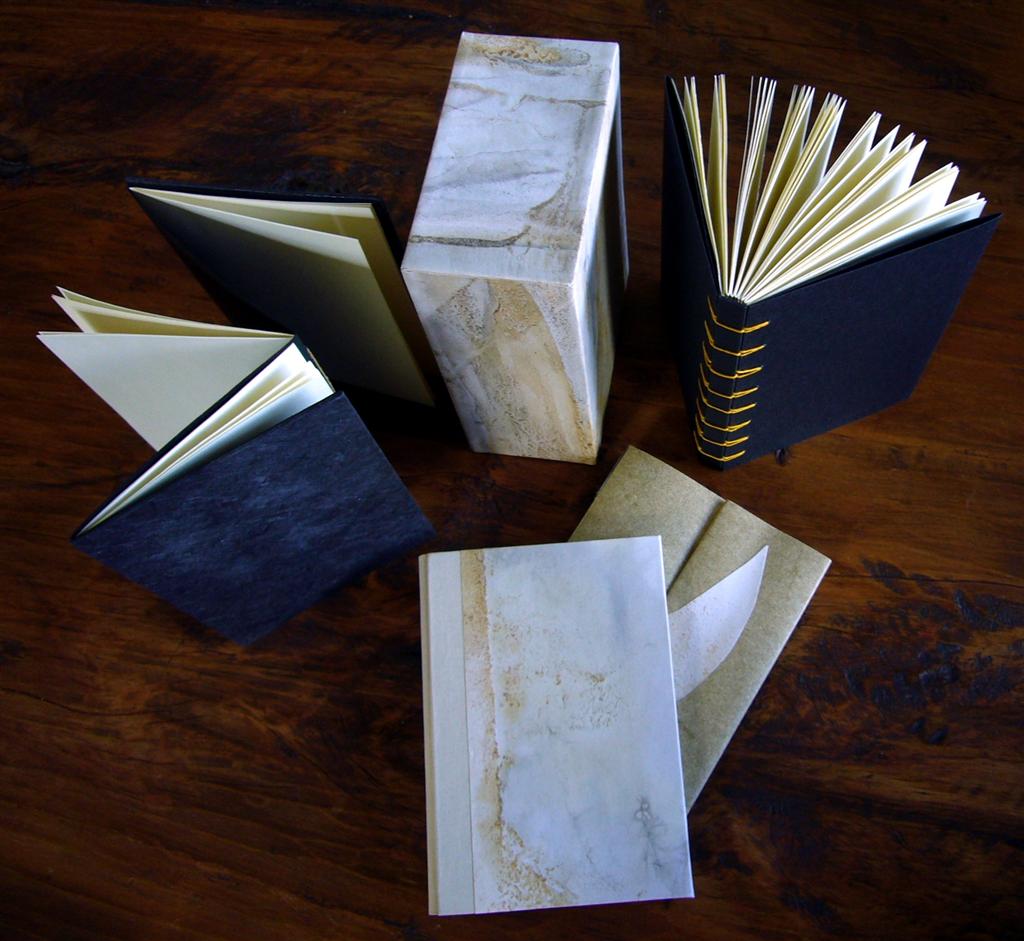
Ex-weaver and now book binder Ann Bell of Hamilton was invited by Marlborough Weavers and ran a tight two-day workshop in Blenheim, and in one weekend, we made four types of small notebooks and a slip cover. She brought some achingly beautiful papers made into pre-cut kits we were to choose from. I chose an elegant gold-and-black kit, and almost everything worked out wonderfully. When I was working on the last crutial part of the last notebook (the partially concealed gold one), almost everybody else was finished and starting to clean up, and I rushed and it turned out less than perfect, but when I do it again, it won't happen.

It was a great lesson in how to run a workshop, too. Ann was incredibly well-organized, and the pre-cut kits guaranteed all of us will come away with a beautiful set, but we picked up how to prepare our own kits, too. I've had ideas on combining weaving and bookbinding, but now I know how to do it. And there will be another workshop next year. Yay!

If you are interested in Ann's workshop for your group, email her. As for me, it's time to start panicking about the exhibit; I have 90 days before it opens. Yikes.

2006/10/30

A Very Sorry Randying

I had put on a burgundy merino warp on the Jack loom for four short and narrow scarves before the workshop. Last week, I finished Scarf 1, and I couldn't resist, so I tried Randying on Scarf 2, but was GREATLY hindered by my limited color palette (that is, almost a complete lack of green/yellow/orange half of the color wheel!) Because I wanted to wear it as a sample, I started out by using only merino, then wool roughly 110/2, (in an attempt to keep the shrinkage even) but after a while anything went.

I must reorganize my wool room so I can Randy better, and I probably need a shopping spree. But here are some embarrassing glimpses of Scarf 2. Scarves 3 and 4 were finished in various Burgundy possum-merino-silk yarns, wonderful to the touch, but I admit, a bit shy of attractive. I hope I can do a bit better than this the next time.

2006/10/26

My Colors

The second reason why I love Randy's work is I love his clear, crisp, honest, straight forward, but sophisticated American colors. And I call them American colors.

Colors are subjective, and for example, my mother thinks Randy's colors are Asian. In fact, he was at one point influenced by the wonderful Japanese weaver and dyer (and Mom's hero,) Shimura Fukumi, so maybe his colors are Japanese/Asian. I can also see different artists and paintings in his different cloths, and naturally Randy's colors change from warp to warp, over time, depending on the weave structures or the intended end-use of his textiles, and ultimately, his whim. I have no clue what kind of impressions his textiles give you, because that depends on where you've been, what you've seen, and what you like. And I don't intend to oversimplify and say, "Randall Darwall uses American colors." No way. But it's the way I see his work.

I lived in Minneapolis, a colorful part of the Midwest of the USA for 10 years off and on, and in Tucson for a year when I was a child. I lived in Auckland, New Zealand, a sub-tropical paradise, for two years, and have been in Nelson coming up to ten years. The rest of the time I lived in Yokohama, Japan, very heavily polluted but with distinctive seasons, and more importantly, seasons and colors deeply embedded in the everyday language and thinking, as cultural codes. So I daresay I have lived in three distinct color cultures.

Now I'm getting deep into an extremely subjective territory, it's like walking on stilts in a swamp after heavy rain, but I'll give it a try.

If you look at traditional (say, pre-1970's) kimono, most design patterns have meanings and names, and are associated with specific season or occasion and color. For example, chrysanthemums are mainly yellow or gold or white, though small mums can come multi-colored. Certain patterns should be worn only during certain months, (regardless of what the weather is really like,) which means the design can dictate the fiber: goldfish; summer; casual cotton, or even silk, but probably not wool. Certain patterns are associated with occasions, e.g. the decorative cart, crane or turtles are good luck, and are worn at weddings, and out of respect for the occasion, the fiber is silk (or synthetics nowadays) but almost never cotton. If you are a fan of Haiku poetry, you'll know about the use of "kigo" or seasonal clues; you get the gist. (Though I understand it's not compulsory in Western Haiku. )

So we grow up with these subconscious interconnection of patterns, seasons/occasions, colors, and fiber, (codes, really) and we need to keep these in mind when, say, putting a set of kimono and accessories together to wear to your sister's wedding. Traditionally a different set of priorities came into play when determining color combinations; one can easily end up with horribly mismatched (in my modern day opinion) colors and over-the-top combination of patterns, embroidery, textures, (ditto). Thank goodness the cut of the garment is simple.

Again, traditional Japanese colors, other that the special-occasion gold, orange red, purple, white and black, are often not saturated but tints (hue + white) or shades (hue + black) of various values, partly because of the available natural dye material, partly because of the overcast weather we often get, but also because these nuanced colors are considered personable, ergo desirable. So, muddy colors, bad combinations, too much cultural baggage, for me. (Modern colors are another story for another day.)

I don't have a firm enough grasp of New Zealand color schemes, but I do see more warm (the yellowy, compared to the bluey) colors, based frequently on nature, and lots of shades. I'm starting to appreciate oranges and yellow-greens in the last few years, especially in combination with purples, but the underlying color schemes are a mystery to me, and again, the in-betweeness (to me) of the colors, the muddiness, I find unattractive.

Now to American colors. I realize the US is a big country and there are different climates, cultures and people, so what I think of as American colors are not the only colors or schemes present in that country. Not at all. (And among other things, Internet shopping takes away the traditional national borders, I know!) But what I see, in contrast to MY Japanese and New Zealand experiences, are what I describe as "clear and crisp" colors and combinations. In some instances, they are true to the original value of the given hue, and they may be more intense/saturated. But more importantly, I think I unconsciously understand why they are put together, and am naturally sympathetic, and that's why they are "honest and straight forward" to me. I simply love them.

As regards sophisticated, well, I learned in class that the narrow range of values over a wide range of hues make it so; that I can explain.

Randy made me feel at home with colors, and I want to investigate colors and dye my own yarns. But there is ALWAYS more to Darwall textiles, and I'm going to have many more "A ha!" moments in the decades to come.

But for now, I need to stop looking back and start my apprenticeship.
A Weaver's Repressed Memory

I'm still having a hard time coming back to terra firma, so I appreciate other weavers letting me know what they are weaving, or rehashing discussions from the workshop.

One told me she didn't want to be a Randiette, and then apologized for sounding disrespectful. Not at all. I expect many of my classmates would have been weaving for 20-, 25- or 30- years and have their own styles, and at any rate, workshops are to enhance one's work, not necessarily to emulate. Sticking to one's own creative direction is part of New Zealand's national psyche, and as mad about Darwall textiles as I am, I don't aim to reproduce his textiles even if I could. Nevertheless I was smittened by his work, and here's one reason.

Between 2000 and 2001, I tried spinning, dyeing, and other skills most weavers know and use to enhance their textiles. Back then, I told myself, "These are interesting but I need time to investigate, so I shall come back to them when I feel more comfortable/competent about my weaving."

To my shock/horror I remembered while recapping Randy's workshop that I made the same decision about colors one afternoon in May, 2001. That is, in my eagerness to improve my weaving technique, I needed to eliminate all "distracting" elements/components, and thus I started to weave with and buy only navy or otherwise blue yarns. Methodical but mad. What's worse, I continued to buy navy and blues, plus a small assortment of undyed, white, black, gray, (all with no or little hues, and more recently, reds,) and forgot that the colorless purgatory was mean to be temporary. Colors used to be my single most favorite part of weaving until that fatal afternoon.

Now that I'm also interested in texture and weave structures, I will keep weaving my monotone cloth, but it's time I resumed playing with colors. That's part of my apprenticeship.

2006/10/25

Dianne Dudfield, Post Randy, No 1.

Dianne writes: The warp is what I took to the workshop. The weft goes bottle green, pinky purple, then murky blue, teal and an apricot/orange. Colours I use quite often but I would never have used on said warp pre-RD so even though I can't get the "use 50 colours" bit (yet) I am trying new adventures. Also put in 4 thick boucle threads in a green, navy and bottle and lurex combination and crossed the warp with that at intervals as well. The frost crystal pattern shows up well after washing and wished I had persevered with it more. I'm happy with the result.

The threading is called Frost Crystal from a Weavers magazine, but not an exact copy. This is also pictured in the new book on twills from Weavers magazine. The wee pattern bits are woven straight draw and the longer pattern is woven 5-end advancing. I'm very impressed at how a weft can disguise a not so attractive warp and make an acceptable creation."

Acceptable? I think you underestimate your piece, but your warp was a very soft, gentle collection of greens and blues, from memory, and I like that with weave and colour, you have put in some sharp-looking areas as well as the soft blended areas. Thank you, Dianne.

2006/10/24

I'm in the Book

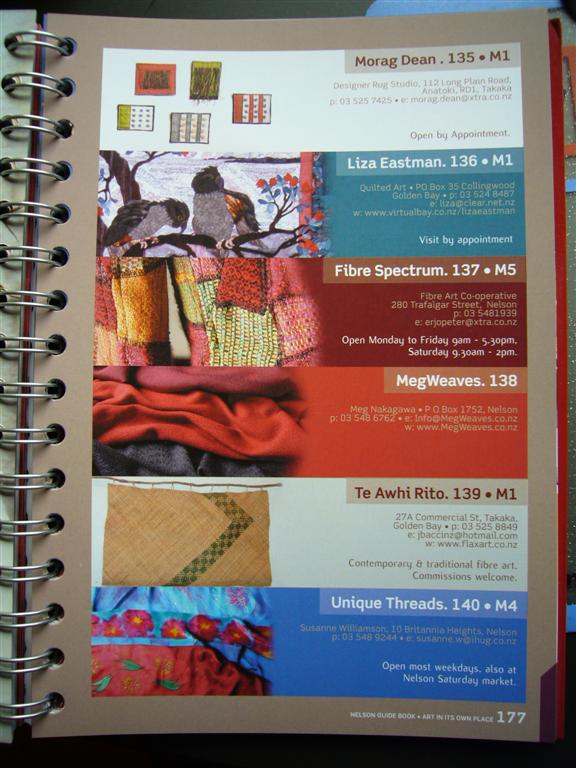
Remember I was moaning about the cost of being a member of the arts community, and then the whole hoo-hah about having my work photographed by a professional photographer? Well, Nelson Arts Guide Book is finally out, and I am in the book now. (Click and zoom, or get your magnifying glass out!) I'm on Page 177.

When I went to pick mine up at Arts Marketing, Martin asked me how I've been, in his usual "interested!!" way, and I noticed of late I give a list of my ailments in response. So, Martin, Alex and Julia, the revised answer is: "The body is creaky but the mind is bursting, because I just came back from five days with the best living weaver of our times; he's the Coltrane, he's the Ansel Adams; I am a changed weaver!"