2006/12/30
How to Prepare Your Loom - A Short Version
I just found this post by Cathy in Maryland. It's a much more concise lesson on how a loom is prepared.
2006/12/26
Baker's Apprentice
Several things happened since June. But before I get into it, let me say I am not placing myself above other weavers, that I do not see myself any better. What I am trying to do is to have a conceptual direction for my art, or if you like, I'm trying to have a clearer product positioning; these two statements sound so different, and yet in my mind, for now, I understand them to be remarkably similar.
In early July, I had a One-on-One with Martin at Arts Marketing. The crux of the discussion was, I may be a different kind of a weaver in that I aspire to weave textiles outside of what is commonly expected of handweavers in New Zealand or Nelson, at least for now. He told me to build stronger ties with weavers with similar aspirations, and to seek inspiration from artists in other disciplines as well.
In October, Randall Darwall told me to be my own apprentice.
Later in October, I met Sue Broad, who now lives in Nelson, and with her arrival, I have, for the first time, a warm-blooded (as opposed to mostly-over-the-Internet) weaving buddy I can talk to and have coffee with and admire each other's stash with. I also became friends with song-writer Kath Bee at a time when we are both taking baby-steps and giant leaps into our respective worlds.
A couple of weeks ago, sculptor Tim Wraight and designer Claudia Lacher, both of whom I met at the June Retreat, came over. While discussing my transformation into a weaver and search for an identity, Tim recalled when he finished his apprenticeship and was about to go solo. He declared he would not trouble himself with "bread and butter" minutiae, but would make cake only, and that I should do the same.
So, in 2007, I'm going to be an apprentice baker who aspires to bakes only the moistest, most delicate, and the most delicious cakes. And if this isn't a clear enough direction, I have no business in art.
Liz, Angel Food, Devil's Food, orange, or whatever, you and I have lots of cakes to go through in our respective lives; I hope we get to share some in person.
In early July, I had a One-on-One with Martin at Arts Marketing. The crux of the discussion was, I may be a different kind of a weaver in that I aspire to weave textiles outside of what is commonly expected of handweavers in New Zealand or Nelson, at least for now. He told me to build stronger ties with weavers with similar aspirations, and to seek inspiration from artists in other disciplines as well.
In October, Randall Darwall told me to be my own apprentice.
Later in October, I met Sue Broad, who now lives in Nelson, and with her arrival, I have, for the first time, a warm-blooded (as opposed to mostly-over-the-Internet) weaving buddy I can talk to and have coffee with and admire each other's stash with. I also became friends with song-writer Kath Bee at a time when we are both taking baby-steps and giant leaps into our respective worlds.
A couple of weeks ago, sculptor Tim Wraight and designer Claudia Lacher, both of whom I met at the June Retreat, came over. While discussing my transformation into a weaver and search for an identity, Tim recalled when he finished his apprenticeship and was about to go solo. He declared he would not trouble himself with "bread and butter" minutiae, but would make cake only, and that I should do the same.
So, in 2007, I'm going to be an apprentice baker who aspires to bakes only the moistest, most delicate, and the most delicious cakes. And if this isn't a clear enough direction, I have no business in art.
Liz, Angel Food, Devil's Food, orange, or whatever, you and I have lots of cakes to go through in our respective lives; I hope we get to share some in person.
Artist/Craftsperson Continuum
Then in June, I went to a weekend Artists Retreat organized by Martin at Arts Marketing. It was designed for artists to learn how to market art (from paintings to woodwork to performances to novels) and to meet other artists.
While working on the previous post, I got used to thinking of myself as an artists whose discipline is textiles; handweaving to be precise. In spite of the superbly organized Retreat, and making new friends, I came home feeling defeated because I felt a chasm between pure art (the kind you can't use) and applied art/craft (things with utility and beauty). I was not sure where I was heading, and I wasn't sure where my textiles fitted in the scheme of things.
The title comes from a chart I made in 2000 which shows pure artist (who may use fiber) at one end, and cottage-industry-production-weaver at the other, and pin-pointing where I wanted to be; it is my visual mission statement.
ARTIST/CRAFTSPERSON CONTINUUM
Drafted June 2006
I was very happy being an artist last week; I want to weave artistic, unique pieces of shawls, scarves and yardage that are wonderful to the touch, beautiful to look at, but are hard wearing serious textiles. But of course the story didn't end there.
For the first forty years of my life, I believed, "of course the glass is half full, and look, if you bend your knees this way, it looks more like 3/4 full!" But of late, I not only see that it's half-empty, but in certain lights, I looks completely empty. This week, it's not just empty, the glass is dirty!
I attended an Artists Retreat at St Arnaud this past weekend; it was well-organized, presentations carefully chosen, and overall it was a superb event and I hope to go every time they hold it. So make no mistake, it wasn't the Retreat itself.
But I came home feeling totally defeated. I didn't meet many who would traditionally be called craftspersons or artisans; there were potters, a fashion designer, and I believe, more than one furniture makers, but most textile people I met were textile artists, many using multi-media, some putting their 3-dimensional work into picture frames. Museum and gallery representatives were overwhelmingly interested in paintings and installations. Almost all the works on display were not utilitarian. In-vogue "craft" magazine are filled with unusable artistic crap. So many galleries declared: "we don't do textiles." And most devastating of all, the message I got from those who buy and curate was: "Don't call us; we'll call you."
So, what happened to craft? What happened to making beautiful things that work; that never-ending appreciation of holding something you use and having a good look once in a while to have your breath taken by its beauty, and the blending of aesthetics and utility? Is there no room for such "tools" in this mass-producing, mass-consuming, over-advertised world except for industrial, stretchable, one-size-fits-all polar fleece junk with the same logo?
I'm really at a loss as to where I am, and I feel the loss for the world. For now.
While working on the previous post, I got used to thinking of myself as an artists whose discipline is textiles; handweaving to be precise. In spite of the superbly organized Retreat, and making new friends, I came home feeling defeated because I felt a chasm between pure art (the kind you can't use) and applied art/craft (things with utility and beauty). I was not sure where I was heading, and I wasn't sure where my textiles fitted in the scheme of things.
The title comes from a chart I made in 2000 which shows pure artist (who may use fiber) at one end, and cottage-industry-production-weaver at the other, and pin-pointing where I wanted to be; it is my visual mission statement.
ARTIST/CRAFTSPERSON CONTINUUM
Drafted June 2006
I was very happy being an artist last week; I want to weave artistic, unique pieces of shawls, scarves and yardage that are wonderful to the touch, beautiful to look at, but are hard wearing serious textiles. But of course the story didn't end there.
For the first forty years of my life, I believed, "of course the glass is half full, and look, if you bend your knees this way, it looks more like 3/4 full!" But of late, I not only see that it's half-empty, but in certain lights, I looks completely empty. This week, it's not just empty, the glass is dirty!
I attended an Artists Retreat at St Arnaud this past weekend; it was well-organized, presentations carefully chosen, and overall it was a superb event and I hope to go every time they hold it. So make no mistake, it wasn't the Retreat itself.
But I came home feeling totally defeated. I didn't meet many who would traditionally be called craftspersons or artisans; there were potters, a fashion designer, and I believe, more than one furniture makers, but most textile people I met were textile artists, many using multi-media, some putting their 3-dimensional work into picture frames. Museum and gallery representatives were overwhelmingly interested in paintings and installations. Almost all the works on display were not utilitarian. In-vogue "craft" magazine are filled with unusable artistic crap. So many galleries declared: "we don't do textiles." And most devastating of all, the message I got from those who buy and curate was: "Don't call us; we'll call you."
So, what happened to craft? What happened to making beautiful things that work; that never-ending appreciation of holding something you use and having a good look once in a while to have your breath taken by its beauty, and the blending of aesthetics and utility? Is there no room for such "tools" in this mass-producing, mass-consuming, over-advertised world except for industrial, stretchable, one-size-fits-all polar fleece junk with the same logo?
I'm really at a loss as to where I am, and I feel the loss for the world. For now.
Who Do You Think You Are, Calling Yourself a Weaver?!
I started this post in May while thinking about what kind of a weaver I want to be and not being able to actually weave because of tendonitis. I have not reached a conclusion, but I now have a direction, so it's a good time to post while I'm looking at the end of an eventful weaving year.
This and the next two posts are dedicated to my oldest (in the length of time I've known her; she is younger than me, to be sure) friend Liz Backlund.
Liz, I used to think once we grew up, we knew where we were and who we were and parts of life would become automatic. Well, some parts may have, but not in the ones I anticipated. The search for our places seem to be on still, so we might as well enjoy the ride. I'm thinking Valley Fair.
WHO DO YOU THINK YOU ARE, CALLING YOURSELF A WEAVER?!
Drafted May 2006
I came to weaving late in my life. As a child I thought I would become an academic; that was the family business and I grew up on a college campus. I had very clear visions of me sitting in an office with wall-sized bookshelves on at least two sides and a twin-bed-sized dark wooden desk.
But now I live in a town without a university. And a strange place this is. What you need to understand is New Zealand is an extremely forgiving country to someone coming from an "old" country like myself; anyone can have a go at just about anything regardless of training, family background or other inherited baggage, and in Nelson, arts and crafts are all around, constantly seducing me to the colorful side.
Having enjoyed a few warps as a hobby weaver, I had hoped to sell my work eventually, but life interfered and I took this step earlier than I had planned. I attended small business seminars, I did market research, I made short-, mid-, and long-term plans, color-coordinated checklists and Gantt charts. And made To Do lists; notebooks of To Do lists.
And I wove. Weaving itself was fun, and considering where I started, I improved with every warp. But becoming a weaver was a different game. I was basing my new life on the familiar system of Gantt charts and To Do lists: weave an average of x pieces in y weeks; make $z sale every quarter, or roughly $z*3 by Year End. Slow was not good, and experimenting to improve designs could interfere with the plans. I had faith my improvements would come in direct proportion to the number of pieces I wove. Well, almost.
That I wove was itself a secret for a long time and I didn't show anyone my work. On 5 February 2001, 10 minutes before attending my first ever weaving workshop, I was left standing in a Blenheim church car park, watching Ben's Pajero heading back west, feeling worse than a kid on his first day of school. This was my day of reckoning, my coming out.
For a few years, when I ran into former work colleagues, I cautiously said I was "trying to be a weaver." I was trying to learn what kind of a life a weaver lives, not just weaving, studying colors, studying design, or learning to draw, but the other stuff. I even lived the tree months of Julia Cameron's The Artist's Way. Then I stopped going to marketing classes.
After six years, I haven't yet found out what a weaver's life is, but I know weaving is slow, and I can't live by the plans, at least not the ones I created back then. I need time to observe, to see, and be inspired. I need to allow myself to be reactive as well as proactive. I need to play more with colors and textures, and not put on a warp knowing exactly what is coming off it. And weave more.
And I need to allow myself to call me a weaver, because in this journey, there is no Commencement, there is no Diploma, I won't have letters at the end of my name to say I have arrived. I am a weaver because I weave.
This and the next two posts are dedicated to my oldest (in the length of time I've known her; she is younger than me, to be sure) friend Liz Backlund.
Liz, I used to think once we grew up, we knew where we were and who we were and parts of life would become automatic. Well, some parts may have, but not in the ones I anticipated. The search for our places seem to be on still, so we might as well enjoy the ride. I'm thinking Valley Fair.
WHO DO YOU THINK YOU ARE, CALLING YOURSELF A WEAVER?!
Drafted May 2006
I came to weaving late in my life. As a child I thought I would become an academic; that was the family business and I grew up on a college campus. I had very clear visions of me sitting in an office with wall-sized bookshelves on at least two sides and a twin-bed-sized dark wooden desk.
But now I live in a town without a university. And a strange place this is. What you need to understand is New Zealand is an extremely forgiving country to someone coming from an "old" country like myself; anyone can have a go at just about anything regardless of training, family background or other inherited baggage, and in Nelson, arts and crafts are all around, constantly seducing me to the colorful side.
Having enjoyed a few warps as a hobby weaver, I had hoped to sell my work eventually, but life interfered and I took this step earlier than I had planned. I attended small business seminars, I did market research, I made short-, mid-, and long-term plans, color-coordinated checklists and Gantt charts. And made To Do lists; notebooks of To Do lists.
And I wove. Weaving itself was fun, and considering where I started, I improved with every warp. But becoming a weaver was a different game. I was basing my new life on the familiar system of Gantt charts and To Do lists: weave an average of x pieces in y weeks; make $z sale every quarter, or roughly $z*3 by Year End. Slow was not good, and experimenting to improve designs could interfere with the plans. I had faith my improvements would come in direct proportion to the number of pieces I wove. Well, almost.
That I wove was itself a secret for a long time and I didn't show anyone my work. On 5 February 2001, 10 minutes before attending my first ever weaving workshop, I was left standing in a Blenheim church car park, watching Ben's Pajero heading back west, feeling worse than a kid on his first day of school. This was my day of reckoning, my coming out.
For a few years, when I ran into former work colleagues, I cautiously said I was "trying to be a weaver." I was trying to learn what kind of a life a weaver lives, not just weaving, studying colors, studying design, or learning to draw, but the other stuff. I even lived the tree months of Julia Cameron's The Artist's Way. Then I stopped going to marketing classes.
After six years, I haven't yet found out what a weaver's life is, but I know weaving is slow, and I can't live by the plans, at least not the ones I created back then. I need time to observe, to see, and be inspired. I need to allow myself to be reactive as well as proactive. I need to play more with colors and textures, and not put on a warp knowing exactly what is coming off it. And weave more.
And I need to allow myself to call me a weaver, because in this journey, there is no Commencement, there is no Diploma, I won't have letters at the end of my name to say I have arrived. I am a weaver because I weave.
2006/12/25
Randy Revisited on Christmas Day
I was threading my navy/teal silk/cashmere warp on my 4-shaft jack in 8-end Dornick, (that's a twill that changes direction every eight warp yarns) while thinking of Randy this evening.
I like regular, square-looking, or symmetrical weaves. I like stripes. I like single-colored plain weave with plenty of tracking. But there is a part of me which started to believe that in order to progress, I needed to include more and more Randy elements in my textiles, and this made me a little sad about having to depart from static (as opposed to his dynamic) textiles.
But I think progress in weaving is not linear. So while I intend to continue investigating the Art of Randying, I am allowed to delve deeper into symmetrical and regularly repeating patterns as well.
I think this is what he meant by my doing my apprenticeship.
I like regular, square-looking, or symmetrical weaves. I like stripes. I like single-colored plain weave with plenty of tracking. But there is a part of me which started to believe that in order to progress, I needed to include more and more Randy elements in my textiles, and this made me a little sad about having to depart from static (as opposed to his dynamic) textiles.
But I think progress in weaving is not linear. So while I intend to continue investigating the Art of Randying, I am allowed to delve deeper into symmetrical and regularly repeating patterns as well.
I think this is what he meant by my doing my apprenticeship.
2006/12/14
How I Make a Shawl: The Two Candidates
I believe good shawls age like good wine. I was unhappy with both of these last week, and refused to photograph them, but today, they didn't look.... so bad.
The yarns I used in this first warp were in three blues and one undyed 100% merino wool, 110/2. The sett was 18 DPI.
 For this first piece, I used a variegated-dyed merino boucle in the weft. The weave is #40229 from Kris Bruland's Handweaing.net. The weft shrunk far more than I had anticipated, so the shawl has a squishy, stretchy texture, but is surprisingly light-weight.
I had anticipated the loops on the boucle to pop up all over, making it a piece showing off the beautiful oranges and greens of the weft yarn, but the result is more warp-dominant. I don't like that the construction is not exactly stable, (i.e. the long warp floats might catch buttons and long earrings, but pulling it warp-wise and weft-wise, the thread will go right back into the textile); on the other hand, I think it looks like water over sea weeds and shells.

 In the second piece, possum/mohair/merino wefts in four colors were placed in Fibonacci sequence, the colors representing grass, sand, shallow and deeper water. The weave is #12833 from the same, turned.
I didn't like the teal yarn being much more vivid than the other three, and even though all four colors were used in the same proportion, the shawl appear predominantly teal. As well, in spite of sampling, the finished textile is much stiffer owing to the weave structure; this is totally different from the shawls I usually weave with the exact same combination of warp and weft yarns and the sett, but woven in looser twills. The appearance and the hand of this piece ended up being masculine/rustic/tough, which is not the kind of textile I normally weave, like, or had planned, but the appearance matches the hand, and this is a sturdy, long-lasting piece of cloth.
I am not sure if these pieces will make it into the final selection. I tried to challenge my self-imposed boundaries and preconceptions, and I created two pieces that I would not have woven had I not tried new things. Yes, I am ambivalent about these at this point, but I also feel both of these suit "Sea, Sand and Sky".
The yarns I used in this first warp were in three blues and one undyed 100% merino wool, 110/2. The sett was 18 DPI.
 For this first piece, I used a variegated-dyed merino boucle in the weft. The weave is #40229 from Kris Bruland's Handweaing.net. The weft shrunk far more than I had anticipated, so the shawl has a squishy, stretchy texture, but is surprisingly light-weight.
I had anticipated the loops on the boucle to pop up all over, making it a piece showing off the beautiful oranges and greens of the weft yarn, but the result is more warp-dominant. I don't like that the construction is not exactly stable, (i.e. the long warp floats might catch buttons and long earrings, but pulling it warp-wise and weft-wise, the thread will go right back into the textile); on the other hand, I think it looks like water over sea weeds and shells.

 In the second piece, possum/mohair/merino wefts in four colors were placed in Fibonacci sequence, the colors representing grass, sand, shallow and deeper water. The weave is #12833 from the same, turned.
I didn't like the teal yarn being much more vivid than the other three, and even though all four colors were used in the same proportion, the shawl appear predominantly teal. As well, in spite of sampling, the finished textile is much stiffer owing to the weave structure; this is totally different from the shawls I usually weave with the exact same combination of warp and weft yarns and the sett, but woven in looser twills. The appearance and the hand of this piece ended up being masculine/rustic/tough, which is not the kind of textile I normally weave, like, or had planned, but the appearance matches the hand, and this is a sturdy, long-lasting piece of cloth.
I am not sure if these pieces will make it into the final selection. I tried to challenge my self-imposed boundaries and preconceptions, and I created two pieces that I would not have woven had I not tried new things. Yes, I am ambivalent about these at this point, but I also feel both of these suit "Sea, Sand and Sky".
How I Make a Shawl - Part 7: Fringing, Embellishing, Wet Finishing, Pressing and Drying
 After the shawl rested overnight (or longer), I needed to fringe. This can be an art in itself, twisting, braiding, and weaving the fringes like lattice work, but there were enough interest in the colors and textures in these two, so I made straight forward fringes. The fringes took about 2 hours per shawl, with frequent rests and counting/recounting.
Sometimes I like to embellish the selvedge/s or the fringes with tiny glass beads, which makes parts of the shawls sparkle in the night, but again, I didn't want to make these two pieces too busy, so I didn't embellish them.
 Then came the last but very exciting part of "weaving": wet finishing is mostly washing, but in case of wool, it also involves controlled felting, so here I did to wool what your mother probably told you never to do to your brand new sweater.
This is our old bathtub which we had fitted into a cradle. I have the hot water tap in the middle of the garage, just next to the lawn mower, and the cold water and drain at the end.

 The very first time a shawl is placed in hot soapy water, it is left alone for about 15 minutes so it can absorb the water at its own speed, and the fiber can open up.
 I washed them in hot soapy water roughly, then plunged them into cold water, and repeated the process. I must watch the transformation of the cloth carefully while I wet finish, but normally, with the combination of the yarns I use, the transformation takes place in the second hot wash, and I rinse the cloth carefully in the last cold wash. The first piece on this warp needed another extra hot wash, but the second was, as predicted, a two-cycle finish. I wash every single piece individually for this reason.
The photo above is during the most exciting second hot wash, and if you click to enlarge, you can see how the wiry/netty warp and weft yarns have integrated to become a piece of cloth.
After I squeezed as much water as I could, I spun the shawls in medium speed in my washing machine for a while, repositioned them, and then spun in high speed.
 Finally the pieces were steam-pressed over and over while still damp, and laid flat on the living room floor to dry overnight. Wet finishing and pressing took about an hour for each piece.
After the pieces were completely dry, I cut off the frizzy ends below the knot of each fringe, and that is the very last job, which took about 15 minutes for each shawl.
I Used the Wrong Weft!!
 I thought I was weaving with a yellow-green 100% cashmere yarn, and though the cloth took on a blueish color on the loom, I thought it was because of the two grays in the warp. I thought nothing of it while fringing, washing or pressing, though the texture did feel slightly stiffer, and the green weft shone more than expected.
It wasn't until I was fishing through my cashmere box that I noticed this cone was labeled incorrectly, and then realized I used the melon-glacé-colored cashmere-silk mix instead. I like the contrast in the sheen, and the way the silk-mix sits slightly above the cashmere warp to show off the weave structure.
For once, Ben was given a piece not because I had made too many mistakes, but because the overall color is one of his favorites.
Men's Cashmere Scarves
 Men's mean they are just a little more densely woven, and are wider. Warp in two grays; one scarf is with weft in clear yellow, another in dirty yellow. 100% cashmere.
The clear yellow is a Christmas present from my friend Joan to her friend; the dirty yellow is a present for my baby brother for taking a giant step in his career earlier in the year.
2006/12/07
How I Make a Shawl - Part 6: Finally the Weaving
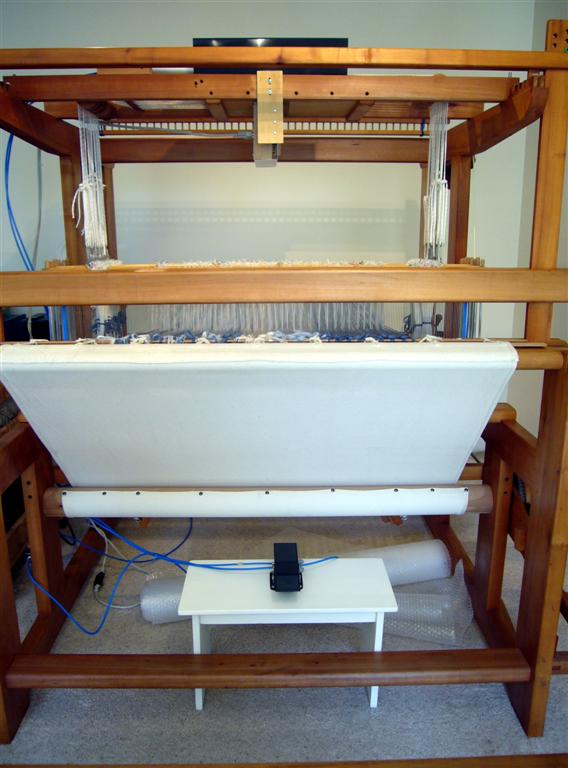 The act of weaving is simple and quick: I stepped on the pedal;
 waited for the shafts to lift, (this photo is crocked, but the shafts lifted evenly, or else I needed to tweak the height of the shafts);
 threw the shuttle between the lifted and the not-lifted threads, (this space is called the "shed");
 and brought the reed forward to position the weft, (this action is called "beating"). Every few inches, I advanced the warp threads and continued weaving.
I wove two pieces of samples, fringed, washed, pressed and dried them to test six weft candidates and five weave structures. I decided on the weft and the weave structure for the first shawl, and wove it, which took a little less than three hours. I decided on the weft yarns, color schemes and the weave structure of the second shawl while I was weaving the first; the weft color distribution took about half an hour to calculate, and the weaving time was a little over three hours on the second shawl.
After I wove the length of the shawl, I advanced the warp enough to get fringes, and cut off the woven shawl. I checked for mistakes or bits of yarn sticking out of the cloth, cut then off, and hung the shawl overnight to rest.
Subscribe to:
Posts (Atom)