2006/10/14

Randall Darwall Workshop - Post Script

I didn't set out to be a chronicler of the workshop, but it turned out I did a little bit of that. I can kick myself for not having learned all my camera is capable of before I went away. I regret not having shot a group picture of the class. But, at the risk of offending a few mild-mannered Kiwis, I do have one last, last story I want to tell.

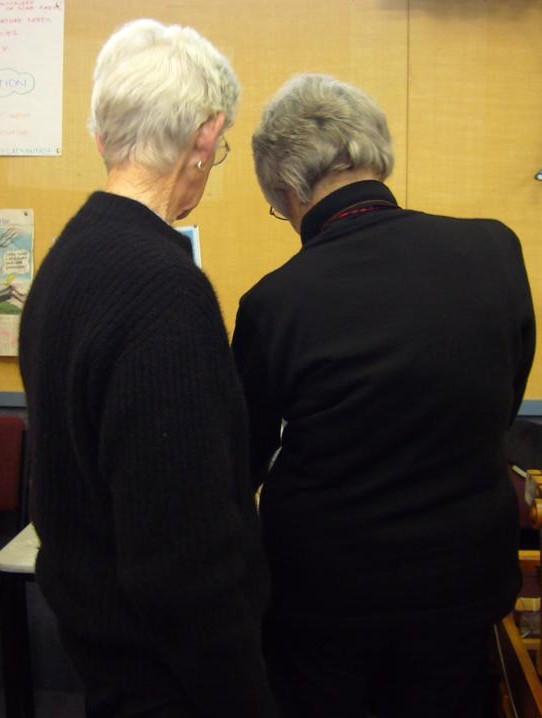
See, Kiwis don't get too excited, and they are not a demonstrative lot. So usually when someone is leaving a party, the best you can hope for is for the host to come to the door to say good bye, and turn on the outside light if it's late in the evening. When Randy and Brian were leaving, we all followed them to their car and waited politely for them to finish hugging and shaking hands with people not from our class, when one weaver mumbled, "It's too bad we can't do a Haka or something."

That was singularly the most explosive outburst of respect, love and appreciation I have ever heard in my 12 years in New Zealand, and I can't think of a better way to express how we felt.

It was one heck of a screamingly gorgeous experience.

(Maori Haka is traditionally performed by men.)
Randall Darwall Workshop Part 7 - Reflections

Clearly, I am unwilling to depart from remembering and reflecting on the workshop, but a workshop is only good if I have fun, and worthwhile if I can use the new knowledge in my work. So I must get downstairs and back on my loom so I can show you what I've learned.

But here's one last story I want to leave you with, for the time being. (NOTE: I'm a visual person, and as hard as I try, I'm no good listening to words, even if the August Randall Darwall is reading or telling stories close to his philosophy and aesthetics. Unless I have the text in front of me, my mind wanders and tries to visualize what I'm hearing. So I'm missing some important details, but you'll get the gist.)

Randy was fresh out of Harvard with an Art History degree, and found himself teaching art to 9th graders (15 year olds). One day, he read something, which made him realize that his task as a teacher was not to discover and encourage the one or two in the class who "got" art, but to convey to all his students, in whatever level each student was capable, the joy and appreciation of living with art. Or something like that.

I don't know about you, but it seems pretty incredible for a young chap in his early 20's to have this kind of maturity and generosity, and he's been doing it to different audiences ever since. And that's the kind of man he is. We were lucky to have had a chance to study with him. His teaching transcends weaving.

Even a giant loves his ice cream.

Randall Darwall Workshop Part 6 - A Sense of Play

Throughout the workshop, Randy also demonstrated to us how simply discharging colors from areas of commercial yarns, fabric, and warp on the loom can create added interest; he just sprayed diluted household bleach and then rinsed (not the warp on the loom) them. These can be further dyed to create even more complex material. I didn't photograph the yarn and fabric he used in the class, but his vest and shoes had gone through these processes, and were made unique and personal.

Oh, don't use bleach on silk.


Randall Darwall Workshop Part 5 - Collaboration

Randy stresses that his is a cottage industry; he has weavers, garment makers and Brian for designing, marketing, and other creative collaboration. I asked when Randy threw a shuttle the last time, to which the answer was an astonishing "10 years ago".

With his scarves, Randy himself dyes the yarns, then chooses the colors, the proportion, and the threading (which thread comes first, second, etc. and what weaves can be woven). His warps are relatively short, around three scarves, and then he assigns a weaver to this warp. They have a brief discussion on the general idea, and the rest is left to the weaver, sans plans, schedule or draft, to choose and change weft colors and weaves as she desires. (I'm pretty sure all three weavers he mentioned were women.)

So the Randall Darwall scarves are, in fact, a brand and a product of collaboration.

And that got this lone, basement weaver thinking; is the complexity of Randy's textile achievable only through collaboration, or is this something that can be learned and planned? I hate to have to give up the solitude of my work, but I would love to incorporate/simulate the results of "many hands working".

"What about this with this?"

2006/10/12

Randall Darwall Workshop Part 4 - What About the Dynamic Part?

I'm still not sure what exactly he means by "dynamic" in "dynamic proportion"; that the numbers (percentage) change seems too simplistic; I'm willing to bet it's more than that. (Warning: we are getting deep into my own interpretation.)

If you choose pleasing hues with value in mind, and pay attention to the amount of each and placement, one can create a kind of cloth where the eye travels over the surface of the cloth, on the strength of the colors alone, (rather than relying on the weave structure, which is how this is more commonly done.) Ergo, "dynamic".

Randy didn't use the word "dynamic' in the workshop. Instead he repeatedly told us to weave in a "painterly" way, to surprise him, and used many beautiful musical metaphors. I'm not sure if I'm placing too much emphasis on the one word that bugged me for months, but I can see when it's working.

Randall Darwall Workshop Part 3 - Dynamic Proportion


This is arguably the most important concept of the entire workshop, and in understanding Randall Darwall textiles, but today, I found nothing on this in my notebook, and no smashing photo to illustrate it. But I'll give it a try.

A few months before the workshop, Randy wrote to us explaining how he wanted us to prepare the warp to bring to the workshop, and in it he wrote: "Color: more is better. I often use the phrase 'why use five colors when fifty will do nicely.' Dynamic proportion is an important element here: try picking a base color and then adding smaller and smaller amounts of different colors to it."

At the time, and until I arrived at the workshop, I struggled with the concept, as I could only visualize a fat navy blue stripe next to a medium-width cyan stripe next to a skinny baby blue stripe. This isn't entirely wrong, but oversimplified. His concept is to use colors in nice proportion, but not in direct alignment. And to this end, the Fibonacci numbers could be a good tool. For example, I could weave a narrow scarf with 136 ends (warp threads) and six colors in the warp: to do this, I wind 55 ends of color A, 34 of B, 21 of C, 13 of D, 8 of E and 5 of F, but not necessarily in that order, and the numbers need not be exact, so I could even be whimsical and add 2 ends of color G and 1 of H. Likewise with the wefts when I weave.

The theory is, unless I'm all over the place in hues or value, the scarf as a whole has a cohesive look, yet with plenty of interest. At least that's how I understood this.

2006/10/11

Randall Darwall Workshop Part 2 - Values

Most people know the language of colors, understand it, or can explain it better than I can, so I'll be brief.

What we normally call 'color' refers to the hue, (red, yellow, green, etc., found on the color wheel), but there are two other parts, value (light/dark) and intensity (brightness) which also come into play; we didn't get to intensity, so we'll ignore it.

I love to weave what I call, "roughly monotone" textiles, mixing almost identical hues but with slightly different values, or textures. (Not sure if values relate to textures, so any help is appreciated.) I believe the weave visually comes to the fore this way.

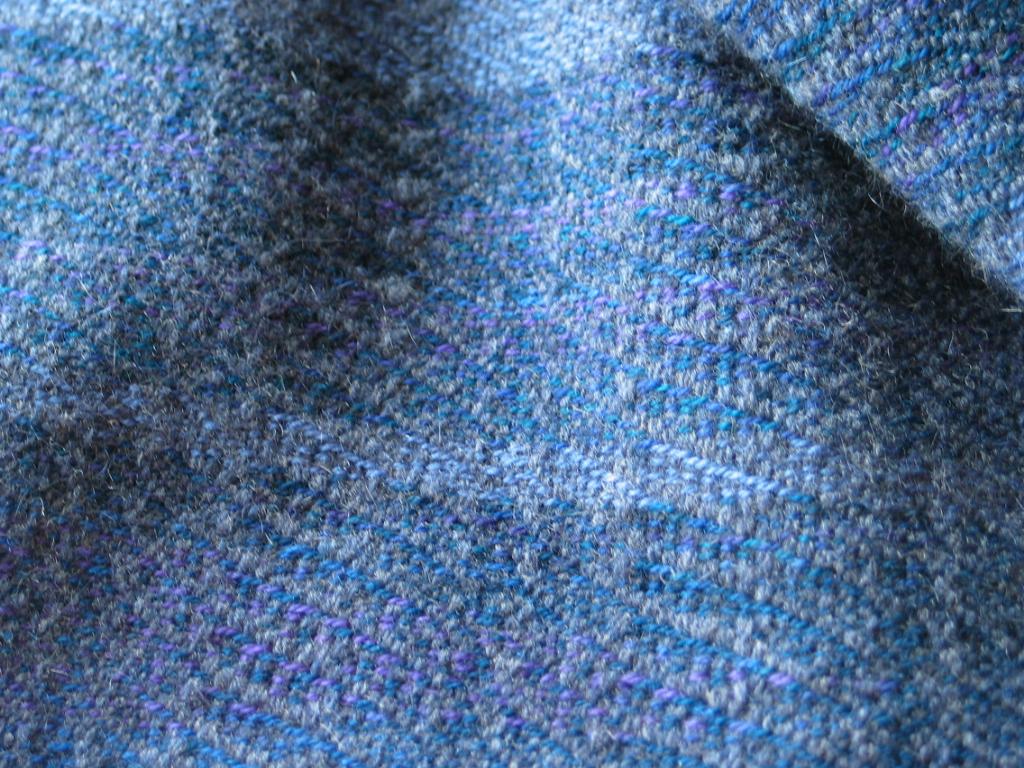
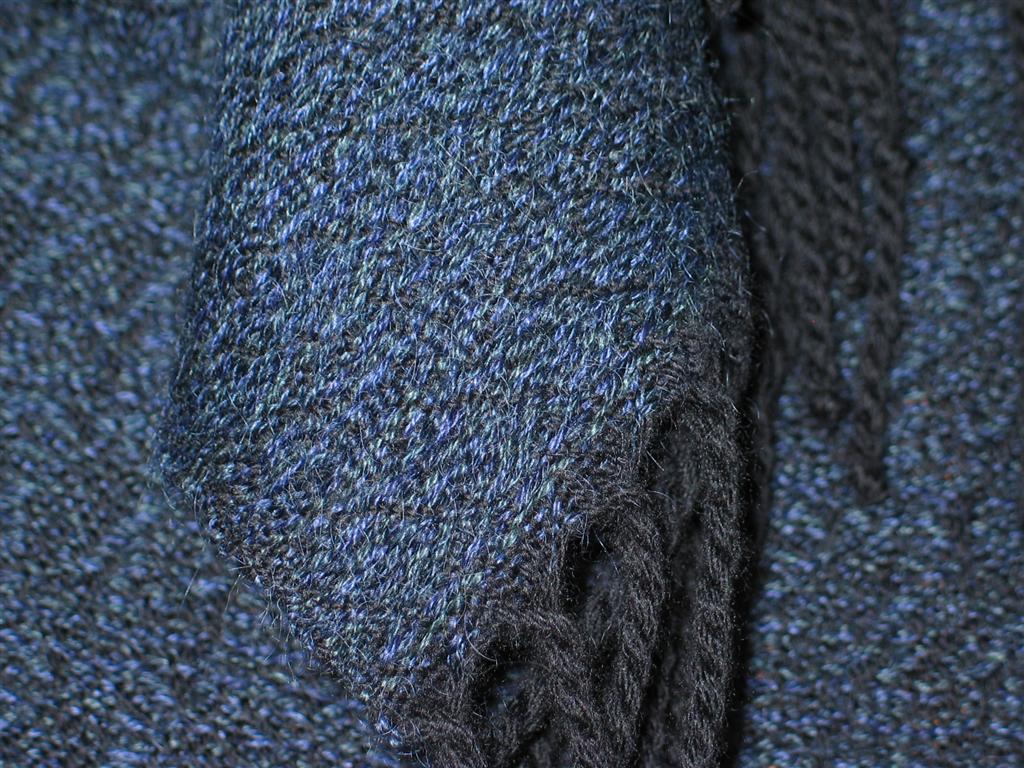
What I find most attractive about Randy's textiles is when he mixes many hues, but within a relatively narrow range of values; so, many colors, but about the same lightness/darkness. This creates a shimmering, elegant effect that gives the textile a different kind of interest than my usual textile. Take a look.


The problem I've always had is I don't see values. I can distinguish black and white, but not the subtle differences of the shades of gray. I have 6-, 10- and 12-block gray scale things with little holes; I have the quilters' red and green plastic sheets; I have squinted and looked under the moonlight, but I just don't see it, and I'm happy when someone tells me A is darker than B. I'm value-blind rather than color-blind. So one of the goals Randy thought I should aim for is to experiment more with colors and develop alternative ways to understand value relationships, so I can weave cloth that shimmer.

2006/10/10

Randall Darwall Workshop Part 1 - Overview

It was like Christmas. But better. We waited and waited for the whole year. And then it finally happened. For six exciting days, our two Santas greeted us at 8.30 AM every morning and we got stuck into the magical world of colors (and values and proportions, but more on these later).

The most surprising thing was both Randy and creative collaborator & life partner Brian Murphy were such nice people, (was I expecting cantankerous East Coast artistes?), as were my 11 fellow weavers. So the week passed in an encouraging, cordial camaraderie. (The weather was glorious and here is Brian plotting to get away for a few hours of bike ride.)

Randy gave us personalized goals during our Show & Tell, and pointers and encouragements throughout the week, as we worked our ways though our own warps, and six inches each on 11 other looms.

Five days of theory and practice culminated in the critique sessions on the last day, when we took the samples off the 12 looms and analyzed each piece.

Bittersweet graduation; I wanted to keep going for at least another week; I wanted to keep these two guys. (Waratahs are Australian, Brian.)

Randy and Brian drove off into the distance (Taupo, to be exact) shortly after this, while we reflected on the excitement of the past week. Unlike Santa, Randy and Brian won't be back next year, but we were given presents we would treasure for years and years to come.

2006/09/28

Breaking the Monotone Barrier

Next week, I'm going to a five-day weaving workshop by Randall Darwall, in Paraparaumu, just north of Wellington. It's going to be a highlight of my weaving life.

Randall Darwall is easily one of the most respected and sought-after weavers of our time, and since he doesn't write books, the quickest way to learn his style is to attend his workshops. So I signed up for this one way back in February. In May or June we received instructions on what to bring to the workshop, and I've been stuck ever since.

Randall Darwall's view on color is "more is better." His motto: "Why use five colors when fifty will do nicely." He wants us to prepare a warp using dynamic proportions of colors, where we select a base color, and then add smaller and smaller amounts of different colors. I have no problems with the way he does it; have a look at his site, his works shimmer and dance and laugh and seduce. But have you seen mine?

I love to weave textiles with subtle color or textual nuances, but on the whole, look monotone. I don't often mix hues too far apart on the color wheel. In fact, most of the yarns I own are on the blue half of the wheel: blue, navy, purple and red, plus black and white and natural.

Liking colorful textile is one thing, but trying to create colorful textile (that is, mix and match hues) is another, and I'm having to take a sledgehammer to an old mental barrier.

I've only three more days to prepare, and am still at a loss as to what I'm going to do, but at least I decided on a simple twill threading today, so I've two and a half days to think about the colors.

Yikes.

2006/09/24

Appreciating Art

I've been a bit under the weather (nothing serious; you can find out about it here and here) and preoccupied with a renewed interest in photography (and blogging here and here), because photography is a hobby Ben and I enjoy together. But I haven't stopped thinking about weaving and art in general. And one thing I noticed is I've come to appreciate art in a different way.

In the last month or so, I've been photographing and sketching a series of works by local sculptor Tim Wraight. Originally, I needed a few nice shots of good-looking pillars to show as public art for the photo blog, but the more I see these pillars and try to do them justice, the deeper I've become involved with them. I still can't photograph them to show how truly beautiful they are, but I'll share some with you soon. Woodwork is in some ways easy for me to understand because I know some of the processes and tools, and looking at these pillars, I can imagine Tim chipping away patiently and deliberately bit by bit by bit. I can feel his quiet passion while he touched the pieces of wood and breathed life into them. And I have never experienced art in this way before.

I also went to see jeweler Ian Longley to order Ben's Christmas present, and had a chance to chat with him about rocks and stones, and he shared with me a little of his creative process. The lasting impression I took home, though, was the way caressed his raw material in the same way I hold my yarns. And I kept pondering about the metamorphosis of those rocks to his jewelry and these yarns to my shawls.

As I mature as a weaver, it has become easier for me to understand the processes and efforts of other artists, and knowing these makes their finished work more meaningful and precious. I've come to appreciate art with my entire body and soul, which is a far more genuine appreciation than mere liking, or reading about their work.

And then I went to see my friend Errol Shaw's modern painting exhibit. I love this man to bits, but I have difficulties with modern art. He tried to explain to me at great length how to 'look' at modern art, but I got nowhere. This story is for yet another time entirely.