2015/11/01

Orange

I started making a warp on Thursday. I like making warps because in recent years this has become the first step in making ideas in my head come to life, whereas previously I tended to start with a draft. I've also felt I shouldn't make any more warps for a while since I have 20 waiting, but I needed a blah buster. (More later.)
I've been thinking of a very orange warp for a while, in combination with A) hot pink/rose wefts, B) saturated dark purple wefts, and C) pale lavender/lilac wefts. I wanted to use five oranges, but I got stuck because I preferred the tangerine but didn't think I had enough of it, and whereas all others are 20/2s, the tangerine is an experimental effort by my source, twisting three 60/2 cottons together. At their request I made small samples and got results surprisingly similar to 20/2s, but I'm not 100% confident this would be the case in a larger piece combined with 20/2s.

Then I picked the orangest yellow I have, but the closer I got to reaching for the fifth cone, I didn't want to mix a yellow in a very orange warp, especially since the yellow might stick out with pink wefts. I think it is going to end up a narrower warp with just the four. At first it was going to be 28 inches wide on the loom, then 27.67 inches, but with only the four, I'll get only 21.67 inches. No biggie.

I needed a blah buster badly because the hotter temperatures, brighter sun, wind, bugs, allergy, and now four free-range dogs, are hindering my gardening And yet I have mentally abstained from weaving until I get "this bit done", except there is always three more bits that needed doing yesterday. About a month ago Ben and I decided we probably need two or even three more winters to make our place look nice, so now we don't feel as pressured as before, but goodness, I've got a lot of seedlings that need to go in the ground, it's taking a lot of time and energy and money, and it is never ending.

I've also been pondering uniqueness of loom-woven cloth. If you can get your hands on similar enough material and equipment, anything I weave is easily repeatable because I only use loom-controlled methods and commercial yarns. Heck, you'd probably improve on it because I beat so erratically.

In comparison, paintings, sculptures, or hand-crafted dolls, say, or even felting, are "more" unique. (Bad English, I know, but you get my point.) So I've been wondering what I can do, and what I'm willing to do, to make my pieces a little more unique. I tried the tapestry technique and though that sample didn't work I know it has potential; using/mixing handspun and/or dyeing/overdyeing work, and I've been looking into embroidering. (That's the first textile craft I tried.) And to this end, structures other than twill once in a while would also bring changes to the mood.

I'm not sure where I'm going with this, but I see more change in my preference; I no longer think handwoven cloth that looks mill-woven is what I want to make. This is great because goodness knows I tried to weave "perfect" cloths and I couldn't and I'm sick of disappointing myself. I'm not sure about same pattern all over, either. The question is, what kind of paw prints I want to leave on my weaving.

2015/10/31

Wet Finish

Once in a while I am asked how I wet-finish, especially when possum is involved. Between 2000 and, oh, 2006, I asked weavers how they do it, and over the years I combined and fine-tuned it to based on the space/equipment/physical-height available to me.

Because these weavers were based in New Zealand, the answers concerned mostly wool or wool-mix, which suited me then. And it works for my cashmeres, even though the vendor recommends a gentler finish because cashmere doesn't full like wool. But as I started using silks and may eventually get to all silk, and I also have to replace my washing machine soon, I have been thinking more about wet finishing of all kinds, so I'm recording this here for my sake, although I did this once before, and it hasn't changed much, and in my Japanese blog more recently.

(My washing machine is a top-loader with an opaque lid which doesn't suit my control-freak-ness, so I haven't used it for wools except the spin cycle, but as this machine has been dying a slow death I'm compelled to ponder the top-loader-which-suits-my-stop-go-penchant vs. front-loader-which-saves-water-and-apparently-takes-out-lint-like-there's-no-tomorrow question.

I am always open to any recommendations/variations/suggestions; thank you in advance. Here goes:

1) I fill the sink/bathtub/container with the hottest hot water from the tap, (mine is about 55C) and dissolve wool wash or shampoo; fill with enough hot water to immerse the piece completely. (Some folks use kitchen detergent but my yarns are seldom that greasy as most are commercially spun and dyed.) Turn off the hot water.

2) I drop the piece in hot water and let it absorb the soapy water in its own time - maybe 15-20 min. If sections refuse to sink, I push it gently to coax; if in a hurry, I push the piece down gently and evenly all over.

3) I press the cloth gently all over so the piece completely soaks up the soapy water, then agitate a little bit to help threads come together.

From here, all depends on the weave/purpose/desired finish.

4) I may agitate some more, or not, then gently squeeze the piece to get rid of soapy hot water, put it aside, discard the water and fill the container with the coldest tap water, then turn off the tap.

5) I immerse the piece in the cold water, and gently agitate evenly, but I may continue for some time. I'm mindful about keeping things parallel/perpendicular. Then gently squeeze the piece to get rid of water, put it aside, discard the cold water and fill the container with the hottest tap water, then turn the hot water off.

6) I immerse the piece, and agitate. This is where dye, possum or mohair start come out, but also merino/wool visibly starts to full, so I observe the cloth vigilantly. Also the piece may not remain folded but spread out, squeezed, bunched together, whatever it takes to full evenly, not have creases, and, fingers crossed, still stay rectangular. Depending on the weave/purpose/desired finish, I work vigorously. Also, as long as the water doesn't fall directly on the piece, I may keep the hot water running so water/piece stay hot. I squeeze the piece to get rid of water, put it aside, discard the water and fill the container with the coldest tap water, then turn the water off.

7) I immerse the piece in the cold water and agitate. Again, I may have the cold water running as long as it doesn't fall onto the piece directly. Sometimes I stay in stages 6) and 7) longer, sometimes I repeated them. When satisfied, I squeeze the piece to get rid of the water.

8) Depending on the piece, I may fold it, or roll it in an bath towel, or fold/roll and wrap it in a towel, then put it through a full spin cycle. Depending on the piece, I sometimes start with a gentler spin, but more often I just let it have it.

9) I unwrap the package, steam press, sometimes with a cotton press cloth, on both sides, then lay it flat on wool carpet. (Cut pile works best; unfortunately my living room is now tiny loop pile so I sometimes dry it in the downstairs workshop on the old living room carpet.) If I'm not happy with how I've pressed, I'll even press it while on the carpet. Then I leave it overnight, or however long it takes, to dry.

10) When I peel it off the the floor it should be pretty straight and wrinkle free. But if it contains possum, it will continue to shed.
The key is, I can't un-full, so I'd rather go slowly and repeat processes, and for me watching and feeling the cloth works best. To that end, I have wet-finished for a second time some pieces after they have dried completely.

Wet-finishing guru Laura Fry demonstrates a dryer method, reminiscent to me of ye olde community waulking; I don't have a surface I can do this without much lining with plastic lining and moving of furniture, but when I did experiment with a small piece on a small surface, I still couldn't see the whole piece which made me uneasy and I haven't tried it with a bigger one. Here's another resource from her.

So far I've been washing my silk-mix pieces in a gentler version of above method; cotton and cottolin pieces are put in laundry nets and through the hottest and the most vigorous wash cycle, steam-pressed and dried either on a tube rather then a line, or on the floor.

EDIT: As I mentioned in the comment, I learned to weave at the end of the era when most/all weaving yarns still had scales left on. I wash superwash merinos in the same way still, but perhaps I need to investigate for this reason as well.

2015/10/20

Slow

My goodness, has it been windy. I looked up some vids of mistral and sirocco, and Nelson has been pretty close, especially yesterday. They say we'll have a brief reprieve midweek, but it's going to be like this for a while. Hay fever has been especially hard on the eyes this year.

Anyhoo, I managed a little more weaving today; it seems I can manage about 20cm on Klik before backache sets in, although some days I've managed two sittings.

I had in mind the hellebore draft for this project, but after the first, sinewy piece, fragile warp and watery eyes, I opted for a simpler lift plan.
It's a twill in regular progression. (Is that the right description?) I have seven weft yarns in pale greens, yellows, and pinks. I would have loved an orange, but ones I had were too thick. Each color is used in a stripe of 30 picks; most stripes are woven in the lifting seen in the top two stripes. The lifting in yellow pops up occasionally, and the bottom two less so. I'm aiming for a cheerful piece suggesting a spring flower garden.

2015/10/18

11 More Weeks

Well, hello there.

I've been gardening a lot, cooking a bit, reading while recuperating, and not weaving much. And I copied this line from the previous post, because that is what I have been doing. I'm glad to report my cooking is improving; learning is never straight-forward for me and practicing is the best way to improve any skills, not reading endlessly about them; I think I've learned that from weaving. I noticed of late I've been able to emulate Ben's cooking a little bit "ending up with" a mixture of flavors rather than one or two ingredients dominating, but without making it all too complicated and mismashy.

It's been a while since I last read a van Gogh book but I've been reading online about his contemporaries, (some are a little earlier): Manet, Degas, (apparently another difficult person,) Cezanne, (ditto), Renoir, Pissarro, Seurat, Toulouse-Lautrec, et al, and who were chummy with whom. On paper, I've been having a ball with Sarah Vowell's refreshing look at American history, and David Rakoff's musings on life as an expat and on modern life.

On another level, I've been envying their uber-cosmopolitan, cerebral, (and surprisingly more mobile,) life, the kind I aspired to when younger, the kind of life someone from Tokyo/Yokohama naturally imagines rather than an almost-rural suburban life in Nelson. I'm happy living this life here now, but I also wonder what I might have missed out on in terms of learning, and culture. Thank goodness for the Internet, then.

A while back I finished weaving the first cashmere mix piece and washed it, but to my dismay it was nowhere near as fluffy as the sample. I felt so disappointed after glaring at it for a week I did a second wet-finishing, which didn't improve the piece at all. I have started a second piece, a commission from Mom, using 100% cashmeres slightly skinnier than the sample, and to be on the safe side, I've increased the PPI.
Middle third of the sample is with the same merino weft.
The garden.

I've become philosophical. Our place won't look like we've been putting in efforts for at least another couple of winters. At the earliest. In four of the main parts we do put efforts in. I learned to be patient from weaving. And the garden is never ending. Now the spring wind has come, and I had a bad start to the hay fever season, (it's settled now,) I'm at the mercy of forces greater than myself on when and how long I can get out. We're expecting a La-Nina-cool/dry summer, so like last year it may blow until early winter, with blinding sunshine in between. Still, I was getting tired of the garden claiming so much of my time, energy and brain juice, I couldn't think of weaving when I've had half and whole days I sat on the couch unable to switch my thinking, so this can only be a good thing.
On the more cheerful note, here are some early-to-mid spring pics.
Pots evacuated for retaining wall treatment.
Had I stuck to my original color plans of almost 19 years ago, our entire garden, or at least a big part, would have been in purples and blues with enduring calm.
Said retaining wall, which has been treated twice, plus the only scented geranium that smells really lovely. The house will be washed by a professional and the exterior paint touched up by his mate, so our house will look pretty for the first time in several years. Or a decade. Maybe I can persuade Ben to help me spruce up the garden furniture, too.
Because of the wind, I've been bringing in flowers more than other years.
Not only have I bought not-blues and not-purples, but this year I even bought variegated.
I love tulips at every stage.
Every. Single. Stage.
One of the eight areas in our garden, and probably the area that should be the prettiest, but it's mostly veggies and here as it's the only flat bit. It's much smaller than it appears in the pic. Seedlings waiting on the deck.

11 more weeks of 2015 left. Goodness, time flies.

2015/09/28

88

I've been gardening a lot, cooking a bit, reading while recuperating, and not weaving much. If I have a dressed floor loom I could weave in spurts, but since it's only the two table looms ready for me, I find it harder to sit down quietly after a morning, or longer, in the garden. But this is the very reason I haven't dressed the floor looms; I prefer to weave on them and I have projects I can only work on the table looms I want to get through.

Daylight savings started last weekend so that should alter my body clock slightly. Strange thing is, the week leading to the switch over, I kept waking up around six o'clock, extraordinarily early for me. Maybe working outside a lot has put my body more in sync with the changes of the season. It's still cold in the mornings, unusually for this time of year, but the direction and the brightness of the sun is decidedly spring, even summer, and hay fever is in full bloom. On the North Island and sunnier gardens around the country, flowers are in bloom. Chez moi, seeds are sprouting, seedlings are going into the ground.
I can show you the cherry tree now; it's about 65% in flower. (Japanese start calling out at about 30% and follow how far a certain famous cherry tree or park or mountain is in flower. It's covered in the nightly news there.) And just as in Japan, the spring wind blows and rain comes down just as the flowers come out, but it's said that this extremely short season is why we Japanese love cherries.
I mended everything that needed mending and fringed everything that needed fringing, and I have two pieces and two big fabric swatches to wash. This one on Klik didn't look very interesting while I wove, but as it sat not under tension for a while, it started to look better and I am heartened.
Today is my Dad's 88th birthday, a double-lucky number in Japan, and I assume China. In Japanese the 88th birthday is called "beiju", pronounced like "beige" but with a stronger vowel at the end, because 88 in Kanji look like "rice", in this case pronounced /bei/, and "ju" means celebration.

                                 八
                                 十   米
                                 八
                                 88           rice

Dad was really looking forward to turning 88, (he died at 85.5,) and his former students were going to throw a big birthday party. Instead, he got two big and two small memorial gathering in two years; he'd be laughing at how it turned out.

It's strange how I miss him, how I don't remember any of his vulnerabilities, his fragility, and his temper; he had a fierce temper but it now feels as distant as something I read but not experienced. I miss him, but I'm now used to the fact he's not around. I'm not even taken aback when I want to ask him about chemistry, history, geography, politics, politics, and politics but I'm annoyed he's not there to answer me. But I still yell at the telly when politicians are being stupid and elicit Dad to do the same.

2015/09/07

Process and Product

The sun came in through the window while I worked with tapestry technique on Wednesday, and the lovely gray-mix silk weft looked... green! I was so disappointed I stopped right there and then because I didn't want to waste an inch more of it.
So I wove fabric. I used the peach and yellow silks I liked in the tapestry, plus a blue wool. Had I been able to calm down and select a different weft, I could have woven a "proper" piece, but I was worked up about the challenges of tapestry, and the aesthetic possibilities, and wanted to think as I wove. It was a process over product kind of an afternoon. Glad to have done it, glad-er it's done.
Next on the menu is the camel-colored cashmere mix on the Klik; I hope to weave a commission piece, a Thank you gift, and a merchandise. I am extra slow on a table loom, but I'm not compromising on the design. At this stage. Just yet.
On the four-shaft I'm wound a purple-mix merino/mohair. This warp is short, for only one piece. I hope to weave a relatively straight-forward twill
On the big loom I'm putting on the navy version of the mill-end gray I loved so much; I hope to weave two commission pieces and one more. Again, I have no idea about the draft yet but I liked how skinny silk wefts worked with this wool, so I'm thinking along those lines.  
Our efforts in the garden have been slow, but we had a tree guy come and take out three and reduce most of our tall trees by about 2/3. Yup, many are about 1/3 of the previous height or density. Ben loves the view from the living room, office and, above, is from our bed. But me, I liked feeling as if I'm living inside trees, so, not so much. And our windows are dirty. But Ben's wanted trees trimmed for a good couple of years, so it was about time.

We now have space for two native Kowhais which tuis love. We have even been looking at what else can be taken out so we can replace with native-birds- or bee-friendly ones. Garden is certainly a process; I don't know if we'll ever see the end of it. I guess that's OK.

2015/09/01

Looking for More Interest

As in, I want my current piece to be more interesting; as in, I find it boring the way it's progressing.

If you look at the second pic from the last post, the small piece I did in 2013, and the red bag I made from the same warp, you see that I make a lot of these fluid wedgy things when using tapestry techniques. It reminds me of the fog/mist often depicted in Heian-era picture scrolls, e.g. The Tale of Gengi; if you see a "big" picture, not details, of a palace and garden where there are a lot of characters doing lots of things, often the view is from above through thin clouds. Once I knew why this technique was in vogue but I can't remember now. Mist/fog and proper clouds are traditional Japanese motifs often seen in textiles and ceramics. (They look like flames when vertical, but they always show up horizontally on the loom so I think of them as mists.)

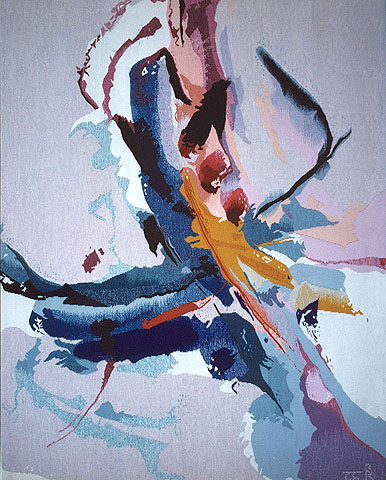
I've been gazing at Pat's tapestry book to get some ideas. Of course there are gazillion techniques but for now I can't be bothered reading and learning so I'm just gazing at shapes without clear lines. And I found some wonderful examples of tapestries that are similar to abstract paintings or collage. I wish I could show all three; if you happen to come in close proximity to "The Tapestry Handbook - An Illustrated Manual of Traditional Technique" by Carol K. Russel, they are:

An untitled abstract by Tricia Goldberg and Bonni Boren, 1987, (bottom of page 110). This could almost be a complicated, manipulated ink blots or finger painting in blues oranges, and browns. Very dynamic. (The colors on her website are much bluer than in the book. I wonder which is true.)

"Lyrical Landscape", by Trudi Eldridge, 1989, (bottom of page 57,) is in hot colors, the mood is an abstract, more childlike version of Gaugin's Tahiti. I see a volcano at night, with large horizontal areas of blacks and blue, with yellow and orange bursting.

And "1941-Baggage", by Silvia Ptak, 1987, (page 165) shows the original collage along with the tapestry. This looks more like an interior. Two of the collage pieces are photos but others are ripped pieces of colors, in pale pinks, grays and browns.

I want to make the current piece salable if possible, so I don't intend to get too adventurous, (sticking my fat fingers through alternate 2/60 cotton is too delicate an operation for practice,) but I think I'm going to try new shapes.

I was thinking back to the time I did the first small piece back in Japan. I struggled because I couldn't get the wefts to meet up conveniently and some areas always had more or thicker wefts so I had to do weave extra rows, but in retrospect I enjoyed it. It was nice to play without having to come up with a "finished" product. I know I don't do enough of these fun things, except in excessive sampling. The current piece is beaten not with a tapestry comb but with the reed and the wefts are roughly similar in sizes so the fell has been straight so far. To my jaw-dropping, butt-falling-off-loom-bench surprise.

* * * * *

Umm... Pictures.
Obviously these are just a tiny, tiny bit of the best bits whereas the rest is wilderness. Although the temperatures are still low at times, the direction and the length of sunlight is definitely changing, and weeds and seed know this. Long-term forecast yesterday told us "real" spring is going to be slow in coming, but I'm more than OK with that. Except bugs and pollen are definitely out when I weed now. Today we have severe rain and wind warning again, but it's not so bad.

2015/08/29

You won't Believe What I'm Doing

This is the scarf I made after the wall piece. The weft is a thin, (slightly thicker than 2/60), papery silk from Mom's stash. The yarn had a starched (?) crispness, so pink from the same lot was among the wefts sampled for the wall piece. Washing, however, took away the stiffness and the fine weft all but disappeared, so not so good for a wall piece, but good for a summer scarf. And it's my kind of look, isn't it?

Except weaving this was excruciatingly boring. I had to do something for the last piece, and even though I have a love/hate relationship with the freer tapestry technique, this was the only way I could think of to put a spring in my treadling step mid-warp. Beside, I intended to try this after Kaz's Saori workshop a year ago anyway.
The weft yarns are various silks of unknown origins, some may even be Mom's hand-dyed, hand-spun singles. The draft has a short weft repeat. I gave the sett some serious thoughts, as these wefts are considerably thicker than the two previous projects, but I couldn't be bothered resleying. Below is the right half of the draft.
Four repeats took a better part of an afternoon, and made up 15cm, so this is going to be slow, but I hope gratifying. I had planned to use the same technique in the cashmere-mix warp on KLIK, so this doubles as practice before that particularly delicate warp.

My thoughts thus far is this: it's all right to delve into the spontaneous, see-what-develops way to experiment/play, but for me this is not a good way to make merchandises. I can work better if I have a piece of paper approximately the size of the finished piece, with a line indicating where I'm weaving, so I can place designs more deliberately. Learning that alone has been worth it.

* * * * *

Thursday night while Skyping with Mom, I tried to explain, more to myself, how as my weaving practice becomes more stable/constant, it has also become boring. The immediate reasons are: 1) I haven't deliberately experimented with colors of late; 2) I default to twills almost without thinking; 3) stash-busting is on my mind, and even though I have a vast choice, I'm not used to thinking yarn=>design and don a phantom straitjacket and grit my teeth; and 4) the colors in the last warp was so not me. (The wall piece is hanging on Mom's wall for now; she's going to discuss it with her students when they come back in fall, and then deliver it to the client.)

In order to keep working steadily/productively, I am not reinventing the wheel with every warp and this does contribute to less satisfaction. I don't rush, and goodness I'm still slow, but I sense, (because I can't cite instances,) a greater portion of decisions are made automatically or default to the same as a previous project. This must mean I've some experience/knowledge, which should be a good thing, and theoretically leave me free to concentrate on more interesting bits. But I haven't moved on, so I'm repeatedly taking roller coaster rides but missing out on that queasy feeling in my stomach. Because I really used to feel that when I worked.

My mind keeps wandering back to Geodyne's project a while ago and the impact it had on me, particularly the second pic. Exciting times.

2015/08/28

Hellebore Love

Ben was home for ten days. We had planned to declutter a little, garden a great deal, cook/eat well, and then go away on a road trip. We had cold weather and rain at times but rushed outside every time the sun came out to do little bits. Ben cooked delish meals and cheesecake. At times I got thoroughly sick of gardening so I read. A good deal, as it turned out. But the house and garden is slightly in a better shape. The only thing is, we didn't do the road trip.

The trip, and in fact the timing of Ben's holiday, was planned around my favorite hellebore grower, Clifton Homestead's annual open house weekend. But when I rechecked the map midweek, I was shocked to find they were way down the bottom of South Island, not in the middle just south of Christchurch, as I had misremembered from other years I checked contemplating a road trip. This would add at least another day of driving, and as we haven't been on long road trips in several years, we weren't keen on making a quick trip to where there may even be snow or ice on the road. We haven't driven on those elements since we came to New Zealand; we are so spoiled in Nelson. Maybe next year.

I fell in love with hellebores when I saw my first one about 15 years ago; I think it was a burgundy/pink single orientalis, but I can't be sure because it died, along with a light yellow green, and a greeny white, among others I planted in the shade as instructed. Having learned that in New Zealand, "shade" pertaining to plants mean "don't need 24/7 sun", I moved the few survivors to another part of the garden, just outside the kitchen window, a few years ago, and they have been doing splendidly. Encouraged by the success, I've been adding two, four or six a year thanks to Clifton.

This year, though, in search of darker grays/purples/blues, I started to read about these flowers seriously and bought seeds from Europe. Because I am in the southern hemisphere, seeds from the north are, um, out of whack with our seasons so I don't know how this will work. And then I read Japanese growers have unique flowers, so they are on next year's wishlist. I've also been pollinating regularly. The only one gray/purple I have is pollinated with itself, but other purples and clarets are cross-pollinated with the gray. I'm not going to collect them but let them come up naturally.

Hellebores are a little like weaving; it takes a long time for seeds to show any signs of life, (up to a year?) and then up to a couple of years for a plant to flower. And new hybrids aren't stable, (is that the right word?) so one never knows how the next generation will look if I cross-pollinate.

The slowness of hellebore growing made me come to terms with gardening being on-going. Unless we go the concrete/paving way. I'm not pleased; I wished I could work really hard for a while and be finished for a while, but one of the reasons we came to New Zealand was we wanted a garden all those years ago, in our misguided relative-youth and I don't mind the work. I just wished I didn't have to do so much of it. Oh, dear.
One of two strenii, this is called Clifton. It needs to move to a sunnier spot after the seedpods mature.
I'm also supposed to have purple picottees, (white with purple edges,) but they are not too evident.
From above,  I can't tell the difference between these purples and the gray, but from below the I can see the difference.
The only gray, (sometimes called slate?), which is really very dark purple, and my favorite. From above it's not as saturated purple but more purple gray.
The clarets are much bigger and have two to three dozen flowers on each plant. They self-seed robustly.
Some time ago when I couldn't sleep, I doodled on the software and came up with this drat. I'm calling it Hellebore Love, but now I think it looks more like pansies; never mind, I love them, too.

2015/08/17

Nor Wall Pieces

Because I find it hard impossible to make them square/rectangular/perpendicular/parallel. It drives me mad. Nevertheless, one reaches a point where there's no use rehemming or redoing the casings, and I've reached it this morning. So this is done. And my eyes are dry.
It's not a big piece, but adequate for, as I keep saying, a small Japanese house or apartment.
I like the 3D-ness. The colors are truest in the top photo; this was taken under brilliant sun yesterday.
Also yesterday, I got this shot by chance, half in the sun, half in shade, though not as dark as the thumbnail suggests; silk sparkles in the sun, the 3D-ness is brought to the fore in the shade, so interesting in different lights, which was one of my goals. (This last pic is click-worthy if I may say so myself.)

I used pine dowels because I had two in just the right length already.

I've been weaving a scarf using a very thin, papery-in-texture straw-colored silk from Mom's stash. I'll show it to you in the next few days.