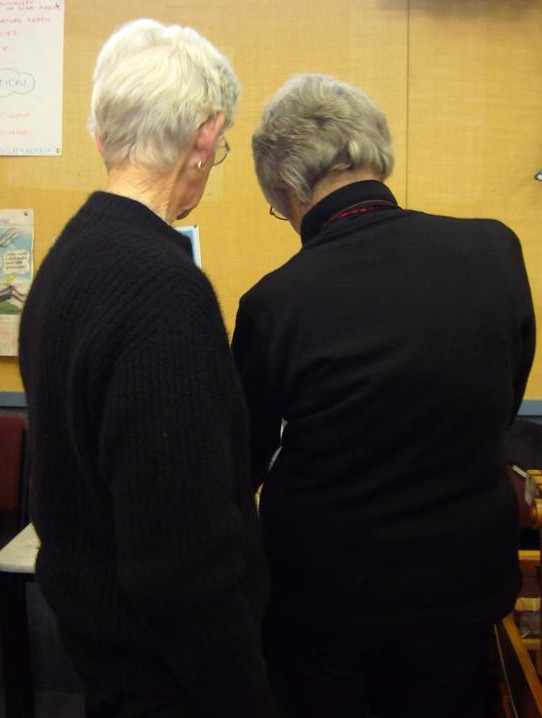
So, what did I learn at the workshop? I think control and planning make predictable but not necessarily interesting cloth, that I've not enough experience not to be experimenting more, and that I may find weaving more enjoyable in a different way if a bit of spontaneity came into play. Here are my samples to illustrate the point. (The colors on these photos do not represent the samples very well, unfortunately.)
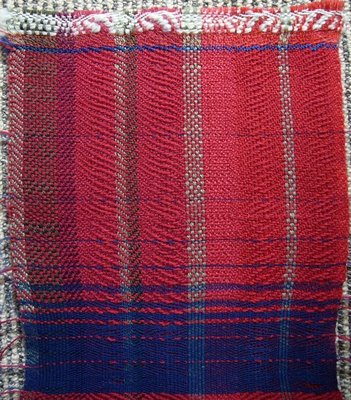
Sample 1a: on my own warp; we practiced weaving picks according to the Fibonacci number, in two colors. In this sample, I wove: 55 red, 1 blue, 34 red, 1 blue, 21 red, 2 blue, 13 red , 3 blue, 8 red, 5 blue, 5 red, 8 blue, 3 red, 13 blue, 2 red, 21 blue, 1 red, 34 blue, 1 red, 55 blue, in roughly similar value, but the blue yarn was much skinnier so the visual proportion is lopsided ; we also ignored different shrinkage.
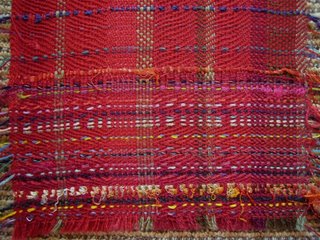
Sample 1b: on mine again, Randy instructed us to maintain the visual proportion, but start introducing other colors and textures and aim to mix 100 colors. As you can see, I did weave a lot of red picks, but I was not exactly adventurous, and was afraid of introducing drastically different hues at first. In fact, I was totally frustrated.
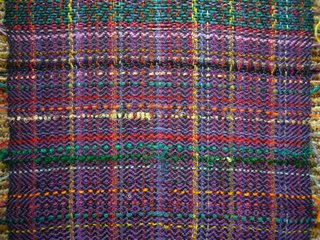
Sample 2: multi-color warp mostly in darker values. I started out resisting, in thin purple wool, by telling myself I needed to get used to the loom. However, I was also highlighting the paler colors, especially yellows and oranges, and also included some textures. When I ran out of the purple wool, I switched to a thicker green cotton, which made the cloth more bumpy/textured, and the cooler contrast less noticeable.
Although you can see that I am still counting, with the purple and green as main colors, I was less inhibited in introducing hues because many already existed in the warp. I like the inclusion of lavender, violet and olive green in the purple area.
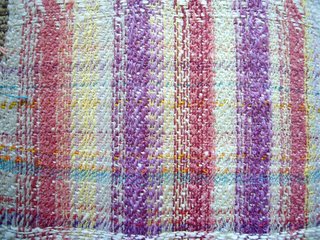
Sample 3: a textured warp. Because of the texture in the warp, and the type of weft yarns I had with me (smooth, thin wool and embroidery floss in various colors), I thought this is a test in how much I can show the weft yarns. In fact, I got braver and started to include intense yellows and oranges, as well as two powder blue-greens, although most other 'interjections' were hues similar to those found in the warp, but in different values.
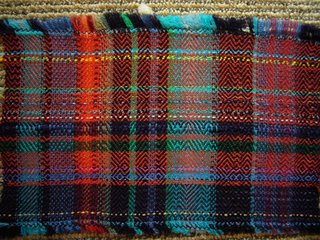
Sample 4: a warp with contrast in values. I found the wide range of values in this warp difficult, and chose an orange (a hue I seldom use) roughly equal in value in warp, to see what would happen. I did this because my natural instinct would have been to use navy as the main weft , which I tried only to get used to this loom. I was more interested in what would happen to the cloth value-wise, and was able to ignore the disharmony (to me) of the hues. Although the finished cloth does not reflect this, I was starting to think on my feet and foraging through my, and other weavers', stash for different yarns.
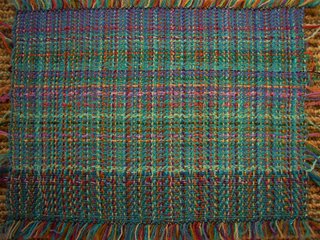
Sample 5: gentle blues and greens. I felt liberated weaving on this warp, because the colors are so different from what I normally choose, I had less preconceived ideas about what I should do. Although I did not know this at the time, I was no longer overly concerned with proportion, being more interested in the evenness of value, and consciously worked on the visual movement i.e. not introducing interesting colors amidst just one base cooler, but moving the viewer's eye. The variety of hues I introduced increased dramatically, and I also used glitter threads.
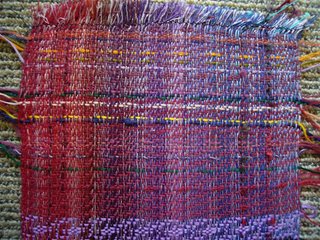
Sample 6: "I wished I warped this" warp. This says more about my preference; I liked all the colors on this warp at first glance, and looked forward to weaving on this loom, but found it difficult. I think it was partially because the value range is wide, partially because I 'know' these hues, and most probably because of the time of the day I reached this loom. Because the warp threads collectively looked very intense, I kept putting in more intense colors, e.g. many embroidery floss, but I carried on with trying to change the base cooler to move the eye, without making obvious stripes. The photo doesn't show this well, but the base colors changed in this sample as in the last one.
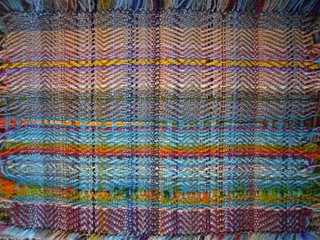
Sample 7: another gentle warp. I was finally starting to feel comfortable about going with the flow, not worrying too much about proportion or value, but just wanting to move the eye and avoid stripes. I was, however, starting to run out of some hue/value wefts, so my options were narrowing, and this proved to be a great exercise because I had to use more and more hues I normally would not touch (nor own).
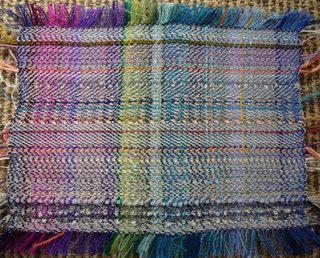
Sample 8: My Randy. By the time I arrived at this loom, I had some clue as to how I could transfer my ideas onto the cloth. We had just seen a series of Randy's silk scarves that morning, and I wanted to recreate the shimmer of silk using wool. I found a shiny acrylic (?) silver/brown/black thread in someone else's basket, so I wove one pick, followed by a dull gray yarn; so two yarns/picks to create one base color 'pick'. Because the warp threads were intense/saturated, for accent colors I used less intense, 'dirty' colors. I was very pleased with the overall look, and the added bonus was the owner of this warp liked it, too.
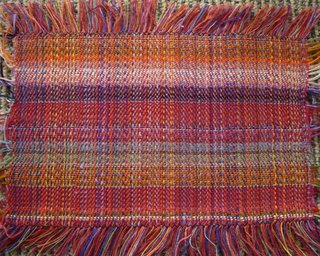
Sample 9: I am Randiette. By this time I was enjoying thinking on my feet, and was not worried about doing the wrong thing. Here, although I tried to avoid obvious stripes, I was more interested in the movement of the viewer's eye, and I did introduce more yarns than in almost any other sample. The interesting thing about this sample is that depending on the distance from which you view this sample, the stripes appear to be of different width and/or the border of the stripes move.
So what did I take home from the week? Well, actually it didn't occur to me until I analyzed these samples: Randy was spot on with his advice on the first day, that I cannot go to workshops looking for a magical formula to improve my weaving, but I need to be my own apprentice, weave more, and learn from experience how to use colors and what kind of cloth I want to weave. What makes him a great educator is he probably knew I would automatically reject his advice had he used words like "play" and "spontaneity", but I don't mind working long and hard, and what a romantic notion to be my own apprentice! That
was my magic formula. So now it's time to get on my loom and weave.

 And Brian and Glenys Mann, the Forum Mother.
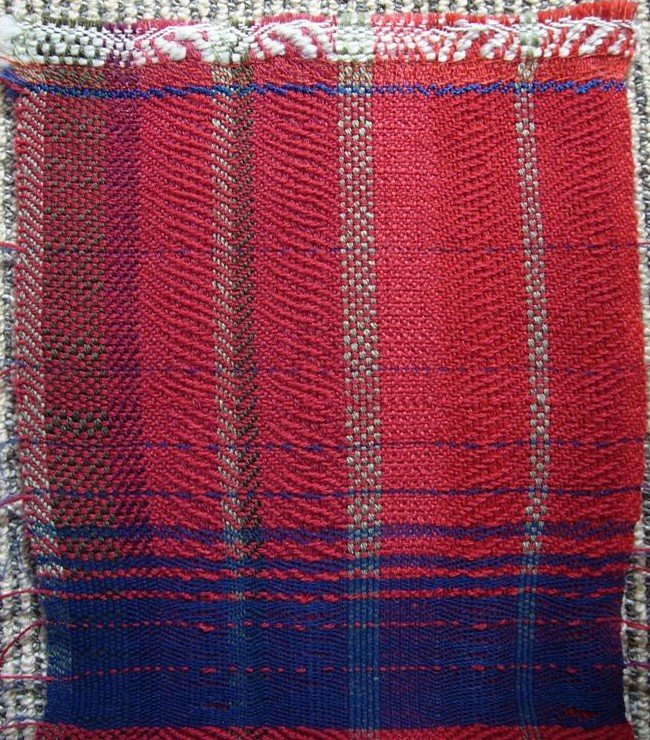 Sample 1a: on my own warp; we practiced weaving picks according to the Fibonacci number, in two colors. In this sample, I wove: 55 red, 1 blue, 34 red, 1 blue, 21 red, 2 blue, 13 red , 3 blue, 8 red, 5 blue, 5 red, 8 blue, 3 red, 13 blue, 2 red, 21 blue, 1 red, 34 blue, 1 red, 55 blue, in roughly similar value, but the blue yarn was much skinnier so the visual proportion is lopsided ; we also ignored different shrinkage.
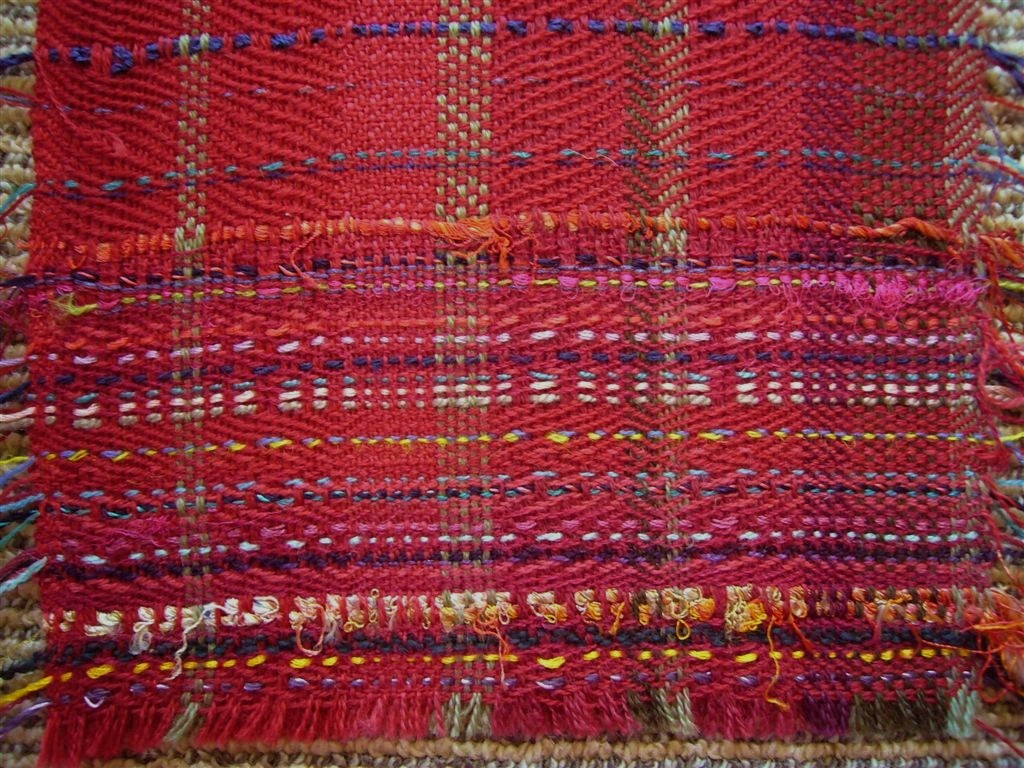 Sample 1b: on mine again, Randy instructed us to maintain the visual proportion, but start introducing other colors and textures and aim to mix 100 colors. As you can see, I did weave a lot of red picks, but I was not exactly adventurous, and was afraid of introducing drastically different hues at first. In fact, I was totally frustrated.
 Sample 2: multi-color warp mostly in darker values. I started out resisting, in thin purple wool, by telling myself I needed to get used to the loom. However, I was also highlighting the paler colors, especially yellows and oranges, and also included some textures. When I ran out of the purple wool, I switched to a thicker green cotton, which made the cloth more bumpy/textured, and the cooler contrast less noticeable.
 Sample 3: a textured warp. Because of the texture in the warp, and the type of weft yarns I had with me (smooth, thin wool and embroidery floss in various colors), I thought this is a test in how much I can show the weft yarns. In fact, I got braver and started to include intense yellows and oranges, as well as two powder blue-greens, although most other 'interjections' were hues similar to those found in the warp, but in different values.
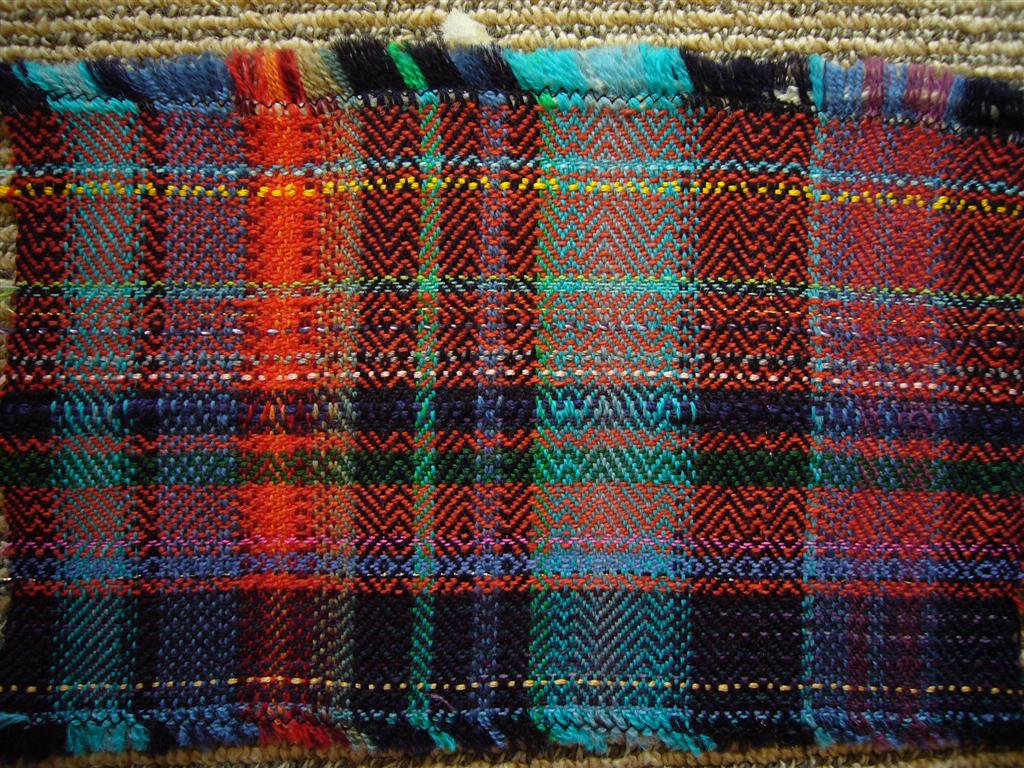 Sample 4: a warp with contrast in values. I found the wide range of values in this warp difficult, and chose an orange (a hue I seldom use) roughly equal in value in warp, to see what would happen. I did this because my natural instinct would have been to use navy as the main weft , which I tried only to get used to this loom. I was more interested in what would happen to the cloth value-wise, and was able to ignore the disharmony (to me) of the hues. Although the finished cloth does not reflect this, I was starting to think on my feet and foraging through my, and other weavers', stash for different yarns.
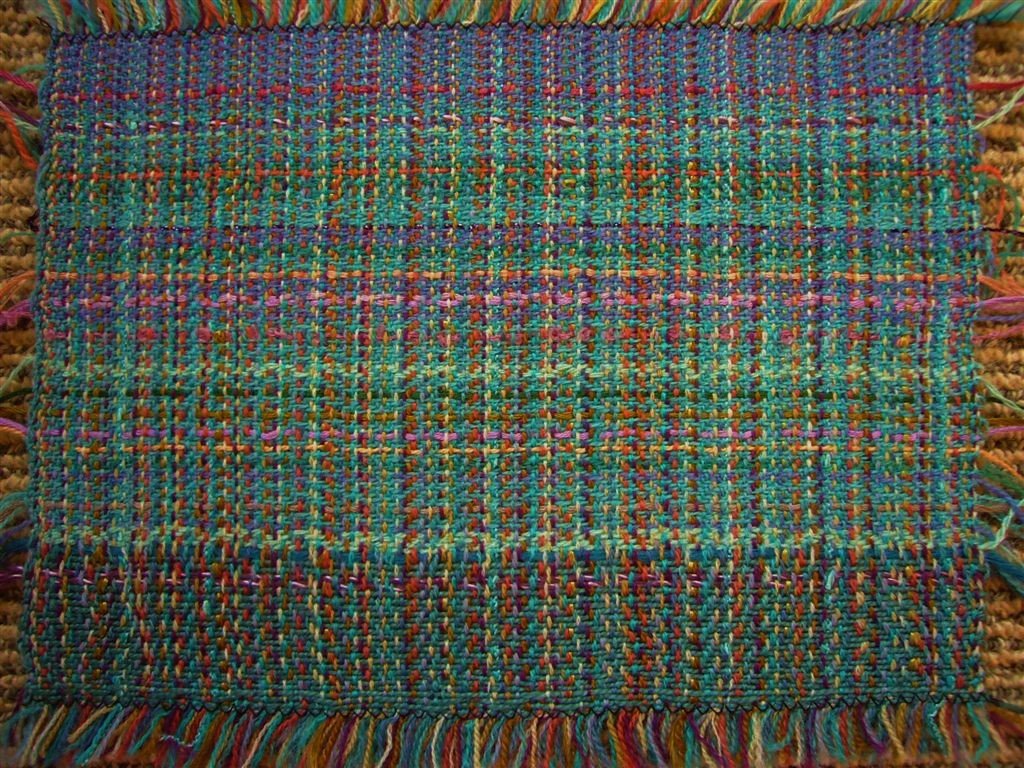 Sample 5: gentle blues and greens. I felt liberated weaving on this warp, because the colors are so different from what I normally choose, I had less preconceived ideas about what I should do. Although I did not know this at the time, I was no longer overly concerned with proportion, being more interested in the evenness of value, and consciously worked on the visual movement i.e. not introducing interesting colors amidst just one base cooler, but moving the viewer's eye. The variety of hues I introduced increased dramatically, and I also used glitter threads.
 Sample 6: "I wished I warped this" warp. This says more about my preference; I liked all the colors on this warp at first glance, and looked forward to weaving on this loom, but found it difficult. I think it was partially because the value range is wide, partially because I 'know' these hues, and most probably because of the time of the day I reached this loom. Because the warp threads collectively looked very intense, I kept putting in more intense colors, e.g. many embroidery floss, but I carried on with trying to change the base cooler to move the eye, without making obvious stripes. The photo doesn't show this well, but the base colors changed in this sample as in the last one.
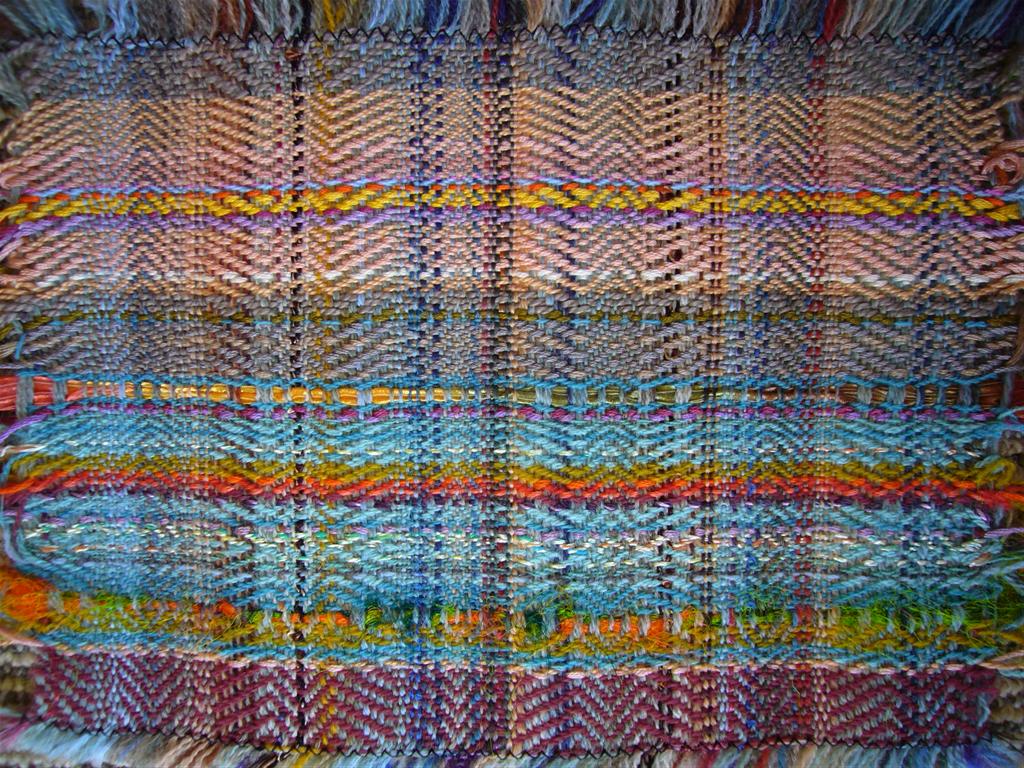 Sample 7: another gentle warp. I was finally starting to feel comfortable about going with the flow, not worrying too much about proportion or value, but just wanting to move the eye and avoid stripes. I was, however, starting to run out of some hue/value wefts, so my options were narrowing, and this proved to be a great exercise because I had to use more and more hues I normally would not touch (nor own).
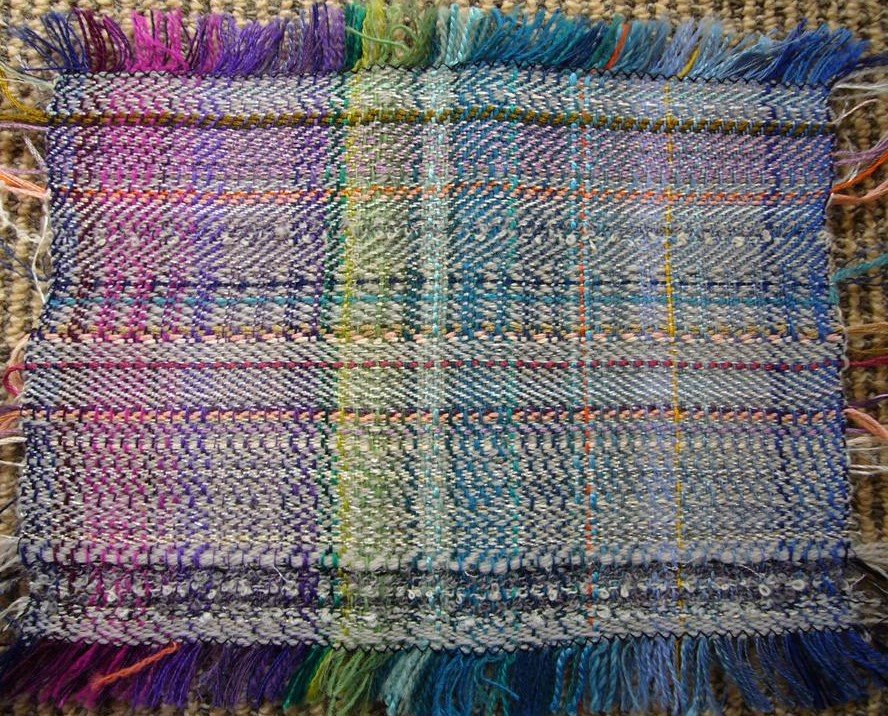 Sample 8: My Randy. By the time I arrived at this loom, I had some clue as to how I could transfer my ideas onto the cloth. We had just seen a series of Randy's silk scarves that morning, and I wanted to recreate the shimmer of silk using wool. I found a shiny acrylic (?) silver/brown/black thread in someone else's basket, so I wove one pick, followed by a dull gray yarn; so two yarns/picks to create one base color 'pick'. Because the warp threads were intense/saturated, for accent colors I used less intense, 'dirty' colors. I was very pleased with the overall look, and the added bonus was the owner of this warp liked it, too.
 Sample 9: I am Randiette. By this time I was enjoying thinking on my feet, and was not worried about doing the wrong thing. Here, although I tried to avoid obvious stripes, I was more interested in the movement of the viewer's eye, and I did introduce more yarns than in almost any other sample. The interesting thing about this sample is that depending on the distance from which you view this sample, the stripes appear to be of different width and/or the border of the stripes move.
 I didn't set out to be a chronicler of the workshop, but it turned out I did a little bit of that. I can kick myself for not having learned all my camera is capable of before I went away. I regret not having shot a group picture of the class. But, at the risk of offending a few mild-mannered Kiwis, I do have one last, last story I want to tell.
 Even a giant loves his ice cream.


 Randy didn't use the word "dynamic' in the workshop. Instead he repeatedly told us to weave in a "painterly" way, to surprise him, and used many beautiful musical metaphors. I'm not sure if I'm placing too much emphasis on the one word that bugged me for months, but I can see when it's working.

 This is arguably the most important concept of the entire workshop, and in understanding Randall Darwall textiles, but today, I found nothing on this in my notebook, and no smashing photo to illustrate it. But I'll give it a try.

 The problem I've always had is I don't see values. I can distinguish black and white, but not the subtle differences of the shades of gray. I have 6-, 10- and 12-block gray scale things with little holes; I have the quilters' red and green plastic sheets; I have squinted and looked under the moonlight, but I just don't see it, and I'm happy when someone tells me A is darker than B. I'm value-blind rather than color-blind. So one of the goals Randy thought I should aim for is to experiment more with colors and develop alternative ways to understand value relationships, so I can weave cloth that shimmer.
 The most surprising thing was both Randy and creative collaborator & life partner Brian Murphy were such nice people, (was I expecting cantankerous East Coast artistes?), as were my 11 fellow weavers. So the week passed in an encouraging, cordial camaraderie. (The weather was glorious and here is Brian plotting to get away for a few hours of bike ride.)
 Randy gave us personalized goals during our Show & Tell, and pointers and encouragements throughout the week, as we worked our ways though our own warps, and six inches each on 11 other looms.
 Five days of theory and practice culminated in the critique sessions on the last day, when we took the samples off the 12 looms and analyzed each piece.
 Bittersweet graduation; I wanted to keep going for at least another week; I wanted to keep these two guys. (Waratahs are Australian, Brian.)
 Randy and Brian drove off into the distance (Taupo, to be exact) shortly after this, while we reflected on the excitement of the past week. Unlike Santa, Randy and Brian won't be back next year, but we were given presents we would treasure for years and years to come.