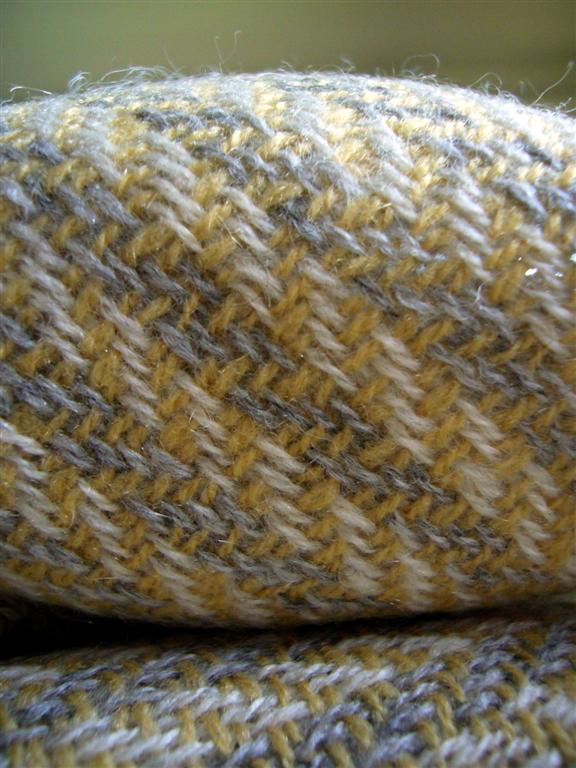
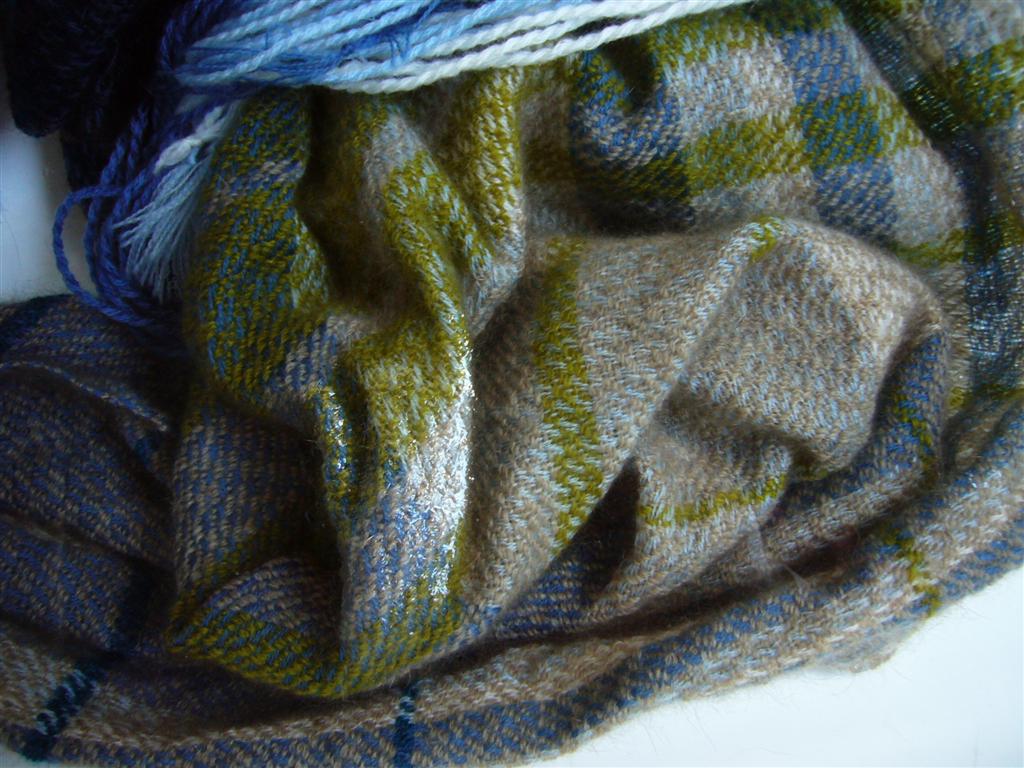
The clear yellow is a Christmas present from my friend Joan to her friend; the dirty yellow is a present for my baby brother for taking a giant step in his career earlier in the year.
Semi-Retired Weaver at the Bottom of the Planet, Occasionally Tending our Sisyphean Patch
A Goddess of Procrastination and Expert Forgetter
2006/12/14
Men's Cashmere Scarves
The clear yellow is a Christmas present from my friend Joan to her friend; the dirty yellow is a present for my baby brother for taking a giant step in his career earlier in the year.
2006/12/07
How I Make a Shawl - Part 6: Finally the Weaving
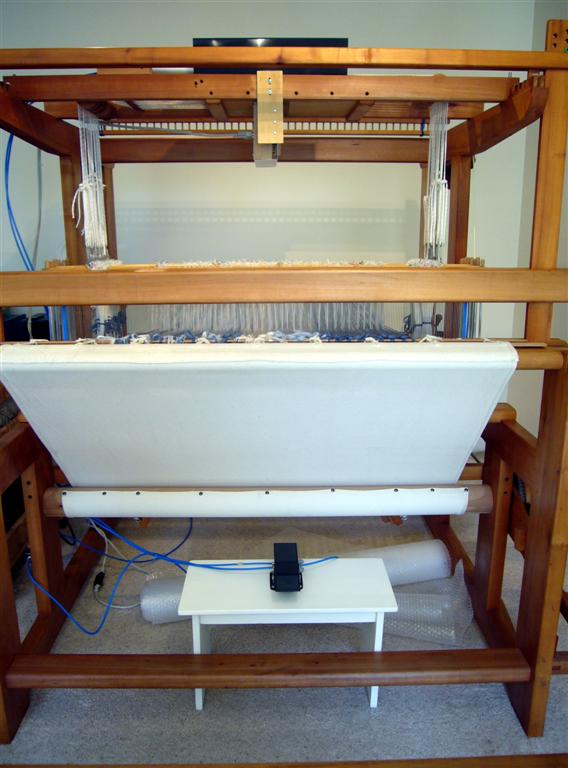
The act of weaving is simple and quick: I stepped on the pedal;
waited for the shafts to lift, (this photo is crocked, but the shafts lifted evenly, or else I needed to tweak the height of the shafts);
threw the shuttle between the lifted and the not-lifted threads, (this space is called the "shed");
and brought the reed forward to position the weft, (this action is called "beating"). Every few inches, I advanced the warp threads and continued weaving.I wove two pieces of samples, fringed, washed, pressed and dried them to test six weft candidates and five weave structures. I decided on the weft and the weave structure for the first shawl, and wove it, which took a little less than three hours. I decided on the weft yarns, color schemes and the weave structure of the second shawl while I was weaving the first; the weft color distribution took about half an hour to calculate, and the weaving time was a little over three hours on the second shawl.
After I wove the length of the shawl, I advanced the warp enough to get fringes, and cut off the woven shawl. I checked for mistakes or bits of yarn sticking out of the cloth, cut then off, and hung the shawl overnight to rest.
How I Make a Shawl - Part 5: Switching on the Loom
With some looms, non-dobby foot looms, there is another process called tie-up, but because I am weaving this series on a computer-controlled loom, I don't have to crawl under the loom to connect the treadles (foot pedals) to the shafts according to the weave structure; this is a relatively short and straight-forward process, unless you have not enough room under the loom and need to test your contortionist skills. (I do this when weaving on my Jack loom.)
A computer-controlled loom (which is not a special loom as much as it has lots of extra parts) can read a weave structure designed (or downloaded) on the computer, in a graph-like format called a draft, and decide which shaft/s is/are lifted in what order.
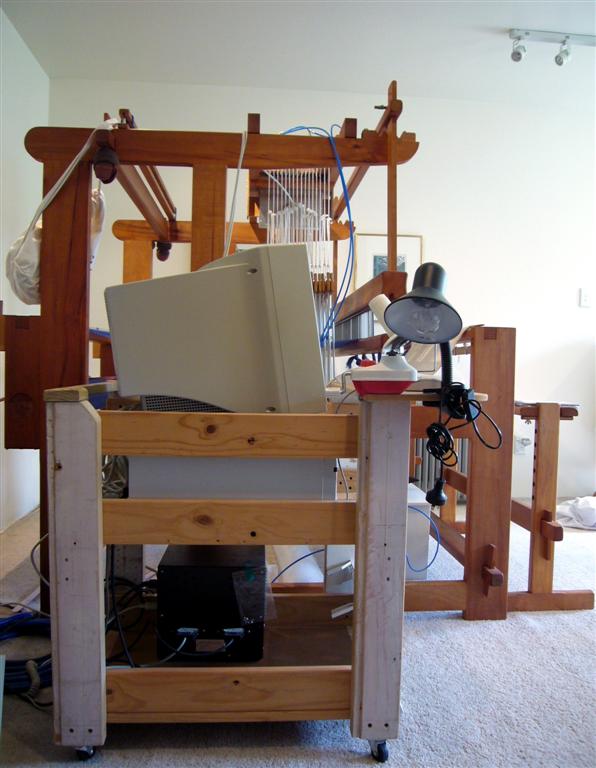
In my case, I needed to switch on the computer, open the program that translates the draft into the lifting order, and select the weave structure I want to sample;
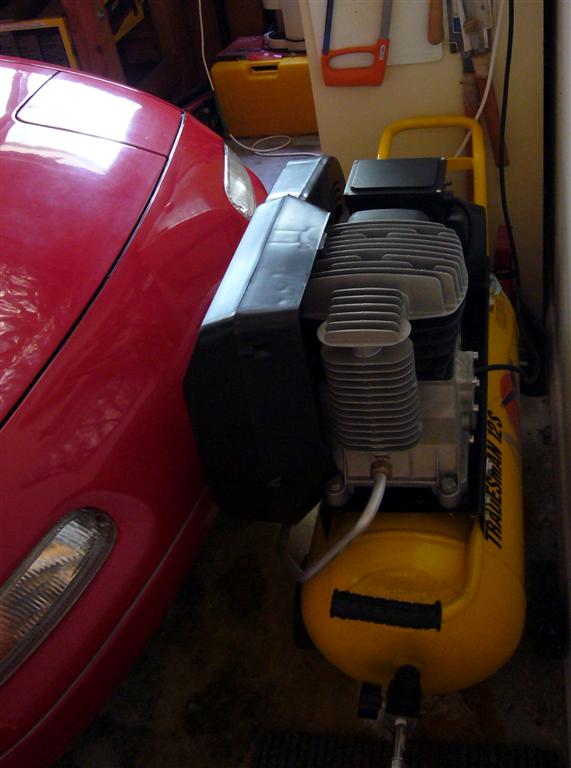
then I switched on the air compressor in the garage to power the physical lifting, (the car is not attached to the compressor; Ben needs to park this close so the garage door can be closed);
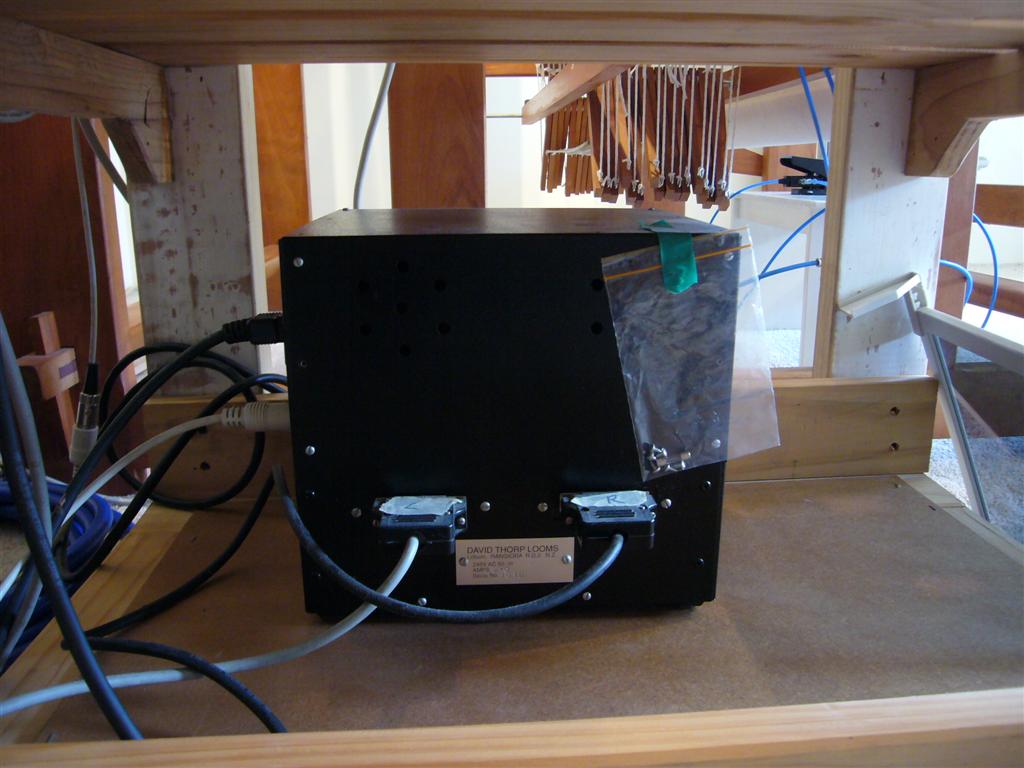
and I switched on the black box which conveys the lifting order to the solenoids.
Oh, and I prepared the weft samples by winding them onto pirns that goes into the shuttle.
My workstation is all ready to roar in less than 60 seconds. (The air compressor in the garage is behind the wall to the left.)
A computer-controlled loom (which is not a special loom as much as it has lots of extra parts) can read a weave structure designed (or downloaded) on the computer, in a graph-like format called a draft, and decide which shaft/s is/are lifted in what order.
In my case, I needed to switch on the computer, open the program that translates the draft into the lifting order, and select the weave structure I want to sample;
then I switched on the air compressor in the garage to power the physical lifting, (the car is not attached to the compressor; Ben needs to park this close so the garage door can be closed);
and I switched on the black box which conveys the lifting order to the solenoids.
Oh, and I prepared the weft samples by winding them onto pirns that goes into the shuttle.
My workstation is all ready to roar in less than 60 seconds. (The air compressor in the garage is behind the wall to the left.)
How I Make a Shawl - Part 4: Dressing the Loom - Winding and Through the Reed
Next was the most dreaded, unnerving (for me) part of the entire weaving experience, the winding, the only step where I need Ben's help.
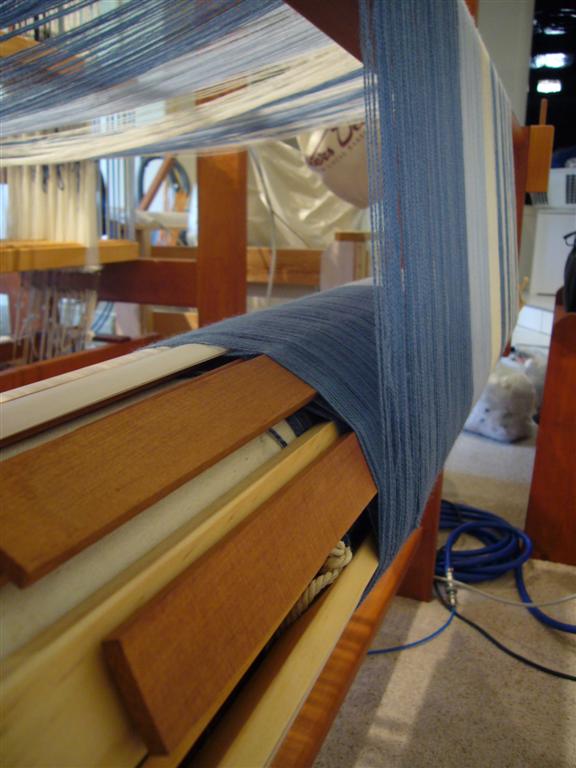
Theoretically, all I need to do is to wind handles attached to the back beam so the warp threads in the warp chain is straightened and wound on to the back beam, which can later be wound forward under tension to be woven. The reality is, warp yarns can get tangled with each other, the threads may be unevenly tensioned, or depending on the type of threads, it can get tangled up with the heddle, and even break, so the winding needs to be done under vary careful and as many watchful eyes as possible. This is the only part of weaving that I really dislike.
But I must wind to weave, so I attached a raddle on the front beam which allowed me to spread the warp relatively evenly to the width of the shawl; Ben held the warp chain, which was gradually undone by him and the threads held under even tension, at the other side of the room, as I slowly wound the warp.
I must have taken this from where I was kneeling while Ben was resting his arms because the warp threads are slack; we watched the back beam, above and below the threads, the front and the back of the heddles and the front and back of the raddle for loose or tangled warp threads. The slats of wood and old plastic Venetian blinds help separate the different layers of warp threads.
We stopped winding when I had about 40cm left in front of the raddle; Ben left the rest of the warp threads hanging and I came to the front of the loom. I removed the raddle, and inserted a 6-dent reed. The reed spreads the warp threads evenly in the exact weaving width; I am using a 6-dent reed, which has six slots for every inch.

I wanted to weave this shawl at 18 ends (warp threads) per inch, so threaded three threads in every slot. When I weave, the bars in the reed helps me push the weft threads forward and into position.
The winding took about an hour; the threading through the reed about another hour. Now I can tie the warp threads on to the front beam, and start weaving. Because I was not happy with the unevenness of the tension, I tied the warp threads directly, tugging at some sections more than the other, fine-tuning the tension.
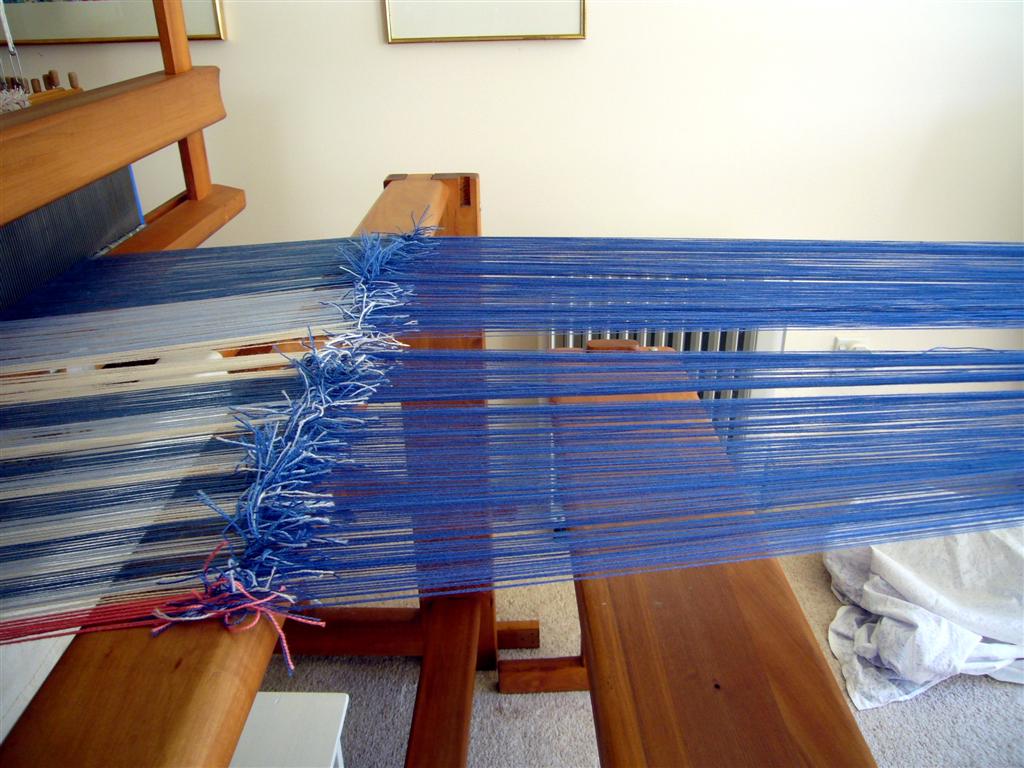
PS. A week later, I tied each new warp thread of the second warp onto the ends of the first warp, thus eliminating the need for threading through the heddles or the reed; the tying took me almost half a day, but this was still a great time-saver. I increased the number of warp threads slightly, so you can see the very long pink leaders, reaching all the way to the back beam, to make up the difference. The second warp is the more intense mid-blue only.
Theoretically, all I need to do is to wind handles attached to the back beam so the warp threads in the warp chain is straightened and wound on to the back beam, which can later be wound forward under tension to be woven. The reality is, warp yarns can get tangled with each other, the threads may be unevenly tensioned, or depending on the type of threads, it can get tangled up with the heddle, and even break, so the winding needs to be done under vary careful and as many watchful eyes as possible. This is the only part of weaving that I really dislike.
But I must wind to weave, so I attached a raddle on the front beam which allowed me to spread the warp relatively evenly to the width of the shawl; Ben held the warp chain, which was gradually undone by him and the threads held under even tension, at the other side of the room, as I slowly wound the warp.
I must have taken this from where I was kneeling while Ben was resting his arms because the warp threads are slack; we watched the back beam, above and below the threads, the front and the back of the heddles and the front and back of the raddle for loose or tangled warp threads. The slats of wood and old plastic Venetian blinds help separate the different layers of warp threads.We stopped winding when I had about 40cm left in front of the raddle; Ben left the rest of the warp threads hanging and I came to the front of the loom. I removed the raddle, and inserted a 6-dent reed. The reed spreads the warp threads evenly in the exact weaving width; I am using a 6-dent reed, which has six slots for every inch.

I wanted to weave this shawl at 18 ends (warp threads) per inch, so threaded three threads in every slot. When I weave, the bars in the reed helps me push the weft threads forward and into position.
The winding took about an hour; the threading through the reed about another hour. Now I can tie the warp threads on to the front beam, and start weaving. Because I was not happy with the unevenness of the tension, I tied the warp threads directly, tugging at some sections more than the other, fine-tuning the tension.
PS. A week later, I tied each new warp thread of the second warp onto the ends of the first warp, thus eliminating the need for threading through the heddles or the reed; the tying took me almost half a day, but this was still a great time-saver. I increased the number of warp threads slightly, so you can see the very long pink leaders, reaching all the way to the back beam, to make up the difference. The second warp is the more intense mid-blue only.
How I Make a Shawl - Part 3: Dressing the Loom - Though the Heddles
Now come three tedious but important steps, which, collectively are called "dressing" the loom.
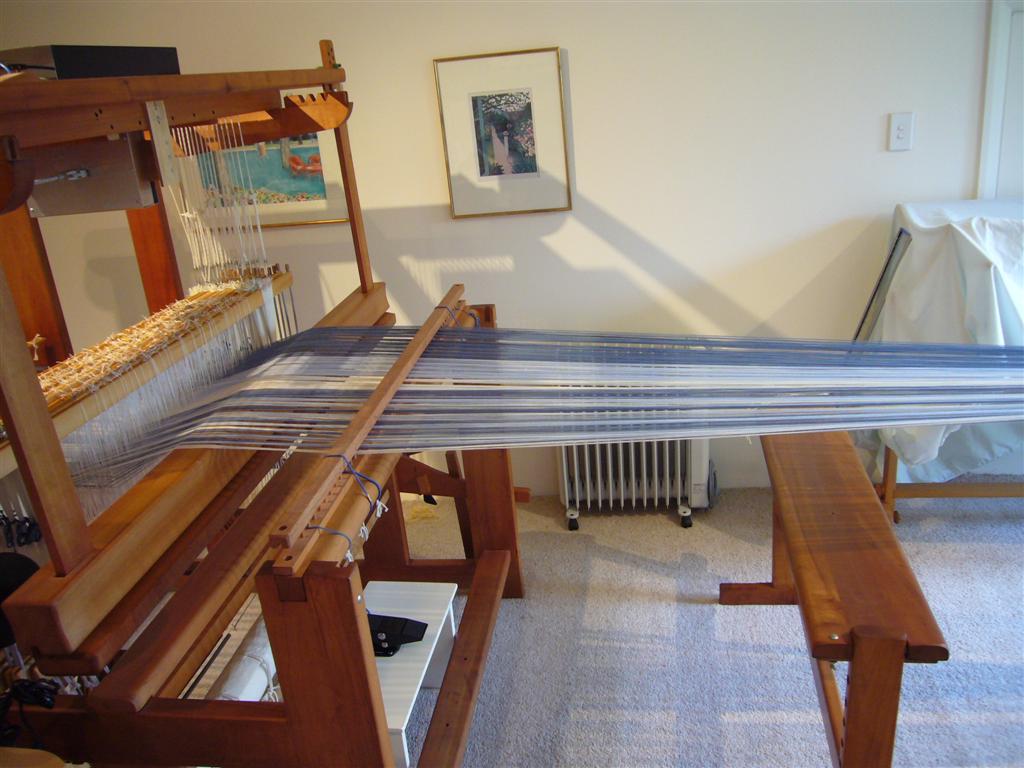
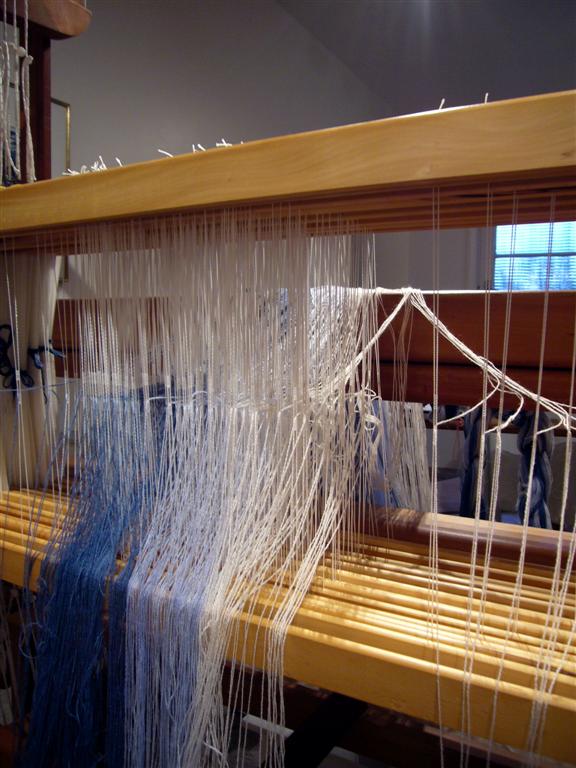
After making a long warp chain and transporting it downstairs, I secured most of the chain to the front of the loom, and stood in the space behind the heddles and shafts, in front of the back beam, and one by one, threaded the warp threads in to the eye of the heddle on the appropriate shaft and in the planned order.
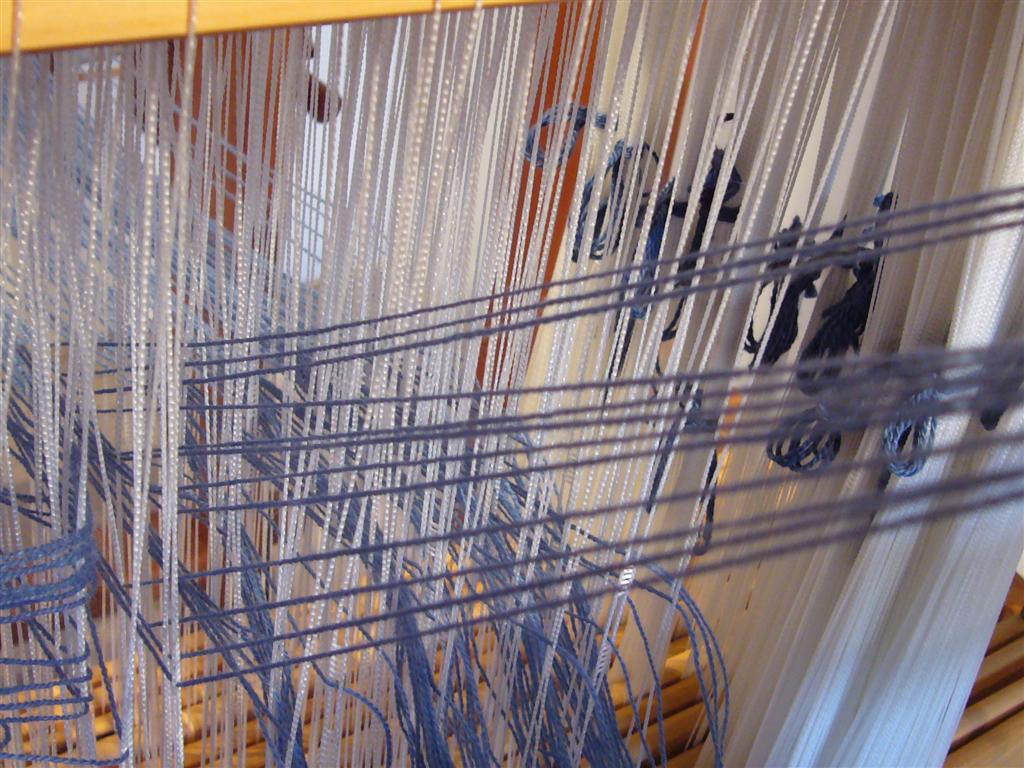
Heddles are the white string-like things with an "eye" though which normally one warp thread is threaded; every heddle is held by a shaft or a harness, (the pieces of wood at the top and the bottom on this loom); each set of heddles on the same shaft behave in unison.
Now, weave structures (or patterns) are created by selectively lifting (and on some looms also lowering) shaft/s so the shuttle and the weft threads can pass through some lifted and some not-lifted (or lowered) threads. You could say that the threading (first thread on the left is threaded on Shaft A, the next on Shaft B...), and the lifting of the shafts create the structure. I know it's getting a little technical, but if you see them in action, it's rather very simple.
I have 16 shafts on this loom, but usually I save Shafts 15 and 16 to weave plain weave on the two edges so I don't have to worry about the weft slipping at the edges, leaving me 14 shafts to play with the weave structure. Because I want to test several structures and weave at least two shawls, I threaded this warp in the simplest and most flexible threading, the straight draw. So, working from behind the shafts, the first warp thread (which will be on the far left when I sit in front of the loom to weave) was threaded through the eye of the heddle on Shaft 16, the one closest to me; the next, on Shaft 15; then the next 494 threads were threaded in shafts 14, 13, 12, 11, and so on to 1, and resuming at 14. The last two, 497 and 498, were on Shafts 16 and 15 again.
Threading the warp threads through the heddles is a simple task, but if mistakes are made, correcting the threading can be annoying, so I prefer to work on only 200-300 warp threads at a time. For this I warp, I worked two afternoons (when the light was better) to thread and check.
When all seemed good, I secured the warp ends to the back beam; because this is a large loom and the loom waste (the portion of the warp that cannot be brought forward to weave) is great, so I added a little bit of what I call the leaders in the end.
The two white threads appearing above the rest were threaded not in the eye, but the space above by mistake. This needed correcting before I could wind the warp onto the back beam.
After making a long warp chain and transporting it downstairs, I secured most of the chain to the front of the loom, and stood in the space behind the heddles and shafts, in front of the back beam, and one by one, threaded the warp threads in to the eye of the heddle on the appropriate shaft and in the planned order.
Heddles are the white string-like things with an "eye" though which normally one warp thread is threaded; every heddle is held by a shaft or a harness, (the pieces of wood at the top and the bottom on this loom); each set of heddles on the same shaft behave in unison.
Now, weave structures (or patterns) are created by selectively lifting (and on some looms also lowering) shaft/s so the shuttle and the weft threads can pass through some lifted and some not-lifted (or lowered) threads. You could say that the threading (first thread on the left is threaded on Shaft A, the next on Shaft B...), and the lifting of the shafts create the structure. I know it's getting a little technical, but if you see them in action, it's rather very simple.I have 16 shafts on this loom, but usually I save Shafts 15 and 16 to weave plain weave on the two edges so I don't have to worry about the weft slipping at the edges, leaving me 14 shafts to play with the weave structure. Because I want to test several structures and weave at least two shawls, I threaded this warp in the simplest and most flexible threading, the straight draw. So, working from behind the shafts, the first warp thread (which will be on the far left when I sit in front of the loom to weave) was threaded through the eye of the heddle on Shaft 16, the one closest to me; the next, on Shaft 15; then the next 494 threads were threaded in shafts 14, 13, 12, 11, and so on to 1, and resuming at 14. The last two, 497 and 498, were on Shafts 16 and 15 again.
Threading the warp threads through the heddles is a simple task, but if mistakes are made, correcting the threading can be annoying, so I prefer to work on only 200-300 warp threads at a time. For this I warp, I worked two afternoons (when the light was better) to thread and check.
When all seemed good, I secured the warp ends to the back beam; because this is a large loom and the loom waste (the portion of the warp that cannot be brought forward to weave) is great, so I added a little bit of what I call the leaders in the end.The two white threads appearing above the rest were threaded not in the eye, but the space above by mistake. This needed correcting before I could wind the warp onto the back beam.
2006/12/06
How I Make a Shawl - Part 2: Measuring the Warp
The work of a weaver, the preparation, the actual weaving, and the finishing, is linear; that is, the work consists of a series of relatively simple tasks, but each step needs to be done in sequence.
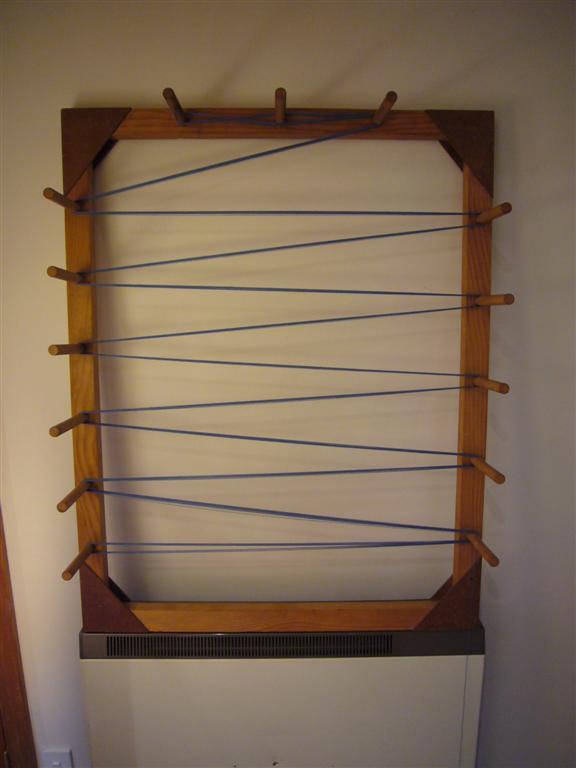
After I decided to use three colors in the warp, I measured the 498 warp threads on the warping board, by wounding a single warp thread at a time around all the pegs on the board; this way I would get roughly eight meters of warp, which should give me plenty to sample and two or three shawls. In my house, I have a wall-mounted heater at just the right height in the hallway, so I propped the warping board on it. Behind me to the right is the stairway, and I placed the cones of yarn on different steps; this way, the yarn is pulled straight up off the cones, over the railing, and onto the board, so the cones didn't topple or dance around.
As the warp threads accumulated, for the first time I saw the exact proportion of the yarns in the exact order they would be set up on the loom. Above is the busier half of the warp threads.
This measuring process took me about 90 minutes, with long breaks and frequent checking and rechecking and lots of counting.
After I decided to use three colors in the warp, I measured the 498 warp threads on the warping board, by wounding a single warp thread at a time around all the pegs on the board; this way I would get roughly eight meters of warp, which should give me plenty to sample and two or three shawls. In my house, I have a wall-mounted heater at just the right height in the hallway, so I propped the warping board on it. Behind me to the right is the stairway, and I placed the cones of yarn on different steps; this way, the yarn is pulled straight up off the cones, over the railing, and onto the board, so the cones didn't topple or dance around.
As the warp threads accumulated, for the first time I saw the exact proportion of the yarns in the exact order they would be set up on the loom. Above is the busier half of the warp threads.This measuring process took me about 90 minutes, with long breaks and frequent checking and rechecking and lots of counting.
How I Make a Shawl - Part 1: Planning/Designing
I'm often asked, "How long does it take to weave a shawl?"to which I have no quick answer. It depends on the purpose of the piece and/or the occasion of the gift, whether I know the person who will be wearing it and what I know about the person, the size of the piece and the yarn, the number of types and colors of yarns, weave structure (or pattern), and the loom, just to name a few. So, rather than giving you the days and hours I spent on a particular piece, I thought I'd take you on a short journey, of weaving two pieces from one warp in preparation of my Exhibit(ion).
Please note this is by no means a tutorial on how to weave. I am leaving out vital but boring technical information. And in weaving, there are always many different ways to accomplish the same thing; most weavers become comfortable over time with one method, which accommodates the body size, the loom type and size, the available equipment/assistance and space. (And this is also a disclaimer for my doing things other weavers and weaving teachers might cringe at if they only saw me.) I also lack confidence with proper weaving or design parlance, but with the help of a few photographs, I hope you get the feel of the work I do.
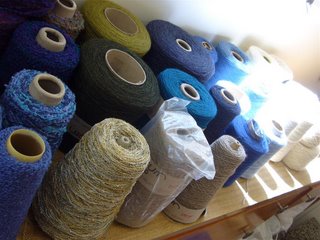
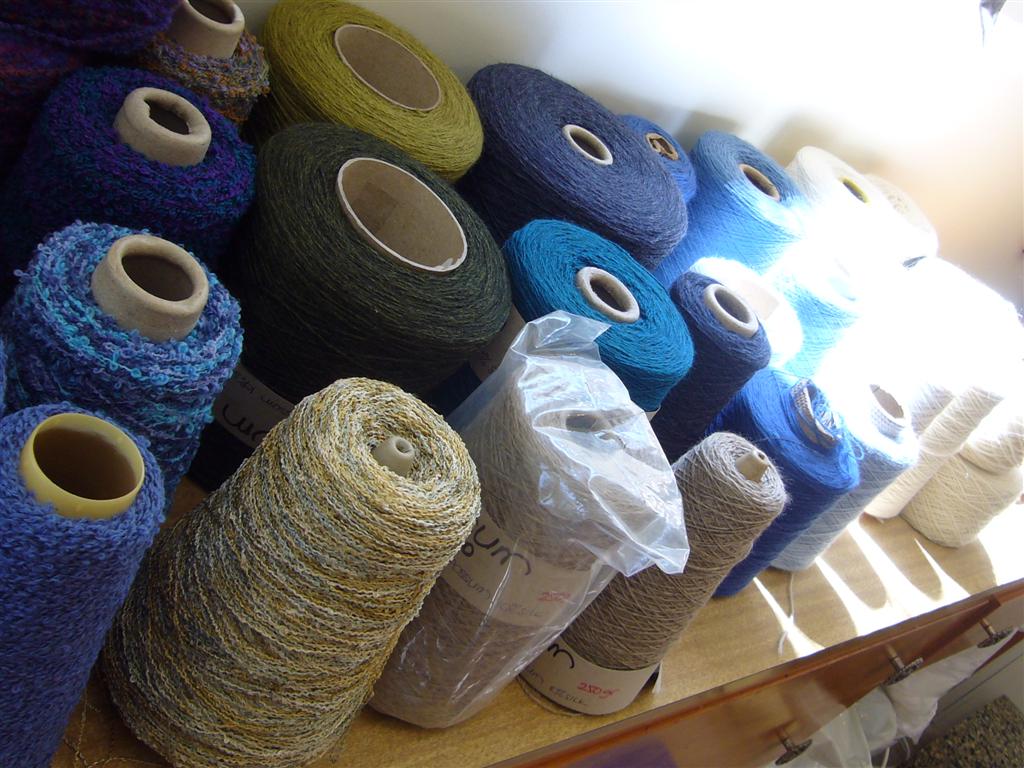
Unlike my usual work, (one-off pieces as special gifts or to be sent to juried exhibits), I need to weave a series of shawls which are interesting in their own right, but collectively not dissimilar, to give the Exhibit(ion) an visual cohesiveness. So I selected the sea as my theme. I placed cones of blue and white yarns all over the house so I was constantly looking at them and thinking about the theme.
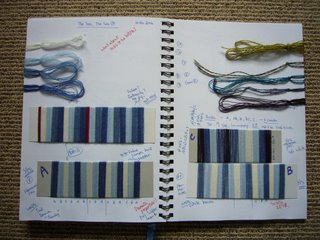
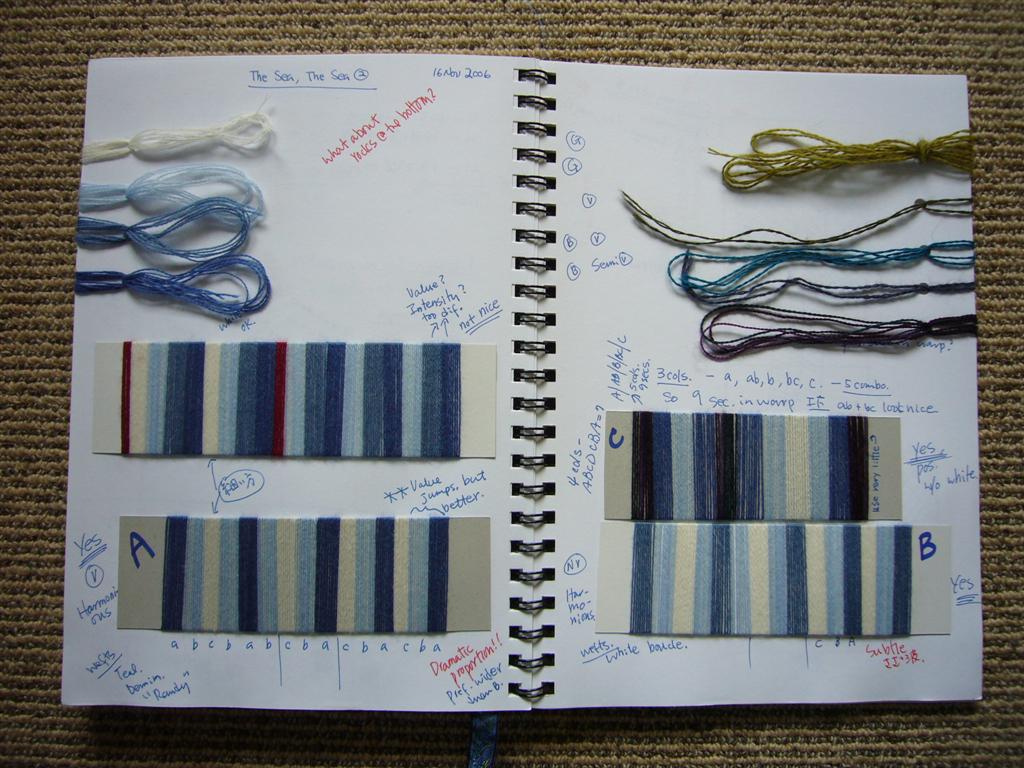
I narrowed down the yarns I can use as my warp (that is, the length-wise group of threads that will be 'attached' to the loom) and started playing with combinations. The small strips you see are called "wrapping", where warp candidates are wound around a small piece of cardboard. I don't usually do this, but because I needed to keep "the series" in mind and thought it best to keep good records, I made a few wrappings. The short time this took paid off as I did not like the look of my two mid-blues adjacent to each other (even though they look alright on cones sitting next to each other); the darker mid-blue was much more vivid/intense than the paler mid-blue. However the variegated powder blue looked good next to either mid-blue.
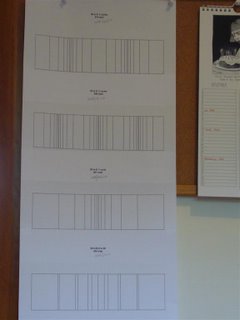
At the same time, I wanted to use my new knowledge of Fibonacci Sequence, so I had charts showing different proportions and arrangements, again, all over the house.
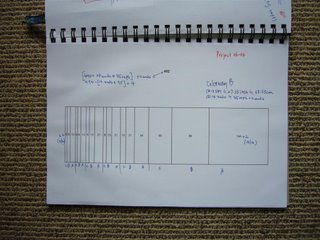
For the first warp, I decided to try the easiest option and place three colors, pale mid-blue, variegated powder blue, and undyed, to express waves on the beach. The order will be a simple repetition of mid-powder-undyed, and I need 494 warp threads for the design part, and two on each edges to secure, so a total of 498 warp threads. A more conscientious weaver might have colored in the chart or made a proportional wrapping, but I'm a waver, not a wrapper, so I moved on .
The design process is a long-drawn out one for me, because I see so many possibilities and I can't make up my mind. I started this about six months ago, and it will be on-going until I cut off the last piece from the last warp. From selecting the yarns for the first warp, deciding on the placement and proportion of the colors, and calculating the number of threads in each color took me approximately an half of an afternoon.
Please note this is by no means a tutorial on how to weave. I am leaving out vital but boring technical information. And in weaving, there are always many different ways to accomplish the same thing; most weavers become comfortable over time with one method, which accommodates the body size, the loom type and size, the available equipment/assistance and space. (And this is also a disclaimer for my doing things other weavers and weaving teachers might cringe at if they only saw me.) I also lack confidence with proper weaving or design parlance, but with the help of a few photographs, I hope you get the feel of the work I do.
Unlike my usual work, (one-off pieces as special gifts or to be sent to juried exhibits), I need to weave a series of shawls which are interesting in their own right, but collectively not dissimilar, to give the Exhibit(ion) an visual cohesiveness. So I selected the sea as my theme. I placed cones of blue and white yarns all over the house so I was constantly looking at them and thinking about the theme.
I narrowed down the yarns I can use as my warp (that is, the length-wise group of threads that will be 'attached' to the loom) and started playing with combinations. The small strips you see are called "wrapping", where warp candidates are wound around a small piece of cardboard. I don't usually do this, but because I needed to keep "the series" in mind and thought it best to keep good records, I made a few wrappings. The short time this took paid off as I did not like the look of my two mid-blues adjacent to each other (even though they look alright on cones sitting next to each other); the darker mid-blue was much more vivid/intense than the paler mid-blue. However the variegated powder blue looked good next to either mid-blue.
At the same time, I wanted to use my new knowledge of Fibonacci Sequence, so I had charts showing different proportions and arrangements, again, all over the house.
For the first warp, I decided to try the easiest option and place three colors, pale mid-blue, variegated powder blue, and undyed, to express waves on the beach. The order will be a simple repetition of mid-powder-undyed, and I need 494 warp threads for the design part, and two on each edges to secure, so a total of 498 warp threads. A more conscientious weaver might have colored in the chart or made a proportional wrapping, but I'm a waver, not a wrapper, so I moved on .The design process is a long-drawn out one for me, because I see so many possibilities and I can't make up my mind. I started this about six months ago, and it will be on-going until I cut off the last piece from the last warp. From selecting the yarns for the first warp, deciding on the placement and proportion of the colors, and calculating the number of threads in each color took me approximately an half of an afternoon.
I'm an Old Timer Now
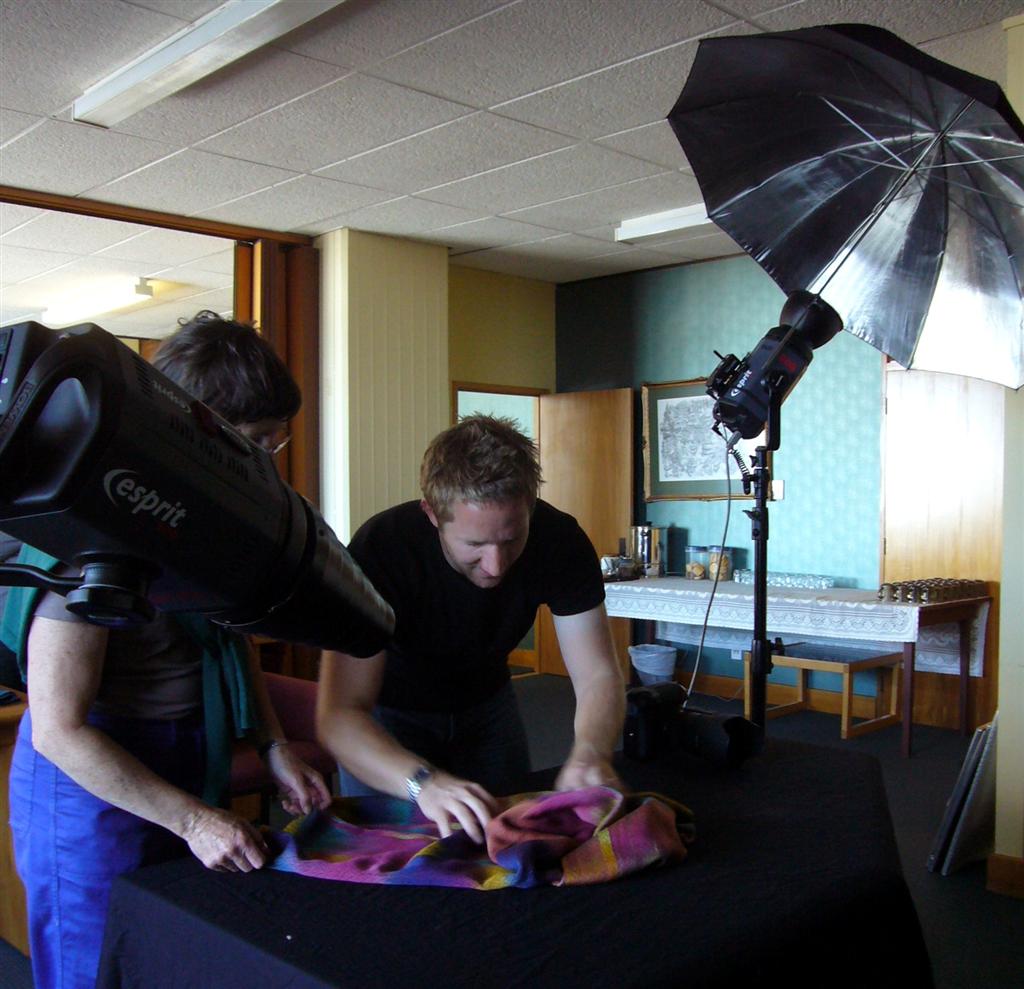
Remember Dan the Camera Man? We had another opportunity to get our work photographed by him today. Now that I'm so experienced in this process, I just gave him my shawls and scarves and left him to it, which in retrospect was such a waste of valuable learning opportunity. But I did get a few shots of Dan arranging Sue Broad's hand-painted silk fabric.Sue is an experienced weaver who has recently moved to Nelson. How lucky am I to be able to access her wealth of knowledge now! This is only her debut in "Unravelling"; she will be making many return appearances here in the future, I hope.
2006/12/05
Making of an Exhibit - Part 3: Angst and Joy
Monday night, I was weaving an ordered scarf unrelated to the Exhibit(ion); it's a simple Dornick twill in two grays, each strip four-ends wide, the twill direction changing with the color change; the weft is a dirty yellow; all in 100% cashmere. It's the kind of textile I weave often, and what I like to weave. It's guaranteed to have a luxurious hand; the wearer will enjoy it for several years; the construction is sound. And I was weaving on the smaller, four-shaft Jack loom, in the shadow of the big loom on which I have been weaving the Exhibit(ion) pieces.
I was thinking if I had many shawls of the kind I like to weave or am good at weaving, "MY" kind of weaving, the Exhibit(ion) will be filled with reliable but predictable textile, just like a department store. And then I wondered why on earth I ever committed to doing an Exhibit(ion), and knew that I am really the wrong type of person for it. If I need to put myself in a box, I aspire to be a master craftsperson, rather than an artist; I do not aspire to shock or protest or really even express by what I make, but I aspire to weave what is beautiful and functional, and make one person happy. So what I am I thinking, flirting with the idea that what I weave, and a whole bunch of them all lined up, may be interesting to look at, and be worth someone else's time!!
There must be a 6- or 10- or 12-states of emotions artists go through in preparing for their first Exhibit(ion), NOT that I'm calling myself an artist now, but Monday was definitely an "Angst & Self Doubt" stage for me. And it brought back the age-old question of art vs craft to the surface.
Oh, but this little scarf is delicious; and it took only a couple of hours to weave. Darn, I'm good.
I was thinking if I had many shawls of the kind I like to weave or am good at weaving, "MY" kind of weaving, the Exhibit(ion) will be filled with reliable but predictable textile, just like a department store. And then I wondered why on earth I ever committed to doing an Exhibit(ion), and knew that I am really the wrong type of person for it. If I need to put myself in a box, I aspire to be a master craftsperson, rather than an artist; I do not aspire to shock or protest or really even express by what I make, but I aspire to weave what is beautiful and functional, and make one person happy. So what I am I thinking, flirting with the idea that what I weave, and a whole bunch of them all lined up, may be interesting to look at, and be worth someone else's time!!
There must be a 6- or 10- or 12-states of emotions artists go through in preparing for their first Exhibit(ion), NOT that I'm calling myself an artist now, but Monday was definitely an "Angst & Self Doubt" stage for me. And it brought back the age-old question of art vs craft to the surface.
Oh, but this little scarf is delicious; and it took only a couple of hours to weave. Darn, I'm good.
2006/12/01
Making of an Exhibit - Part 2: Exhibit(ion) Shawls, My Shawls
Preparation is time-consuming; weaving is quick. After much thinking and worrying and finally getting a warp on the big loom, I completed two shawls in three days, neither of which I am crazy about. And I have been wondering why I am so tired and so grouchy.Since I signed up to do an exhibit(ion), I've been thinking a lot of about the visual coherence of an exhibit. Since Randall Darwall's workshop, I've been obsessed with color changes and Fibonacci sequence. Since I named the exhibit(ion), I've been concentrating on "Sea, Sand and Sky" expressed in colors, textures and weave structures. And I've been in a rush to try to weave to a schedule.
Fundamentally, the kind of shawls I like to weave haven't got a lot of colors but more like nuances: I use the subtle differences of the color or sheen in the warp and weft to highlight the weave. And these two pieces I've finished don't do that. In fact, rather than spending time to design a twill to show waves and water and sand and grass on the dunes, I'm downloading handsome weaves and sampling them one by one. I've been working with concepts trying to make pictures and not doing "my" weaving. At this rate, I won't be showing my best stuff.
On the other hand, these two suit the theme and make good fillers, and by that I don't mean these are inferior, just not to my liking. I know it's good to extend oneself, and I am doing just that. And in the end, I can never tell what you like.
So for the next one or two warps, I'm going to use one color in the warp and do my thing with weave structures, and get it out of my system. At the end of this process, I should have accumulated about half a dozen, at which time I can decide if I need more of "my" kind of shawls, or the "conceptual/pictorial" kind, or if I have the energy and guts and time to try to combine both.
Thank you for clarifying that for me; you've been of great help.
Subscribe to:
Posts (Atom)