A lot of what I learned, saw, thought, read and somehow remember in September should have been examined in more depth. A lot of the ideas were worthy of the scrutiny and reflection. I don't remember much, and I want to move on, but I hope some of it will come back to me in weeks or in years.
The issue that continues to stumps me is who I am, where my aesthetics and dogma come from, and how I see my personality and "default" behavior/penchant/reactions. I don't like the notion that this unknowing may go on for a while; it would be nice to come to understand where I'm at at certain significant junctions and be able to regroup myself. Alternatively, I can live with being too busy weaving and not having time to think about it.
I sought advice from those I trust in the days following the workshop, and received conflicting views. In the past few years I tended to choose paths opposite to what I would have chosen myself, to open new avenues, to try new things, to meet new people. Some have worked and some failed; when they failed, I could recall the foreboding I felt before I made my mind.
Whether taking the Wada workshop was good or bad, or right or wrong, for me will remain a mystery, if ever taking a workshop can be "wrong/bad" for me. One thing I was reminded is I have a fairly good grasp of what I like and instincts for what should or shouldn't do, and "trying new things" that goes against my instincts hasn't worked all that well. This is not to say I'm closing myself to serendipity, but I should feel OK about not choosing certain things.
Once again, from the left field, I was recommended The Highly Sensitive Person from a reliable source, and it should be in the post from a bookseller. I'm hoping this will also help me in selecting my paths in the next little while.
2010/10/03
Sweet & Sour September, Part 7: Yoshiko Wada Workshop - My Pieces
 Left, old cashmere scarf sample, warp in two grays, 2/2 twill, machine-stitched in "katana"; right, two end calico pieces, dyed in synthetic indigo. The very white spots in the calico were stitched by hand in addition to the machine-stitching; I can't see these spots on the cashmere sample, but it's a nice idea. Dyed in the darker synthetic indigo once. Yoshiko and I discussed variations on the theme with in-between blues because wool absorbs the dye readily.
 Fine tussah silk (?), machine woven scarf with peony motifs, from Japan. I hand-stitched the contours of seven of the flowers, then tied four in ”kumokukuri" and capped three as with the first step of "tsujigahana". Dyed in a weak natural indigo twice. The stitching did not follow the exact outline of the flowers on purpose, but it would have looked more interesting had the stitching veered further off course. The pulling of the stitches were inexact, resulting in one flower showing the "Tasmania effect", while another extending the white area outward in a cone shape.
I should have done one where only the outline was left white the the inside dyed as well.
 Fine silk handwoven scarf from Laos; folded irregularly and clamped with CD-roms. The original color was chocolate/tea blue brown; to create lots of in-between colors, (here, greens); dyed in the weaker of the synthetic indigo. I clamped approximately one quarter of the CDs tightly with two clamps, but and left the other sides open. This turned out to be my favorite piece from the workshop.
Dichotomy? A lot of the workshop was about Japanese-style planning, precision, and knowledge, of which I am proud and strive at, but I loved the unknowable, incalculable, the unplanned results more.
I never got around to working with my favorite method, pole-wrapping, but I think I know how to do this. I have one more piece I started in the workshop, which I'll dye during my Indigo Duty next week.
* * * * *
It astonishes me that I felt so alienated I didn't ask Yoshiko if she had her first book to sell, but that I relied on Deb to ask her, and when someone else took the last copy, I felt a bit numb, and mumbled something about Ben having access to the one in the Polytech library. So, no autographed copy!
I know some of you know the terminology of shibori much better than I, so I've listed only what I remember. If you're really stuck, let me know and I'll dig up the information.
* * * * *
After putting up with these many posts, I think you deserve a bonus. Here are two tips I picked up from Yoshiko:
* To cap and resist an area, as in my white peonies above, use plastic shopping bags rather than kitchen wraps.
* Indigo is alkali; rinse wools and silks in diluted vinegar water to neutralize and soften the fabric.
* * * * *
I discovered Colleen occasionally reads this blog and she asked me to write something about the workshop. On Day One I replied that it will be an extremely personal view, not exactly relating to the contents of the workshop, and she said that was fine. I hazard to guess she, nor you, ever expected to read the internal journey of one confused Japanese/American/Kiwi weaver who seeks the life of a pretend-savant. If you were disappointed by the lack of techniques, recipes or process photos, I'm sorry. If you were appalled, I remind you there are plenty of sane weaving blogs to enjoy. If you enjoyed the roller-coaster ride, I can't even promises there will be more of that to come.
All I can promise is that this is the last of the workshop-related posts for the time being. Onward and upward!
EDIT: I originally used the term pretend-idiot-savant, even though I knew it was an outdated term, because that is exactly how I felt in the workshop. But I support most changes of terminology if they peel away prejudices and discrimination, so I've taken it off somewhat belatedly. Folks with Savantism and their loved ones have a hard enough time, they don't need an idiot to use an old and mean word.
Sweet & Sour September, Part 6: Yoshiko Wada Workshop - Postscript
It may astound my classmates from Randy Darwall's workshop but I took less than a dozen pictures during the workshop.
This is my "new" friend Colleen bubble-bubble-toil-and-troubling.
 This is Yoshiko showing me how to cap my flowers.

Here are pictures form Yoshiko's shibori workshop in Melbourne which took place a couple of weeks before mine, on Sampling's blog.
The day after the workshop, on Thursday, Yoshiko held a lecture at the School of Music introducing three Japanese designers. To me, it was somewhat of a diluted talk after the intensive three days, but I sat with Joan, (who drove up from Blenheim,) Esmae from Melbourne, Rosemary, (whom I met in Jill Alexander's workshop,) and behind Jo, (who attended the workshop with me). I saw a few other friends, and it was lovely to sit amongst textile women.
Maria, from the workshop and originally from Norway, brought up an interesting point after the lecture; that sustainable anything had to be examined not only from source and energy-footprint of the production, but at the end of its life; the discussion then turned to how, in that view, polyester was a good fiber. %$#@!!!
I stayed until Yoshiko and the troops left. She as rushed off, and again, I said nothing. Afterworlds I went to have coffee with Esmae and Joan, and later discussed with Joan some future projects I had in mind. I knew this was as good a closure to the workshop as I could have expected. But then as far as medicine goes, it doesn't get any better than Joan.
Friday morning I went to the last session of this term's drawing class. My head was exploding with ideas and plans and I wanted to take the last term off of drawing to concentrate. However, I had great energy in class, and the model, Gurli, seriously rocked that morning, I decided to stick with drawing. I already know that what I try and learn in my drawing feeds into my weaving. Hopefully energy flows in the other direction as well.
I met up with Rosie the Art Historian in the afternoon; I did my first indigo duty, (it looked great in the afternoon warmth) and then we had lunch in the Queens' Gardens and talked art. We later went to the Suter and stared at two drawings of women, one precise from late 19th century, and the other fluid and gestural in the mid-20 century way, and argued, mused, discussed, and contemplated them until closing time. She came over to my house Monday afternoon as well and we watched several DVDs and discussed artists' lives. And gardening.
I think perhaps I don't think enough about eco/sustainable/green/bio aspect of my weaving, beyond "I don't want harsh chemicals in my house." Jo introduced me to Treliske organic (??) merino during the workshop, and I bought a small cone to test. Let me just say, it's not cheap, either, but the communication with the company so far has been professional, and pleasant.
I usually rely on friends study and tell me what is good and what is bad for the environment, but with so much information and terminology thrown around, I know I should spend some time reading up at least about the fibers and dyes I use. Crikey, that's more time away from the loom.
I've been wanting to get stuck right into weaving, but feel exhausted, so I'm trying to get stuck ring into weaving, slowly.
This is my "new" friend Colleen bubble-bubble-toil-and-troubling.
 This is Yoshiko showing me how to cap my flowers.
Here are pictures form Yoshiko's shibori workshop in Melbourne which took place a couple of weeks before mine, on Sampling's blog.
The day after the workshop, on Thursday, Yoshiko held a lecture at the School of Music introducing three Japanese designers. To me, it was somewhat of a diluted talk after the intensive three days, but I sat with Joan, (who drove up from Blenheim,) Esmae from Melbourne, Rosemary, (whom I met in Jill Alexander's workshop,) and behind Jo, (who attended the workshop with me). I saw a few other friends, and it was lovely to sit amongst textile women.
Maria, from the workshop and originally from Norway, brought up an interesting point after the lecture; that sustainable anything had to be examined not only from source and energy-footprint of the production, but at the end of its life; the discussion then turned to how, in that view, polyester was a good fiber. %$#@!!!
I stayed until Yoshiko and the troops left. She as rushed off, and again, I said nothing. Afterworlds I went to have coffee with Esmae and Joan, and later discussed with Joan some future projects I had in mind. I knew this was as good a closure to the workshop as I could have expected. But then as far as medicine goes, it doesn't get any better than Joan.
Friday morning I went to the last session of this term's drawing class. My head was exploding with ideas and plans and I wanted to take the last term off of drawing to concentrate. However, I had great energy in class, and the model, Gurli, seriously rocked that morning, I decided to stick with drawing. I already know that what I try and learn in my drawing feeds into my weaving. Hopefully energy flows in the other direction as well.
I met up with Rosie the Art Historian in the afternoon; I did my first indigo duty, (it looked great in the afternoon warmth) and then we had lunch in the Queens' Gardens and talked art. We later went to the Suter and stared at two drawings of women, one precise from late 19th century, and the other fluid and gestural in the mid-20 century way, and argued, mused, discussed, and contemplated them until closing time. She came over to my house Monday afternoon as well and we watched several DVDs and discussed artists' lives. And gardening.
I think perhaps I don't think enough about eco/sustainable/green/bio aspect of my weaving, beyond "I don't want harsh chemicals in my house." Jo introduced me to Treliske organic (??) merino during the workshop, and I bought a small cone to test. Let me just say, it's not cheap, either, but the communication with the company so far has been professional, and pleasant.
I usually rely on friends study and tell me what is good and what is bad for the environment, but with so much information and terminology thrown around, I know I should spend some time reading up at least about the fibers and dyes I use. Crikey, that's more time away from the loom.
I've been wanting to get stuck right into weaving, but feel exhausted, so I'm trying to get stuck ring into weaving, slowly.
Sweet & Sour September, Part 5: Yoshiko Wada Workshop - My Difficulties
*** Warning: Serious Self-Pitying Confusion and NOT a Lot of Dye Stuff ***
There were a lot of things I was unaware of, or not aware enough of, that made me uncomfortable.
I wasn't aware the degree to which the Japanese textile is in vogue now, presumably in the US, and what kind of prices they fetch. I did not have the social background to understand Yoshiko's frustration (??) with romanticiz-ation of Boro.
I was unaware the existence of Kiwis who followed Yoshiko around the world, in our very classroom, who were very familiar with her work. This alone made me feel uncomfortable, or irresponsible, but we had one in particular who knew everything about Japan, because she had been there. (Yes, I'm being facetious!) I was genuinely appalled and dismayed by her disregard to symbolism and cultural reference, offset by her excessive willingness to share. Good lord. I couldn't help wondering what she heard while Yoshiko's lectured.
And yet, I knew also that such primal, instinctual, sensual (as in "of the senses") interpretation unencumbered by the usual intellectual baggage could potentially give great boosts to her art-making. As no doubt I do with other people's treasures.
To say that I had an identity crisis before and during the workshop is an understatement. I'm convinced the stressed caused my not-hear-attack the previous week. I was unsure of who I was or where I picked up certain knowledge, (because to me, the sum of my knowledge and actions I take as a result constitutes me,) but I knew what labels could be attached to me, and to what degree I felt responsible or irresponsible in not knowing certain things, particularly about but not restricted to things Japanese.
I didn't know if Yoshiko is Japanese, or an American of Japanese descent, and how she expected me to behave. (Turns out, it didn't matter, as she takes everybody at face value.) Until Monday afternoon, I was all to aware I was clueless as to what we were expected to do in the workshop, and though I had project ideas of my own, I was clueless as to what degree Yoshiko would prescribe our course. And having attended a few Kiwi workshops, I'm now all too comfortable with the "come up with someone of your own" style, but what would Yoshiko think of me, not anyone else in class, but me, the American-sounding, Japanese-looking me in a workshop in New Zealand. (Turns out, it didn't matter what we did.)
"Labels" are hard to stay away from. The aforementioned omniscient one accused of someone else for not knowing something; the accused is a Kiwi of Japanese descent. Don't get me wrong, I don't dislike being "labeled" Japanese, because I am that, but it entails a lot of responsibility I tried to shed by choosing to live outside that country. Being called a "Japanese weaver", (and while I live in New Zealand, I don't have a hope in hell being labeled a "Kiwi" anything, so this cross is mine to bear,) even if it means I'm ethnically Japanese and weaving is what I do, to me it comes with a huge vine-and-leaf patterned futon-sized ooburoshiki full of responsibilities.
That's the extent to which I can explain my identity crisis. I look one way, sound another, but have learned to do things yet a third way. I have an easy life, and some would say it's a history of running away from the right things to do. Most times I get away with being the different one, though I'm not that different inside, but once in a while life throws me Truth Balls so I confront my choices. What's unique-ish about my case is that nationality is usually not something a person has to confront over and over again; it's usually a given, but if you are a Japanese female, there is a lot you can choose to run away from, and un-become one. I'm sure there are other groups and categories that are just as puzzling if you're not in the thick of it.
(I see your light bulb go on; yes, my BA on James Joyce; we're getting somewhere...)
On the occasion of this workshop, though, I unexpectedly encountered another side of me which I was vaguely aware was develop ping, but hitherto never met face to face. And for want of a better work, it's the unassertive, overly sensitive side of me. And this is possibly what frustrated me the most.
*** Mental Health Issues Cropping Up about Now - No Offense Intended, by there May Be Some ***
I couldn't stand the noise in the classroom and felt jumpy with the commotions over every little interesting idea or reaction. I thought the joy and commendation expressed were much too over-the-top. I was annoyed by assertive people butting in and taking up Yoshiko's time and wrecking her train of thought; I was even more angry with passive-aggressive questioning and hogging of her time. I became aware of the two tiers in the class - the assertive lot who asserted, and the unassertive lot who went about doing their tasks quietly. Yoshiko did her best to pay individual attention, or perhaps this is her nature, but I understood she was never going to get around to giving me the rest of her instructions, which was interrupted half a day at a time.
I had to be innovative, and quick. So I concocted this Idiot Savant Weaver personna; I imagined a dark gray cloud surrounding me, with a light gray glow on the inside that was me. I pretended everybody had knowingly left me alone to stitch ever so slowly, they knowing whatever I touched eventually turned to gold.
It didn't help much. At one point the aforementioned Omniscient one told me to get my hands out of the dye pot because I had been dyeing "the longest" and others needed the chance; the fact was, we had been there for the same duration, trying the same "katana" technique, which Yoshiko emphasized over and over needed opening up of the folds and dyeing throughly to get maximum contrast of white and blue.
Less intentional but as aggressive was a work-table-mate standing, with shoes on, on my projects-in-progress and dyed items, hanging her wet pieces on the clothes line above me, instead of clearing her area and hanging them above it, not to mention she was hogging well over half the table, while I and another shared the rest of the less-than-half.
Oh, the paranoia! It was a regular Animal Kingdom and the only thing that save me was Sir Richard Attenborough calmly narrating to me the ability of the strong to sniff out the prey. I felt powerless, and disappointed, but I didn't die.
It was a foreign experience, but I was aware that it wasn't new, this different side of me; I had picked up reflections of this person in the periphery of my mirror for the last couple of years.
*** Back to Relative Normalcy - You May Sigh a Collective Sigh of Relief ***
One of the issues that exposed Yoshiko's passion, and one with which I strongly agree, is the decline of New Zealand wool industry. In the past decade, the "bottom line" brigade successfully moved New Zealand wool "industry" off shore, leaving the country as "a mere third world country exporting raw material", as Yoshiko so aptly described. She feels passionate that some of us, artists/crafters and academics, need to collaborate with the wool "industry", from farmers, the Wool Board, to the mills and fashion houses, to keep as much of the work in New Zealand as possible. The discussion may have come about from the fact Otago Polytechnic in Dunedin was excluding the weaving component from their textile program and our classmate Christine Keller therefore lost her job. I understood there is to be no weaving components in any of the tertiary institution in New Zealand from next year.
One of the best things out of the workshop for me was a new/renewed friendship with the Nelson coordinator Colleen Plank. She's always been a member of our loose textile group alongside Rose, Ronette, Rosie and Ali, but like Ali, I never got to know her as well as the three R's. I knew she used to be a weaver; I knew she now works with felts; I knew she had hilarious stories of her two successful sons; and that she worked at the Polytech for some years. I discovered she went to the Polytech weaving school; I got to see some samples she wove; and look forward to more time with her.
I volunteered to be on of the Indigo stirers while Colleen was away; indigo vat is a living thing and it needs to be stired approximately every other night, and three Nelsonians promised to keep the vat going, in return we were allowed to dye if we wanted to.
The problem was, the making of and caring of the Indigo dye vat was never explained to us in the workshop, at least not in an organized way I had hoped. For the workshop, the vats were prepared by Colleen and Deb, the Wellington coordinator, and were opened when ready to dye. We watched them stir from time to time, but many of us weren't exactly sure how to care for it. We were told the recipe is in one of Yoshiko's books. I talked to Colleen and Deb and look at my notes, and extracted the minimum information I thought we needed and shared with the other two. When I showed up for my first stirring duty, I discovered to my dismay Colleen had left us all kind of other packets, of dye and chemicals and whatever. I just hope it stays alive until Colleen gets back.
The workshop finished in like a bad party, people putting things away, loading their cars, and disappearing one by one. No official thank yous, no ceremony. I was left hanging around the periphery of the classroom. I also overheard that Colleen was having a pot luck dinner and was inviting a select few; the nosy, inquisitive side of me hung around just long enough to be invited, so I can make it my choice to not go. I didn't have the guts to approach Yoshiko and thank her personally.
Chances are, the pot luck was something Colleen thought up at the last minute so out-of-towners could be looked after. Chances are, she didn't mean to create an First and Second tier by selectively inviting people, because she is so not like that. But then, you know me, I hate any groups or gathering where only a few is invited, so I was determined not go to.
I had to wait for Ben to finish work, which gave me enough to time to mull over things and overturn my conviction and make except and go to the pot luck. Bottom line, I wanted my money's worth, the exact same reason that got me out of the car for three mornings when I felt like a tight ball of steel wire, while Ben repeated, "well, it's really up to you." We went to the supermarket, Ben made me a dip I could bring, and he drove me to Colleen's house, but he, being a genuinely shy person, chose not to stay.
We had a lovely dinner, around seven of us, but I don't remember what we talked about besides a brief discussion on the New Zealand wool industry's fate. Once again time came to leave, and I couldn't say thanks or good bye to Yoshiko, and I was left hanging around until Ben came to pick me up.
There were a lot of things I was unaware of, or not aware enough of, that made me uncomfortable.
I wasn't aware the degree to which the Japanese textile is in vogue now, presumably in the US, and what kind of prices they fetch. I did not have the social background to understand Yoshiko's frustration (??) with romanticiz-ation of Boro.
I was unaware the existence of Kiwis who followed Yoshiko around the world, in our very classroom, who were very familiar with her work. This alone made me feel uncomfortable, or irresponsible, but we had one in particular who knew everything about Japan, because she had been there. (Yes, I'm being facetious!) I was genuinely appalled and dismayed by her disregard to symbolism and cultural reference, offset by her excessive willingness to share. Good lord. I couldn't help wondering what she heard while Yoshiko's lectured.
And yet, I knew also that such primal, instinctual, sensual (as in "of the senses") interpretation unencumbered by the usual intellectual baggage could potentially give great boosts to her art-making. As no doubt I do with other people's treasures.
To say that I had an identity crisis before and during the workshop is an understatement. I'm convinced the stressed caused my not-hear-attack the previous week. I was unsure of who I was or where I picked up certain knowledge, (because to me, the sum of my knowledge and actions I take as a result constitutes me,) but I knew what labels could be attached to me, and to what degree I felt responsible or irresponsible in not knowing certain things, particularly about but not restricted to things Japanese.
I didn't know if Yoshiko is Japanese, or an American of Japanese descent, and how she expected me to behave. (Turns out, it didn't matter, as she takes everybody at face value.) Until Monday afternoon, I was all to aware I was clueless as to what we were expected to do in the workshop, and though I had project ideas of my own, I was clueless as to what degree Yoshiko would prescribe our course. And having attended a few Kiwi workshops, I'm now all too comfortable with the "come up with someone of your own" style, but what would Yoshiko think of me, not anyone else in class, but me, the American-sounding, Japanese-looking me in a workshop in New Zealand. (Turns out, it didn't matter what we did.)
"Labels" are hard to stay away from. The aforementioned omniscient one accused of someone else for not knowing something; the accused is a Kiwi of Japanese descent. Don't get me wrong, I don't dislike being "labeled" Japanese, because I am that, but it entails a lot of responsibility I tried to shed by choosing to live outside that country. Being called a "Japanese weaver", (and while I live in New Zealand, I don't have a hope in hell being labeled a "Kiwi" anything, so this cross is mine to bear,) even if it means I'm ethnically Japanese and weaving is what I do, to me it comes with a huge vine-and-leaf patterned futon-sized ooburoshiki full of responsibilities.
That's the extent to which I can explain my identity crisis. I look one way, sound another, but have learned to do things yet a third way. I have an easy life, and some would say it's a history of running away from the right things to do. Most times I get away with being the different one, though I'm not that different inside, but once in a while life throws me Truth Balls so I confront my choices. What's unique-ish about my case is that nationality is usually not something a person has to confront over and over again; it's usually a given, but if you are a Japanese female, there is a lot you can choose to run away from, and un-become one. I'm sure there are other groups and categories that are just as puzzling if you're not in the thick of it.
(I see your light bulb go on; yes, my BA on James Joyce; we're getting somewhere...)
On the occasion of this workshop, though, I unexpectedly encountered another side of me which I was vaguely aware was develop ping, but hitherto never met face to face. And for want of a better work, it's the unassertive, overly sensitive side of me. And this is possibly what frustrated me the most.
*** Mental Health Issues Cropping Up about Now - No Offense Intended, by there May Be Some ***
I couldn't stand the noise in the classroom and felt jumpy with the commotions over every little interesting idea or reaction. I thought the joy and commendation expressed were much too over-the-top. I was annoyed by assertive people butting in and taking up Yoshiko's time and wrecking her train of thought; I was even more angry with passive-aggressive questioning and hogging of her time. I became aware of the two tiers in the class - the assertive lot who asserted, and the unassertive lot who went about doing their tasks quietly. Yoshiko did her best to pay individual attention, or perhaps this is her nature, but I understood she was never going to get around to giving me the rest of her instructions, which was interrupted half a day at a time.
I had to be innovative, and quick. So I concocted this Idiot Savant Weaver personna; I imagined a dark gray cloud surrounding me, with a light gray glow on the inside that was me. I pretended everybody had knowingly left me alone to stitch ever so slowly, they knowing whatever I touched eventually turned to gold.
It didn't help much. At one point the aforementioned Omniscient one told me to get my hands out of the dye pot because I had been dyeing "the longest" and others needed the chance; the fact was, we had been there for the same duration, trying the same "katana" technique, which Yoshiko emphasized over and over needed opening up of the folds and dyeing throughly to get maximum contrast of white and blue.
Less intentional but as aggressive was a work-table-mate standing, with shoes on, on my projects-in-progress and dyed items, hanging her wet pieces on the clothes line above me, instead of clearing her area and hanging them above it, not to mention she was hogging well over half the table, while I and another shared the rest of the less-than-half.
Oh, the paranoia! It was a regular Animal Kingdom and the only thing that save me was Sir Richard Attenborough calmly narrating to me the ability of the strong to sniff out the prey. I felt powerless, and disappointed, but I didn't die.
It was a foreign experience, but I was aware that it wasn't new, this different side of me; I had picked up reflections of this person in the periphery of my mirror for the last couple of years.
*** Back to Relative Normalcy - You May Sigh a Collective Sigh of Relief ***
One of the issues that exposed Yoshiko's passion, and one with which I strongly agree, is the decline of New Zealand wool industry. In the past decade, the "bottom line" brigade successfully moved New Zealand wool "industry" off shore, leaving the country as "a mere third world country exporting raw material", as Yoshiko so aptly described. She feels passionate that some of us, artists/crafters and academics, need to collaborate with the wool "industry", from farmers, the Wool Board, to the mills and fashion houses, to keep as much of the work in New Zealand as possible. The discussion may have come about from the fact Otago Polytechnic in Dunedin was excluding the weaving component from their textile program and our classmate Christine Keller therefore lost her job. I understood there is to be no weaving components in any of the tertiary institution in New Zealand from next year.
One of the best things out of the workshop for me was a new/renewed friendship with the Nelson coordinator Colleen Plank. She's always been a member of our loose textile group alongside Rose, Ronette, Rosie and Ali, but like Ali, I never got to know her as well as the three R's. I knew she used to be a weaver; I knew she now works with felts; I knew she had hilarious stories of her two successful sons; and that she worked at the Polytech for some years. I discovered she went to the Polytech weaving school; I got to see some samples she wove; and look forward to more time with her.
I volunteered to be on of the Indigo stirers while Colleen was away; indigo vat is a living thing and it needs to be stired approximately every other night, and three Nelsonians promised to keep the vat going, in return we were allowed to dye if we wanted to.
The problem was, the making of and caring of the Indigo dye vat was never explained to us in the workshop, at least not in an organized way I had hoped. For the workshop, the vats were prepared by Colleen and Deb, the Wellington coordinator, and were opened when ready to dye. We watched them stir from time to time, but many of us weren't exactly sure how to care for it. We were told the recipe is in one of Yoshiko's books. I talked to Colleen and Deb and look at my notes, and extracted the minimum information I thought we needed and shared with the other two. When I showed up for my first stirring duty, I discovered to my dismay Colleen had left us all kind of other packets, of dye and chemicals and whatever. I just hope it stays alive until Colleen gets back.
The workshop finished in like a bad party, people putting things away, loading their cars, and disappearing one by one. No official thank yous, no ceremony. I was left hanging around the periphery of the classroom. I also overheard that Colleen was having a pot luck dinner and was inviting a select few; the nosy, inquisitive side of me hung around just long enough to be invited, so I can make it my choice to not go. I didn't have the guts to approach Yoshiko and thank her personally.
Chances are, the pot luck was something Colleen thought up at the last minute so out-of-towners could be looked after. Chances are, she didn't mean to create an First and Second tier by selectively inviting people, because she is so not like that. But then, you know me, I hate any groups or gathering where only a few is invited, so I was determined not go to.
I had to wait for Ben to finish work, which gave me enough to time to mull over things and overturn my conviction and make except and go to the pot luck. Bottom line, I wanted my money's worth, the exact same reason that got me out of the car for three mornings when I felt like a tight ball of steel wire, while Ben repeated, "well, it's really up to you." We went to the supermarket, Ben made me a dip I could bring, and he drove me to Colleen's house, but he, being a genuinely shy person, chose not to stay.
We had a lovely dinner, around seven of us, but I don't remember what we talked about besides a brief discussion on the New Zealand wool industry's fate. Once again time came to leave, and I couldn't say thanks or good bye to Yoshiko, and I was left hanging around until Ben came to pick me up.
Sweet & Sour September, Part 4: Yoshiko Wada Workshop - Recap
*** Warning: Much Self-Pitying (OK, some) and Confusion (Much) and NOT a Lot of Dye Stuff ***
Where do I begin, to tell you about my experiences in this workshop. In retrospect, I might have lived in a quasi-panic-attack for the entire duration. I have only impressions and feelings and hazy mind-pictures to recall, as if I wasn't really there. And I found dichotomy everywhere.
Yoshiko Iwamoto Wada ran a Boro workshop in Nelson from September 20 to 22, 2010. She is a petite, elegant woman who appears and speaks exactly as she did in some of the video clips discussing Boro. For someone who teaches dyeing, she was immaculately dressed in interesting textiles, and from time to time we all were very distracted by what she wore.
Yoshiko is an overwhelmingly-lovely person, someone who finds joy, discovery, and praises for others easily. But inside there is also a fireball who works tirelessly to convey the correct information, to preserve what she sees worthy, and to promote the vanguards in fashion and textiles, and not just things Japanese.
The first morning, I walked into the classroom almost late, as usual, and soon afterwards Yoshiko approached me to introduce herself, and to tell me she saw some of my pieces at the Suter the previous weekend. Needless to say, I was completely floored by her kindness, but I think she had something nice to say to everybody, and every student took away from the workshop something personal, a moment or a few words, that each of us will treasure for a long time. Which is amazing considering how busy we all were, and how chaotically the workshop progressed.
Our Boro workshop started with a brief discussion on the history and definition of Japanese Boro; that it is not only stitching but includes mending and repurposing; but that in our own making, it doesn't have to have anything to do with Japanese or Indigo, but everything to do with the history of each piece of cloth, and sometimes, the maker. So, my understanding of how Yoshiko uses the word "boro" is more a philosophy/mindset rather than a style, specific to material, technique, or even aesthetics.
Something I found conflicting (??) was this: Yoshiko emphasized the original boro quilts having been textiles of necessity, of make do, as many quilts used to be. There was never much aesthetic intention in the making-process. I think she even spelled that these makers were not "artists". Almost in the same breath she insisted "beauty" was an integral part of (art/craft) objects.
I wasn't sure if she meant the lack of intention by the makers in the making of boro made them (automatically) beautiful; if she used the word "beauty" to point to a specific, visual characteristic; or the aesthetics of these unintended quilts coincided with a type of critical... umm... criteria; or something else entirely. Since I've always held the same ideal about beauty in (art) objects, I found to my surprise greater difficulty in understanding someone with whom I was in agreement!
She briefly discussed Yanagi and Mingei (folk craft), but not Tanaka, some background to Yanagi, Hamada and co's battle on behalf of craft art, and her experience of art education in Kyoto in hte '60's, (all fine, no craft). If interested, any of Yanagi's books, but "The Unknown Craftsman" in particular, may be a good place to start, as may writings on the subject by Bernard Leach, but I haven't read anything by Leach yet, so don't hold me responsible.
What fascinated me, however, was the Japanese word "asa"; though it means linen now, for a long time it pointed to bast fiber, such as hemp, remy, nettle, linden, wisteria and mulberry. This was a eye-opener, since all my adult life, I saw tags pointing to exhibits or captions under photos with this very word, even though the fiber seldom looked like linen, and, strangest of all, I have never seen mass planting of flaxes in the Japanese country side, (though there may be some, you never know!)
Then there was some discussion on natural dyes, most of which went over my head because of my lack of dye experience, but I resolved to read a bit about the chemistry of fibers and dyes, at least what I use. Names to Google are Michel Garcia of Lauris, France, for natural dyes, and Joy Boutrup from the Chemistry side.
From Monday afternoon to Wednesday night, we were allowed to work on whatever projects we preferred. Some started Boro piecing-and-stitching, while others concentrated on shibori techniques. If you so wished, Yoshiko was available for individual consultation.
The best part of the workshop for me was when she discussed Boro projects with students individually. It was quite a simple process: Yoshiko asked the story/history of individual items, she might have commented on them, she might have asked what the student intended to with them, Yoshiko might have had some ideas. And I could see that in this subtle toing and froing that the student was formulating a concept of her own and translating it/them into a visual and examining the techniques and additional material she might use to realize the picture.
It was such a loving and encouraging environment I hesitate to call it brain-storming, more like coaxing and hand-holding. Because I had thought I had to do something with boro, I followed Yoshiko and listened to her conversations, and it took me a while to realize she was helping students work concepts into their stitch work. And it was so easily done, apparently, by both parties. And I wasn't worried that clearly this process entailed a whole lot of intentions, as opposed to the original boro quilts.
When my tern came, she looked at what I had brought: Ben's old pair of jeans, a torn flannel fitted sheet I loved, some calico pieces, some of Jill Alexander's offcuts, and some of my woven samples and swatches. Yoshiko might have picked up that I found any of these, or the thought of boro, none too interesting, and she suggested I concentrate on some shibori techniques I can use on handwoven scarves. And she named some techniques she wanted me to try, and chose pieces that would be appropriate for the purpose.
This is also where things got chaotic and stayed there. Yoshiko would be speaking to a student, think of something that may be of interest to others, and would address the whole class, lilting "Excuse me, excuse me." And before she finished one subject, she would see something someone else was working on, and start another lecture on the second subject. And so on, and so on. I cannot stitch and listen or look at the same time, I was ever afraid of missing a vital information or a fabulous inspiration, so at an early stage I began to mentally follow Yoshiko around the rooms and listened to her as best I could, whether she was addressing individuals or the group, and put my projects on the back burner.
Where do I begin, to tell you about my experiences in this workshop. In retrospect, I might have lived in a quasi-panic-attack for the entire duration. I have only impressions and feelings and hazy mind-pictures to recall, as if I wasn't really there. And I found dichotomy everywhere.
Yoshiko Iwamoto Wada ran a Boro workshop in Nelson from September 20 to 22, 2010. She is a petite, elegant woman who appears and speaks exactly as she did in some of the video clips discussing Boro. For someone who teaches dyeing, she was immaculately dressed in interesting textiles, and from time to time we all were very distracted by what she wore.
Yoshiko is an overwhelmingly-lovely person, someone who finds joy, discovery, and praises for others easily. But inside there is also a fireball who works tirelessly to convey the correct information, to preserve what she sees worthy, and to promote the vanguards in fashion and textiles, and not just things Japanese.
The first morning, I walked into the classroom almost late, as usual, and soon afterwards Yoshiko approached me to introduce herself, and to tell me she saw some of my pieces at the Suter the previous weekend. Needless to say, I was completely floored by her kindness, but I think she had something nice to say to everybody, and every student took away from the workshop something personal, a moment or a few words, that each of us will treasure for a long time. Which is amazing considering how busy we all were, and how chaotically the workshop progressed.
Our Boro workshop started with a brief discussion on the history and definition of Japanese Boro; that it is not only stitching but includes mending and repurposing; but that in our own making, it doesn't have to have anything to do with Japanese or Indigo, but everything to do with the history of each piece of cloth, and sometimes, the maker. So, my understanding of how Yoshiko uses the word "boro" is more a philosophy/mindset rather than a style, specific to material, technique, or even aesthetics.
Something I found conflicting (??) was this: Yoshiko emphasized the original boro quilts having been textiles of necessity, of make do, as many quilts used to be. There was never much aesthetic intention in the making-process. I think she even spelled that these makers were not "artists". Almost in the same breath she insisted "beauty" was an integral part of (art/craft) objects.
I wasn't sure if she meant the lack of intention by the makers in the making of boro made them (automatically) beautiful; if she used the word "beauty" to point to a specific, visual characteristic; or the aesthetics of these unintended quilts coincided with a type of critical... umm... criteria; or something else entirely. Since I've always held the same ideal about beauty in (art) objects, I found to my surprise greater difficulty in understanding someone with whom I was in agreement!
She briefly discussed Yanagi and Mingei (folk craft), but not Tanaka, some background to Yanagi, Hamada and co's battle on behalf of craft art, and her experience of art education in Kyoto in hte '60's, (all fine, no craft). If interested, any of Yanagi's books, but "The Unknown Craftsman" in particular, may be a good place to start, as may writings on the subject by Bernard Leach, but I haven't read anything by Leach yet, so don't hold me responsible.
What fascinated me, however, was the Japanese word "asa"; though it means linen now, for a long time it pointed to bast fiber, such as hemp, remy, nettle, linden, wisteria and mulberry. This was a eye-opener, since all my adult life, I saw tags pointing to exhibits or captions under photos with this very word, even though the fiber seldom looked like linen, and, strangest of all, I have never seen mass planting of flaxes in the Japanese country side, (though there may be some, you never know!)
Then there was some discussion on natural dyes, most of which went over my head because of my lack of dye experience, but I resolved to read a bit about the chemistry of fibers and dyes, at least what I use. Names to Google are Michel Garcia of Lauris, France, for natural dyes, and Joy Boutrup from the Chemistry side.
From Monday afternoon to Wednesday night, we were allowed to work on whatever projects we preferred. Some started Boro piecing-and-stitching, while others concentrated on shibori techniques. If you so wished, Yoshiko was available for individual consultation.
The best part of the workshop for me was when she discussed Boro projects with students individually. It was quite a simple process: Yoshiko asked the story/history of individual items, she might have commented on them, she might have asked what the student intended to with them, Yoshiko might have had some ideas. And I could see that in this subtle toing and froing that the student was formulating a concept of her own and translating it/them into a visual and examining the techniques and additional material she might use to realize the picture.
It was such a loving and encouraging environment I hesitate to call it brain-storming, more like coaxing and hand-holding. Because I had thought I had to do something with boro, I followed Yoshiko and listened to her conversations, and it took me a while to realize she was helping students work concepts into their stitch work. And it was so easily done, apparently, by both parties. And I wasn't worried that clearly this process entailed a whole lot of intentions, as opposed to the original boro quilts.
When my tern came, she looked at what I had brought: Ben's old pair of jeans, a torn flannel fitted sheet I loved, some calico pieces, some of Jill Alexander's offcuts, and some of my woven samples and swatches. Yoshiko might have picked up that I found any of these, or the thought of boro, none too interesting, and she suggested I concentrate on some shibori techniques I can use on handwoven scarves. And she named some techniques she wanted me to try, and chose pieces that would be appropriate for the purpose.
This is also where things got chaotic and stayed there. Yoshiko would be speaking to a student, think of something that may be of interest to others, and would address the whole class, lilting "Excuse me, excuse me." And before she finished one subject, she would see something someone else was working on, and start another lecture on the second subject. And so on, and so on. I cannot stitch and listen or look at the same time, I was ever afraid of missing a vital information or a fabulous inspiration, so at an early stage I began to mentally follow Yoshiko around the rooms and listened to her as best I could, whether she was addressing individuals or the group, and put my projects on the back burner.
2010/10/02
Fashion
My mom and I have been giving Japanese Indigo-dyed or shibori-sculpted textiles and Chiyogami-made little things to non-Japanese friends since the early 60's; they have been received variously as cheap Japanese junk, Asian curiosities, and precious gifts, depending on the thinking and the fashion of the day.
I don't have objections to Japanese textiles, particularly Indigo-related antiques, being in vogue at the moment, nor to some of you expressing passion for them. But you do understand if I don't share the love? I mean, they've always been around forever, these items, and I like some, not so much others. I feel dubious about the psychology and nature of "fashion" in general, and this one in particular, and am finding it excruciatingly difficult to put forth what I got out of Yoshiko Wada's workshop without appearing a big fat ingrate.
Not that I'll shy away from the challenge...
I don't have objections to Japanese textiles, particularly Indigo-related antiques, being in vogue at the moment, nor to some of you expressing passion for them. But you do understand if I don't share the love? I mean, they've always been around forever, these items, and I like some, not so much others. I feel dubious about the psychology and nature of "fashion" in general, and this one in particular, and am finding it excruciatingly difficult to put forth what I got out of Yoshiko Wada's workshop without appearing a big fat ingrate.
Not that I'll shy away from the challenge...
2010/10/01
Glutton for Punishment
A short reprieve from recalling my somewhat tumultuous September; this is what I've been doing.
I took off approximately one shawl length of wide purple-variegated merino warp in 2007 when I was invited to take part in "Culturally Routed" and had to get started right away. I wanted to weave something with a luxurious feel, so I decided to put this back on last week. Luckily I saved the cross. But after looking at it for a couple of days I thought it might be too short to get a proper shawl.
 So I've been halving the width, taking each pair of warp, tying one end to the warp beam and threading the other in a straight draw. It's tedious beyond belief, but feels great, and I am hoping I will be ready to weave in a couple of days.
Come to think of it, I've the rest of the Big Ribbon warp saved in the interrupted warp drawer; from memory there is about eight meters left on that one.
I took off approximately one shawl length of wide purple-variegated merino warp in 2007 when I was invited to take part in "Culturally Routed" and had to get started right away. I wanted to weave something with a luxurious feel, so I decided to put this back on last week. Luckily I saved the cross. But after looking at it for a couple of days I thought it might be too short to get a proper shawl.
 So I've been halving the width, taking each pair of warp, tying one end to the warp beam and threading the other in a straight draw. It's tedious beyond belief, but feels great, and I am hoping I will be ready to weave in a couple of days.
Come to think of it, I've the rest of the Big Ribbon warp saved in the interrupted warp drawer; from memory there is about eight meters left on that one.
Sweet & Sour September, Part 3: This, That, and the Other
Most of September felt like I was attempting and failing one thing after another.
After Auckland, I worked hard to weave textured white swatches to experiment with in the upcoming Yoshiko Wada workshop. I had prepared a familiar warp of 110/2 wool, the yarn I've used many time including a 24 meter warp from the same cones on my big loom. For some reason, the warp kept breaking, sometimes three and four at once in a narrow 144 end warp. At once point I even unwound and rewound the warp, but it didn't improve the situation.
The wool felt nice in chain, while winding, and even on the loom. The only explanation I could reach was it spent a few years on the cone on my shelf, and during that time it "aged", making it susceptible to breakage when lifted on the big loom. It appeared ends on Shafts 15 and 16 broke most often. I had prepared three white warp chains, intending to use different textures, fiber contents, and sizes in the weft in about a dozen different drafts, but one day I felt so fed up I took the warp off the loom and decided all three can go into the compost heap.
Another day, I tried to sort the material I would bring to the Wada workshop; this preparation took me a whole day, as the list included quite a disparate lot of stuff. I made up a few smallish skeins of yarns to dip as well. The actual preparation, of stuffing things into bags and boxes, seemed to calm my underlying anxiety about this workshop. I still didn't want to stitch boro, but I was prepared to do anything the workshop brought on.
The week before the workshop, I had a small "heart attack" incident; "incident" because it turned out to be not a heart attack, but a dynamite case of upset stomach. I woke up in the middle of the night with loud palpitations and pressure on my chest, and I regretted not having gone to see my doctor in June when I had a similar experience. After a couple of hours at the clinic, I was "discharged" and prescribed Gaviscon. Still, it must have been a pretty upset upset stomach because it took 48 hours for Gaviscon to work.
The next day, Esmae Emerson of Melbourne came to visit; (her mum lives half an hour away from here.) It was the first time we met, and my house was a mess (as usual) with weaving and design stuff strewn all over, but we had a lovely, lovely time talking about weaving, designs, yarns, and the acceptance of weaving as "art". She brought me a lovely bouquet of yellow and orange spring flowers, among them were two fancy Dianthus filling my room with sweet smells.
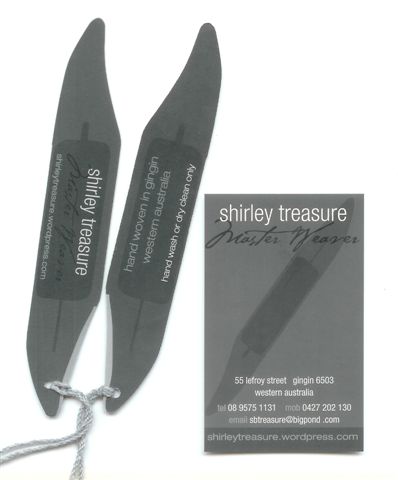
The subject of business cards/swing tags has been on my mind again, not because I'm thinking about marketing, but I've been in the process of shifting pieces among the three galleries in Nelson, and withdrawing some pieces. I was fed up looking at my tags. I love the idea of having a home-made feel to the tags, but fading home-printer-printed tags are not a good look at all.
 Shirley Treasure of Australia sent me a picture of her tags; she wrote: "I have scanned both back & front of my swing tags & my matching business card. They are much fancier and glossy in the flesh but you can get the idea."
I love her tags, and played around with the idea of making my stuff a bit fancier, too, I think I'm keeping it simple and sticking to my old yellow logo and Monotype Corsiva, and get a local printer to produce them. Among other things, I'm not looking to rebrand, but just to make myself look less tacky. I like what I set up years ago, even though it was intended as a temporary solution at the time. You could say it's grown on me, and I've come to identify the logo/tags as representation of myself. The home-made feel will come from my handwriting the name of the piece, the story behind it, and the fiber contents, on each tag. At least that's the plan for now.
Otherwise, I worked in the garden, slowly, but conscientiously.
After Auckland, I worked hard to weave textured white swatches to experiment with in the upcoming Yoshiko Wada workshop. I had prepared a familiar warp of 110/2 wool, the yarn I've used many time including a 24 meter warp from the same cones on my big loom. For some reason, the warp kept breaking, sometimes three and four at once in a narrow 144 end warp. At once point I even unwound and rewound the warp, but it didn't improve the situation.
The wool felt nice in chain, while winding, and even on the loom. The only explanation I could reach was it spent a few years on the cone on my shelf, and during that time it "aged", making it susceptible to breakage when lifted on the big loom. It appeared ends on Shafts 15 and 16 broke most often. I had prepared three white warp chains, intending to use different textures, fiber contents, and sizes in the weft in about a dozen different drafts, but one day I felt so fed up I took the warp off the loom and decided all three can go into the compost heap.
Another day, I tried to sort the material I would bring to the Wada workshop; this preparation took me a whole day, as the list included quite a disparate lot of stuff. I made up a few smallish skeins of yarns to dip as well. The actual preparation, of stuffing things into bags and boxes, seemed to calm my underlying anxiety about this workshop. I still didn't want to stitch boro, but I was prepared to do anything the workshop brought on.
The week before the workshop, I had a small "heart attack" incident; "incident" because it turned out to be not a heart attack, but a dynamite case of upset stomach. I woke up in the middle of the night with loud palpitations and pressure on my chest, and I regretted not having gone to see my doctor in June when I had a similar experience. After a couple of hours at the clinic, I was "discharged" and prescribed Gaviscon. Still, it must have been a pretty upset upset stomach because it took 48 hours for Gaviscon to work.
The next day, Esmae Emerson of Melbourne came to visit; (her mum lives half an hour away from here.) It was the first time we met, and my house was a mess (as usual) with weaving and design stuff strewn all over, but we had a lovely, lovely time talking about weaving, designs, yarns, and the acceptance of weaving as "art". She brought me a lovely bouquet of yellow and orange spring flowers, among them were two fancy Dianthus filling my room with sweet smells.
The subject of business cards/swing tags has been on my mind again, not because I'm thinking about marketing, but I've been in the process of shifting pieces among the three galleries in Nelson, and withdrawing some pieces. I was fed up looking at my tags. I love the idea of having a home-made feel to the tags, but fading home-printer-printed tags are not a good look at all.
 Shirley Treasure of Australia sent me a picture of her tags; she wrote: "I have scanned both back & front of my swing tags & my matching business card. They are much fancier and glossy in the flesh but you can get the idea."
I love her tags, and played around with the idea of making my stuff a bit fancier, too, I think I'm keeping it simple and sticking to my old yellow logo and Monotype Corsiva, and get a local printer to produce them. Among other things, I'm not looking to rebrand, but just to make myself look less tacky. I like what I set up years ago, even though it was intended as a temporary solution at the time. You could say it's grown on me, and I've come to identify the logo/tags as representation of myself. The home-made feel will come from my handwriting the name of the piece, the story behind it, and the fiber contents, on each tag. At least that's the plan for now.
Otherwise, I worked in the garden, slowly, but conscientiously.
Sweet & Sour September, Part 2: Auckland Part 2
Finn and I talked quite a bit about the paisley motif, and how Japan is a tiny island nation at the end of Silk Road.
The next morning, I wanted to see something more of paisley, and may read its history. I went to the Special Collections section of the Auckland Library where staff member Kate remembered me from two years ago. This time she brought out the 1856 edition of Owen Jones's "The Grammar of Ornament", a huge tome, with individually printed color plates. I think the book is typical of its time, the author expressing strong subjective opinions; he reveres Greek; doesn't have respect for the Rome. He also focused on what I call the "oak leaf" motif but couldn't find any reference to paisley, but nevertheless sat with the book for six and a half hours reading the development of the leaf motif from Egypt to Renaissance, when I realized the library was closing in an hour and I whipped though the rest of the volume taking pictures.
Again, I can't post my photos because of an agreement I signed with the Library, but here are some images from the book; Kate told me an edition of this book came out "recently" and I bought it from England after I came home; this edition is tiny, and the details in the pictures almost not-discernible, but I am going to enjoy reading the outrageous texts.
Once again I did the bookshop rounds; I couldn't believe the spectacular sale prices at the art book specialist, Parsons, including relatively newly published New Zealand books. I was drooling, but I knew I had quite a few recent acquisitions waiting for me at home, so for the first time in several trips, I came walked away from the shop, after a couple of hours of oohing and ahhhing.
The last day in Auckland, Wednesday, Ben and I took a short cruise on a yacht in Auckland Harbor.
New Zealand is supposed to be a great sailing nation; most of our friends are artists and don't have boats, and those who do have never invited us, so after 16 years we bit the bullet and took a cruisey touristy cruise, (as opposed to the hard-working America's Cup cruise,) for experience. It was rainy, gray and not pretty, but the water was calm and we had great fun.
 After the cruise, we picked up our luggage and got on the shuttle to the airport; it was the most dangerous car ride in the longest time, driven by the most reckless and clueless driver we've ever had in New Zealand, dropping people off in the wrong order at the wrong parts of the airport. He spoke with a thick Dutch accent, and most of us were quite unsure of what he was saying. We were cutting it the closest, but luckily our flight was delayed, so we made it on time. An interesting end to an otherwise lovely trip.
The next morning, I wanted to see something more of paisley, and may read its history. I went to the Special Collections section of the Auckland Library where staff member Kate remembered me from two years ago. This time she brought out the 1856 edition of Owen Jones's "The Grammar of Ornament", a huge tome, with individually printed color plates. I think the book is typical of its time, the author expressing strong subjective opinions; he reveres Greek; doesn't have respect for the Rome. He also focused on what I call the "oak leaf" motif but couldn't find any reference to paisley, but nevertheless sat with the book for six and a half hours reading the development of the leaf motif from Egypt to Renaissance, when I realized the library was closing in an hour and I whipped though the rest of the volume taking pictures.
Again, I can't post my photos because of an agreement I signed with the Library, but here are some images from the book; Kate told me an edition of this book came out "recently" and I bought it from England after I came home; this edition is tiny, and the details in the pictures almost not-discernible, but I am going to enjoy reading the outrageous texts.
Once again I did the bookshop rounds; I couldn't believe the spectacular sale prices at the art book specialist, Parsons, including relatively newly published New Zealand books. I was drooling, but I knew I had quite a few recent acquisitions waiting for me at home, so for the first time in several trips, I came walked away from the shop, after a couple of hours of oohing and ahhhing.
The last day in Auckland, Wednesday, Ben and I took a short cruise on a yacht in Auckland Harbor.
New Zealand is supposed to be a great sailing nation; most of our friends are artists and don't have boats, and those who do have never invited us, so after 16 years we bit the bullet and took a cruisey touristy cruise, (as opposed to the hard-working America's Cup cruise,) for experience. It was rainy, gray and not pretty, but the water was calm and we had great fun.
 After the cruise, we picked up our luggage and got on the shuttle to the airport; it was the most dangerous car ride in the longest time, driven by the most reckless and clueless driver we've ever had in New Zealand, dropping people off in the wrong order at the wrong parts of the airport. He spoke with a thick Dutch accent, and most of us were quite unsure of what he was saying. We were cutting it the closest, but luckily our flight was delayed, so we made it on time. An interesting end to an otherwise lovely trip.
Sweet & Sour September, Part 1: Auckland Part 1
Yikes, it's been October for over nine hours here.
We were in Auckland at the end of August and early September, from Sunday afternoon to Wednesday evening; we go to Auckland almost every other year when Ben has a 3-day seminar, (a Microsoft geek fest); some years I gaze at artworks, some years I stay in the room and design, and other years I go to the zoo and wait for the hippos to surface. Every trip, I do my rounds of my favorite bookshops.
Sunday afternoon we spent walking up and down Queen Street and ending up at a Korean Barbecue restaurant, an Auckland treat because there are none in Nelson. On Monday I took a harbor cruise in high winds, just because I walked past a sign that said, "Next cruise, 12 O'clock". It turns out the same sign is there every day, but the wind was pretty rough and we had to contend with viewing, not docking at, one of the smaller islands. Thrilling! Afterwards I wanted to get on another smaller commuter ferry, but the timing was wrong, so I did the bookshop rounds and came away with a small damage.
I also went to the Auckland Art Gallery and saw, among others, saw "Local Revolutionaries: Art & Change 1965 – 1986"; many of the work here felt strangely modern and yet familiar. Contrasting that to my reaction to The Walter Prize 2010 exhibition, (Barf!) I contemplated if up to about 1986 is as far as I can tolerate "modernity" in art. To be honest, I felt dirty coming out of the Walter Prize room. So much of "edgy" art seem to me to expose the underside of the society, as did Caravaggio, but in the far more insignificant, dirty and private/personal arena, and my immediate reaction was to blame the "everybody can be a celeb and deserve their time in the spotlight" mood of reality TV.
Tuesday afternoon, I had an appointment with a staff at Auckland Museum. I had been in communication with a couple of them, and expected to be shown some textiles for about an hour and then let go to roam around the rest of the museum for the remainder of the afternoon. Wrong! A very art-school-ly chap named Finn McCahon-Jones showed me boxes and boxes of textiles, (I had requested "Muslim" textiles, plus some Italian and Indian pieces,) mostly embellished work, but two just-woven pieces, too. They were in different kinds of conditions as all/most of these items had been bequeathed, some after considerable amateur maintenance/damage. I didn't take notes, but loads of photos; because of the museum rules, I can't post them, but here are some pics Finn provided.


Until closing time, Finn and I talked about his knowledge of other art forms, (he knows a lot about ceramics, but because of his work, he has taken lace-making, embroidery and other textile-related workshops,) Japan, Korea, Silk Road, manga/anime, Ponsonby, (a now-posh suburb of Auckland), paisley, and Kohana Reo.
We were in Auckland at the end of August and early September, from Sunday afternoon to Wednesday evening; we go to Auckland almost every other year when Ben has a 3-day seminar, (a Microsoft geek fest); some years I gaze at artworks, some years I stay in the room and design, and other years I go to the zoo and wait for the hippos to surface. Every trip, I do my rounds of my favorite bookshops.
Sunday afternoon we spent walking up and down Queen Street and ending up at a Korean Barbecue restaurant, an Auckland treat because there are none in Nelson. On Monday I took a harbor cruise in high winds, just because I walked past a sign that said, "Next cruise, 12 O'clock". It turns out the same sign is there every day, but the wind was pretty rough and we had to contend with viewing, not docking at, one of the smaller islands. Thrilling! Afterwards I wanted to get on another smaller commuter ferry, but the timing was wrong, so I did the bookshop rounds and came away with a small damage.
I also went to the Auckland Art Gallery and saw, among others, saw "Local Revolutionaries: Art & Change 1965 – 1986"; many of the work here felt strangely modern and yet familiar. Contrasting that to my reaction to The Walter Prize 2010 exhibition, (Barf!) I contemplated if up to about 1986 is as far as I can tolerate "modernity" in art. To be honest, I felt dirty coming out of the Walter Prize room. So much of "edgy" art seem to me to expose the underside of the society, as did Caravaggio, but in the far more insignificant, dirty and private/personal arena, and my immediate reaction was to blame the "everybody can be a celeb and deserve their time in the spotlight" mood of reality TV.
Tuesday afternoon, I had an appointment with a staff at Auckland Museum. I had been in communication with a couple of them, and expected to be shown some textiles for about an hour and then let go to roam around the rest of the museum for the remainder of the afternoon. Wrong! A very art-school-ly chap named Finn McCahon-Jones showed me boxes and boxes of textiles, (I had requested "Muslim" textiles, plus some Italian and Indian pieces,) mostly embellished work, but two just-woven pieces, too. They were in different kinds of conditions as all/most of these items had been bequeathed, some after considerable amateur maintenance/damage. I didn't take notes, but loads of photos; because of the museum rules, I can't post them, but here are some pics Finn provided.


Cap, skull (dopa), [Chinese Turkistan], date unknown (pre 1938)
Gift of Mr H I Harding, collection of Auckland War Memorial Museum: Tamaki Paenga Hira, 24291, 1938.229
 Shoes, pair, Asia, Date unknown
Child's, silver embroidered with upturned pointed toes. hand stitched leather soles
Collection of Auckland war Memorial Museum : Tamaki Paenga Hira, 1995X1.397
There were household silver polish stuck in between the silver threads on these shoes.
 Ceremonial Outfit, Ankh Tribal Group, Northern Thailand
Purchased, 1990, collection of Auckland War Memorial Museum : Tamaki Paenga Hira, 1990.253
Gift of Mr H I Harding, collection of Auckland War Memorial Museum: Tamaki Paenga Hira, 24291, 1938.229
 Shoes, pair, Asia, Date unknown
Child's, silver embroidered with upturned pointed toes. hand stitched leather soles
Collection of Auckland war Memorial Museum : Tamaki Paenga Hira, 1995X1.397
There were household silver polish stuck in between the silver threads on these shoes.
When the museum had an open day some time ago, a staff spotted a woman in full regalia approaching slowly over the grassy hill. The staff ran outside and offered to purchase the entire costume on the spot, and the woman obliged. This made me think a lot about textiles; it was a victory of sorts for the museum, not only to acquire an entire outfit, but to receive all the knowledge that comes with it from the woman; it will be a great asset and would help future students and researchers. On the other hand, the outift may never be worn by a human again, and the woman's daughters and granddaughters will not inherit it. And I had mixed feelings about the fate of this outfit. And the mission of museums in general.
 Ceremonial Outfit, Ankh Tribal Group, Northern Thailand
Purchased, 1990, collection of Auckland War Memorial Museum : Tamaki Paenga Hira, 1990.253
Until closing time, Finn and I talked about his knowledge of other art forms, (he knows a lot about ceramics, but because of his work, he has taken lace-making, embroidery and other textile-related workshops,) Japan, Korea, Silk Road, manga/anime, Ponsonby, (a now-posh suburb of Auckland), paisley, and Kohana Reo.
Subscribe to:
Posts (Atom)