2006/09/28

Breaking the Monotone Barrier

Next week, I'm going to a five-day weaving workshop by Randall Darwall, in Paraparaumu, just north of Wellington. It's going to be a highlight of my weaving life.

Randall Darwall is easily one of the most respected and sought-after weavers of our time, and since he doesn't write books, the quickest way to learn his style is to attend his workshops. So I signed up for this one way back in February. In May or June we received instructions on what to bring to the workshop, and I've been stuck ever since.

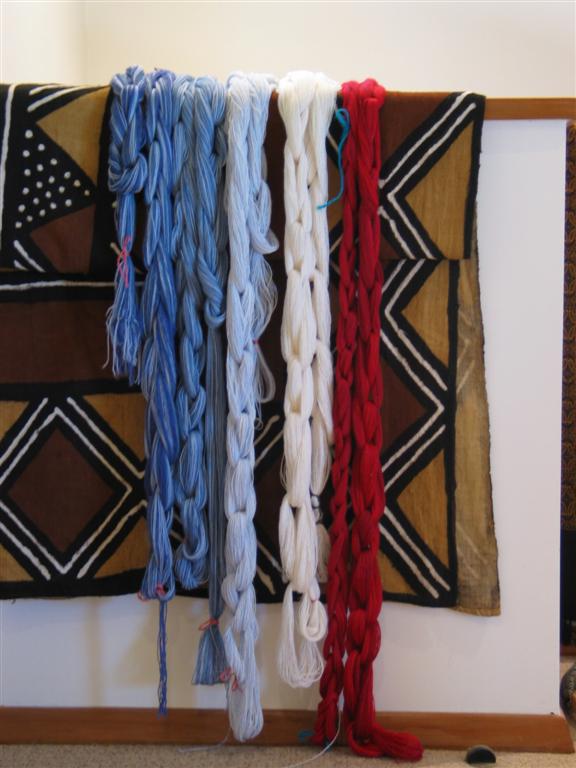
Randall Darwall's view on color is "more is better." His motto: "Why use five colors when fifty will do nicely." He wants us to prepare a warp using dynamic proportions of colors, where we select a base color, and then add smaller and smaller amounts of different colors. I have no problems with the way he does it; have a look at his site, his works shimmer and dance and laugh and seduce. But have you seen mine?

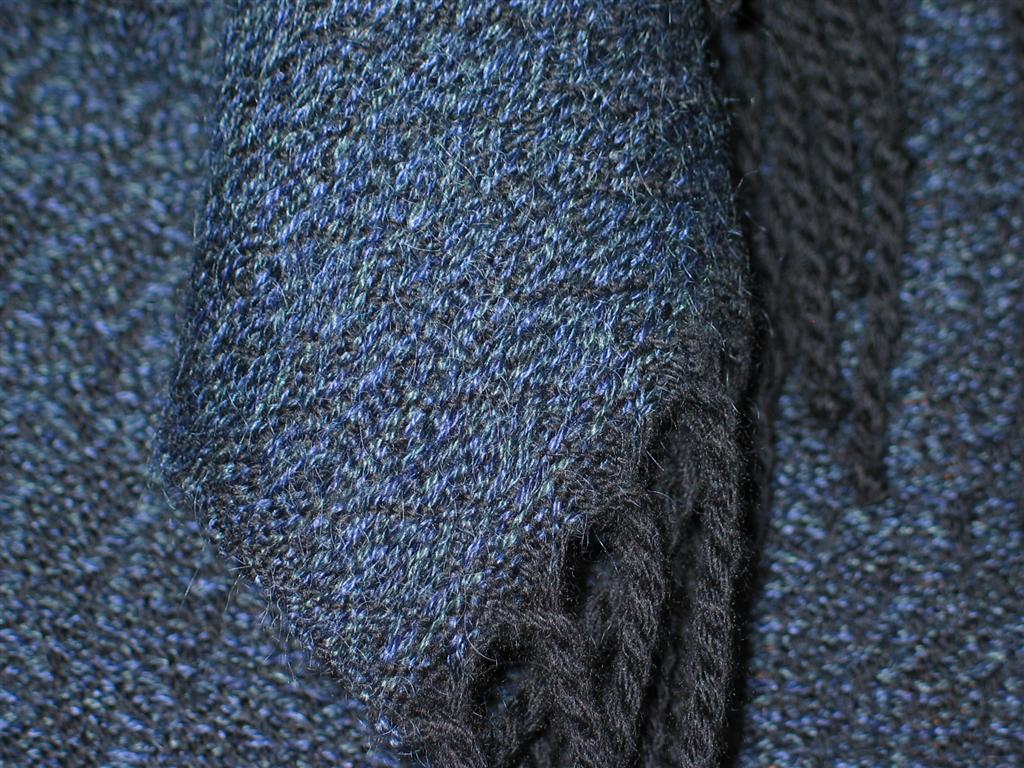
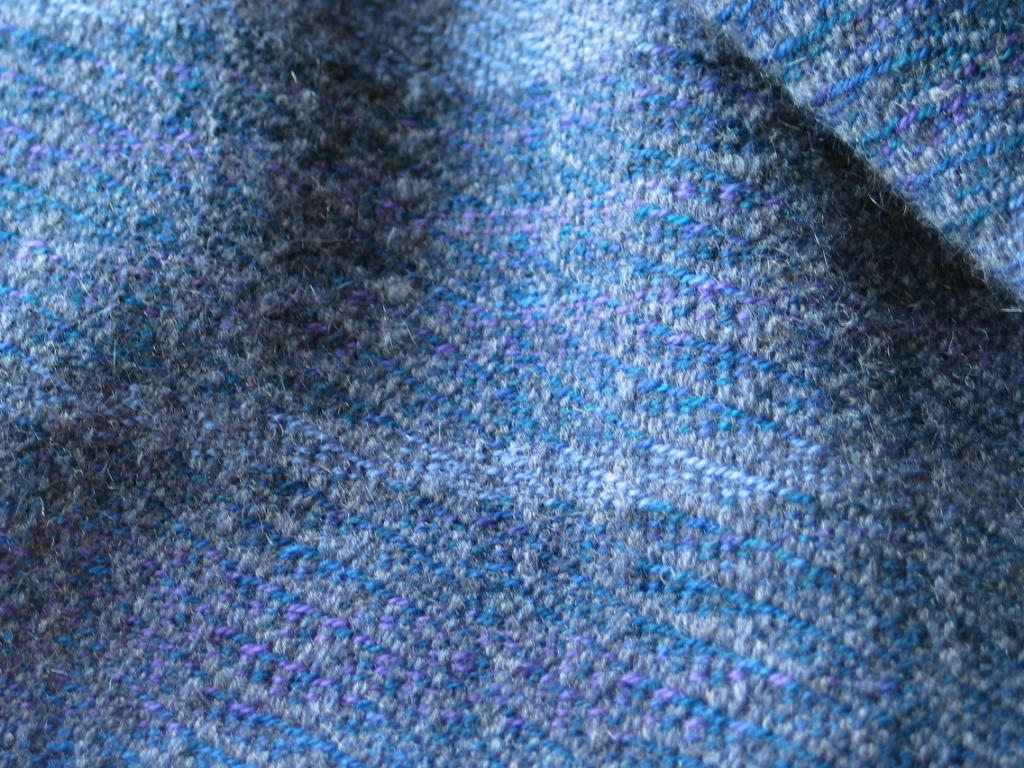
I love to weave textiles with subtle color or textual nuances, but on the whole, look monotone. I don't often mix hues too far apart on the color wheel. In fact, most of the yarns I own are on the blue half of the wheel: blue, navy, purple and red, plus black and white and natural.

Liking colorful textile is one thing, but trying to create colorful textile (that is, mix and match hues) is another, and I'm having to take a sledgehammer to an old mental barrier.

I've only three more days to prepare, and am still at a loss as to what I'm going to do, but at least I decided on a simple twill threading today, so I've two and a half days to think about the colors.

Yikes.

2006/09/24

Appreciating Art

I've been a bit under the weather (nothing serious; you can find out about it here and here) and preoccupied with a renewed interest in photography (and blogging here and here), because photography is a hobby Ben and I enjoy together. But I haven't stopped thinking about weaving and art in general. And one thing I noticed is I've come to appreciate art in a different way.

In the last month or so, I've been photographing and sketching a series of works by local sculptor Tim Wraight. Originally, I needed a few nice shots of good-looking pillars to show as public art for the photo blog, but the more I see these pillars and try to do them justice, the deeper I've become involved with them. I still can't photograph them to show how truly beautiful they are, but I'll share some with you soon. Woodwork is in some ways easy for me to understand because I know some of the processes and tools, and looking at these pillars, I can imagine Tim chipping away patiently and deliberately bit by bit by bit. I can feel his quiet passion while he touched the pieces of wood and breathed life into them. And I have never experienced art in this way before.

I also went to see jeweler Ian Longley to order Ben's Christmas present, and had a chance to chat with him about rocks and stones, and he shared with me a little of his creative process. The lasting impression I took home, though, was the way caressed his raw material in the same way I hold my yarns. And I kept pondering about the metamorphosis of those rocks to his jewelry and these yarns to my shawls.

As I mature as a weaver, it has become easier for me to understand the processes and efforts of other artists, and knowing these makes their finished work more meaningful and precious. I've come to appreciate art with my entire body and soul, which is a far more genuine appreciation than mere liking, or reading about their work.

And then I went to see my friend Errol Shaw's modern painting exhibit. I love this man to bits, but I have difficulties with modern art. He tried to explain to me at great length how to 'look' at modern art, but I got nowhere. This story is for yet another time entirely.

2006/08/14

Copyrights in Art: Meandering

Last week, I had a very uncomfortable experience concerning copyrights. Here is how it went.

As a resident of Nelson, I would like other Nelsonians to know about the stained glass window and the mural, and be proud we all 'own' them, and frankly, I don't think the artists would mind that. I would like prospective visitors to know about them and be interested in visiting the museum. (The museum has a fantastic collection of old photographs, by the way, some of which you can order.) I would like as many people around the world as I can reach to see them on-line, and other parts of Nelson, and share in the appreciation/admiration of the place I live. But then, there's copyrights.

When we submit pieces to exhibits and competitions, we are asked if it is an 'original' work, and the definition of originality seems to depend on the organization hosting the exhibit or competition.

I can't possibly reinvent 2/2 twill, but that's one of the structures I love to use. I decide the size of the piece, select the size and composition of the yarns, pick the colors, set the sett, and weave, and in my case, the elbow grease is all mine. (Except winding the warp onto the loom; that's my blood, sweat and tears, mixed with Ben's patience/exasperation depending on the day.) In weaving, there are weave structures supposedly in the 'public domain' but there is no Bible or Koran listing which ones are which.

A few years ago, mohair boucle and rayon chenille were all the rage; these yarns, especially the mohair, don't render easily to complicated weaves, so we all wove similar looking stuff, showing our true colors, as it were, in the color selection.

If you see a breathtaking example in a weaving magazine or a book, how much modification do I have to make to make it an 'original'; are you allowed to submit a work inspired by another weaver's work, before or after reading the instructions; is it inspiration or imitation? How about taking a magnifying glass to the pages of other glossy magazines; accomplished weavers can decipher weaves and guess materials rather accurately.

Michelangelo did not invent frescoes, and didn't even paint parts of the Sistine Chapel; he selected his apprentices on the basis of their knowledge of frescoing, because he was busy sculpting for a while prior to the commission. He probably selected the subjects and designed by sections; he or an apprentice then traced the designs onto the ceiling, and the apprentices filled them in.

Tapestry work, if documented, is normally linked with the artist who drew the design, or the cartoon, and seldom is the tapestry weaver mentioned, unless it is a modern work and was deigned by the weaver. Likewise with sculpture; how many blurbs have you read where those who executed the work is named? Likewise, I recently learned, with prints: the original design is drawn by the artist, but the plates can be made by, and the prints are often printed by, experts.

Come to think of it, I have a personal experience with this; the copyrights of the photographs Daniel took of my work, I've been told, belongs to Daniel.

Meandering down this path shall continue.
2006/08/06

Making of an Exhibit - Part 1: Reconnaissance

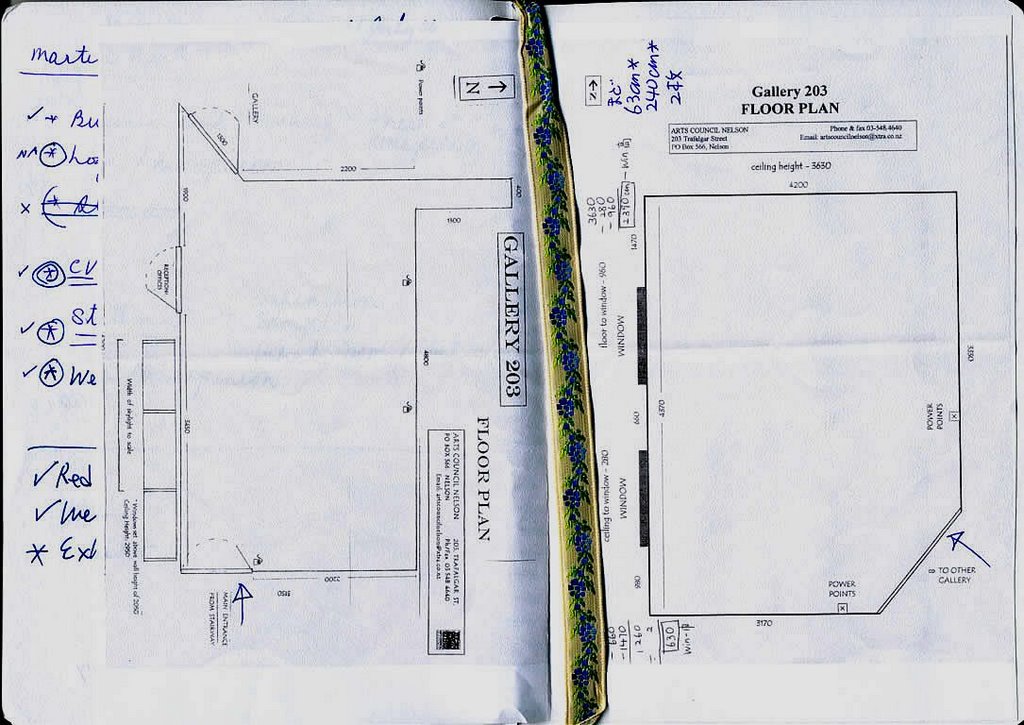
Now, I am a rank amateur at this, and I don't know where to begin, so I've been pestering Mr H at Gallery 203 for weeks on end, and when you are in that frame of mind, you see him all over town; as he leaves the building for a meeting... when he is just walking down the street... when he is with his family... (Honestly, I haven't started stalking you, yet, Mr H.)

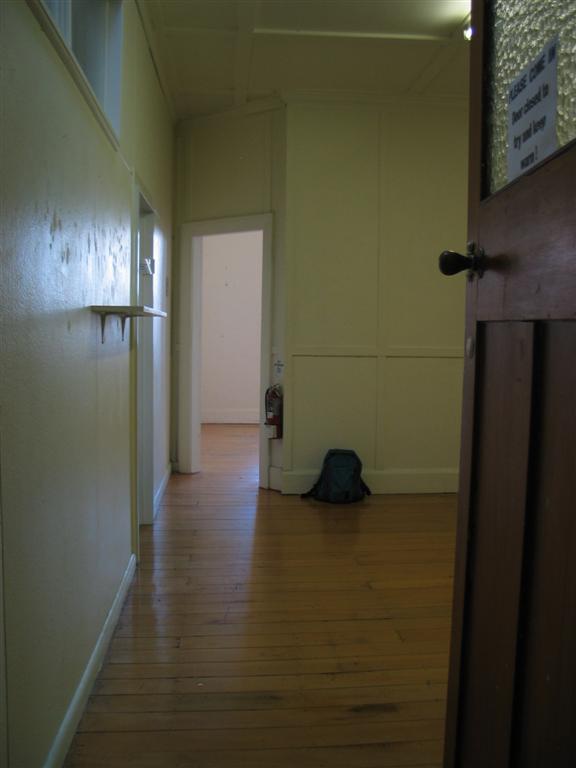
He gave me the exact dimensions of the two rooms, but I also needed to be able to 'see' the space whenever I wanted, and 'know' it intimately, so he let me photograph the empty gallery between exhibits. The closest I can describe these needs is possibly that of a rally driver inspecting the route and practice-driving (do rally drivers 'practice'?) before the day of the race. I can't imagine anybody driving those treacherous roads at 160kph for the first time on race day, just because a good mate is shouting "left, right, curve" in your ear; I can't imagine driving that fast in any case.
The view of the space as you enter, and the 3630mm (12ft) ceiling from which I would love to hang stuff.

2006/08/05

Pinch Me!


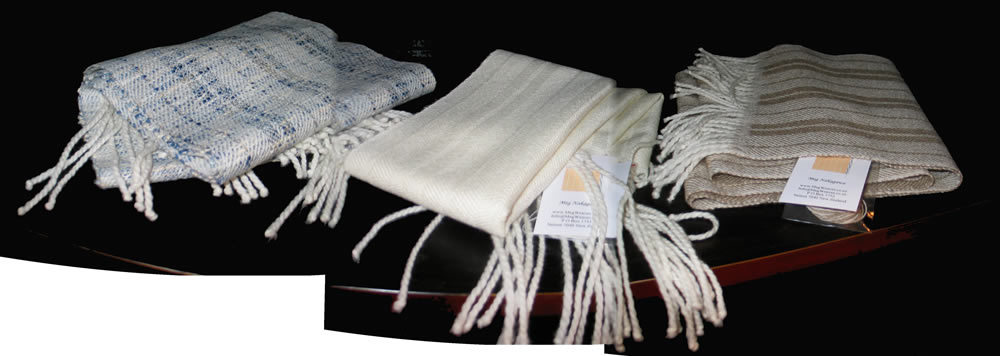
I didn't have the nerve to go in and see for myself, so I asked Ben to go while I was at the gym. It was a little dark in the Gallery, so the second picture is particularly blurry, but, says my dearest, "Your stuff looked better in the dark."

A staff told Ben a man tried the white and natural striped possum scarf, but worried about loosing it and decided not to buy it. Dear Sir, I say, if you loose it, come back and get another one!

*****

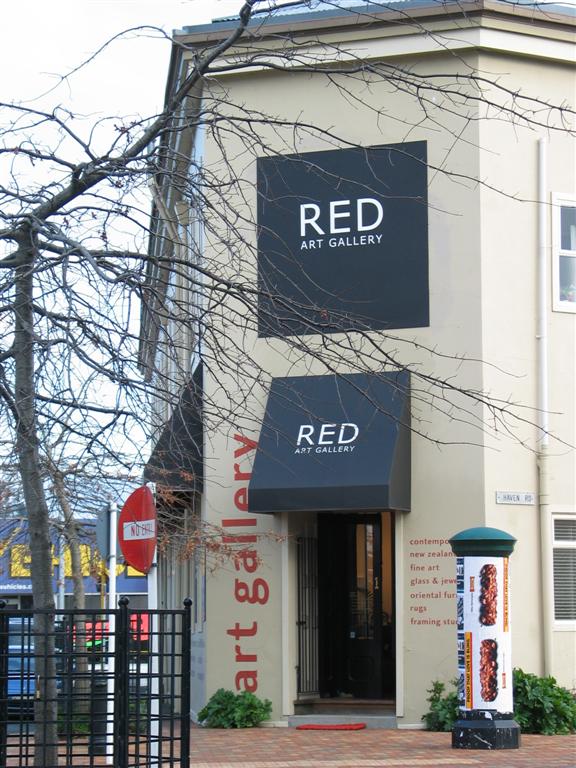
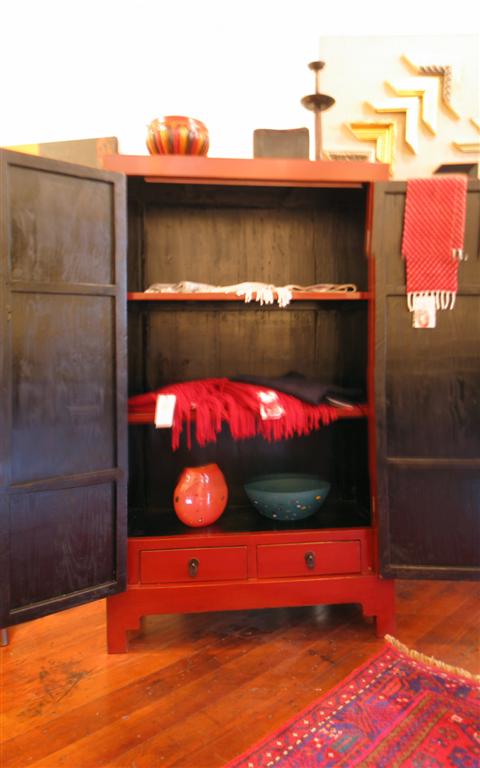
My work is now available at the Red Art Gallery.

2006/07/30

When Reading can be Bad for You

I felt terrible after the last post about the amount of time I spend TV gazing, so I thought I'd try to catch up on the Listener; this is a weekly NZ magazine that started out as a radio program guide some 75 years ago; now it covers just about anything under the Kiwi sun and beyond, and is the only magazine whose subscription we have not let lapse for over 10 years. (Yip, that includes Fiberarts and Handwoven...)

First off, it doesn't pay to pile up and then catch up on weekly magazines. With the world changing as rapidly as it does, even news from a week ago is history; when you pile them up for five months, even the recipes are out of season. And I don't want to know about movies I missed, or never came to Nelson.

Secondly, I get a bit sad when I read book reviews. It was only about two years ago that I realized I would most probably never read all the books that interest me, or ones I should read to remain a well-informed member of the global society. This was about the same time I hit a nine-month spell of picking up bad fiction. Uggh.

But most importantly, for me, for now, I sunk further into the Word World after an evening of semi-serious reading, and woke up this morning almost sea sick from the swirls of words. So for me, for now, maybe TV gazing, or magazine gazing without reading, is not such a bad thing.

*****

I still remain a hopeless book buyer, however, and today, I picked up 'A Perfect Red: Empire, Espionage and the Quest for the Colour of Desire' by Amy Bulter Greenfield from Black Swan, a division of Random House. My favorite bookstore in Nelson, Page and Blackmore, has a little bit more info about it, and Amazon says the title is the same in the US except for Colour/Color. Perhaps of interest to some?

2006/07/29

What I Learned about How I Work from a Reality TV Show about American Motorcycle Builders

When I was choosing my domain name, I had a few I liked. TheHermitWeaver.co.nz was one, because I liked the idea of me living outside the busy world and weaving (instead of meditating) in relative silence in my cave-like studio, (relative because looms can be noisy, and I often listen to music or books-on-tapes CDs,) and finding enlightenment. TheWeepingCherryStudio.co.nz was another, after the lovely tree in the middle of our overgrown garden; it was the first tree we bought when we moved into our house, and regardless of its surrounds, it blooms cheerfully every spring, and some years also in the autumn, though the branches don't weep but grow upwards in all directions.

SloWeaver.co.nz was hard to drop, because I am a slow weaver, plus I am a Slow Food sympathizer. To improve my weaving, at one point I deliberately slowed down my pace at every stage to make sure I was putting in the highest quality I possibly could into my work. In the end, I chose MegWeaves.co.nz to remind myself what I am supposed to be doing every day; to motivate myself to weave conscientiously, consistently and constantly.

The slowness of my weaving frustrates me at times, and my laziness irritates me. Working with a right arm prone to pain hasn't helped, but at the best of times, it takes a while from inception of an idea, to refinement, to selection of colors and material, to sampling, to the actual weaving, and the finish. The inception to refinement is particularly slow. I am new to this kind of creative process, and I don't understand how mine works.

It took a very unlikely event, one of Ben's TV shows, to help me understand a little. I usually have my ear plugs in during this show and read, while Ben ooohs and aaahs, and I honestly can't remember what made me watched it last Thursday. It's called American Chopper, and it's a reality TV of an Orange Country father-and-two (?)-sons team who build custom-made motorcycles. Simply put, the father is portrayed as the bossy dad/mechanic, and the eldest son as the temperamental artist with an amazing ability to transform vision into a bike. In this episode, the father complained that the son stood around doing nothing and wasted valuable time, whilst the son rebutted he was deigning, and in fact, he was trying out ideas (in this case different lines adorning the fuel tank), stepping back to see if they worked, and refining the lines.

The way the father sees his son is how I usually see myself as a worker. I pace too much, gaze at nothing for far too long, and waste an awfully lot of time. But on Thursday I understood and sympathized with the son. I realized sometimes when I think I'm being lazy, in fact, I am still designing, albeit unconsciously. And I should allow enough gestation/meditation so I understand the design better and come up with the most satisfying design.

At least that's the story this week and I'm sticking to it.

*****

Now, I challenge you to use the words 'adorn' and 'fuel tank' in one sentence.

2006/07/22

A World Without Words

Sorry, it's been a while. I have two reasons; I pondered this one train of thought for over six weeks, but the harder I tried, the more tedious and uninteresting it became, so I needed to give it a rest; the other reason is, I have been weaving. And I noticed when I am in full weaver mode, as I have been, it is jolly tiresome to try to think with words.

I count and count and recount warps; measure warps; thread them through heddles and reeds; fringe the woven shawl; wash; press; and photograph. I have images rush through my head, and I capture them on whatever piece of paper at hand, with color blotches (crayons, pencils, pastels, whatever is the quickest), yarn samples, lines/squiggles (I can't draw), and a few words (most of which read like gibberish after a few weeks). And I spend days seeing yarns, textiles, images and colors, immersed in a world without words, where translating thoughts into words is disruptive, and the lovely images fly away while I'm looking for the right word.

This has been an unlikely transition for me. Since around age seven, I've wanted to be a writer, a poet, then a linguist, so I've had an amicable relationship with words, and believed congition was possible only through words. Then I became fascinated with Philosophy and the first dead man I read was Descartes, so I've been examining my life ever since. I have to plan, analyze, evaluate, summarize and review elements of my life meticulously, in words, before I can move on. I talk to myself often, but it's not as much talking TO myself as it is talking BY myself, tidying up my thoughts, and rehearsing in case someone asks me what I think.

When I decided to become a weaver, I needed to think differently, and I came to realize I needed to shut out the constant flow of words in my head. It took me a good part of five years to train myself, and up to now, this has been the hardest thing about learning to weave, and it's still on-going.

I love to weave and I love to write. I now know I can shut out words from my head, but it took a while to come back to the Word World, and now I'm afraid I'm stuck here before I can return to colorful side. Wish me luck.

And what do you know, this relates to THAT other train of thought.

2006/06/22

This Moment in My Life

This morning, on our way into town, the sky looked like the first page from a sketchbook belonging to someone taking Introduction to Drawing; narrow bands of grays getting progressively darker until almost black; the bands in nearly uniform width and length, and nearly straight, but in places, not so; the blending/smudging done well in places, but in others, the pencil marks still distinct. I wished I had a camera, but we didn't have time to fetch it because I was on my way to see Jay, the owner of the aforementioned Red Art Gallery.

I had hoped to chronicle such a momentous event as this in a way these momentous events are recorded in artists' biographies, but this happened organically, and I don't remember the details. Jay and I started to talk about weaving, textile and dye in the last few months I've been loitering in her gallery on my way to or from my physiotherapist. She must have wondered about this woman who claimed to weave, but was in her gallery almost every day, right arm cradled in a slightly serious-looking splint. I, on my part, was only trying to see as many beautiful things as possible so I can use the inspirations when I finally resumed serious weaving.

One day in early June she suggested I showed her my work. So I did, this morning. And she offered to have some of my work at the Red.

I cannot contain my excitement. Some of my limbs have been shaking all morning. In terms of my weaving, I feel my effort of the last six years have paid off. As a child, I was taught it is not polite to ask for too much or too good, so I seldom pursued my first choices in life, selecting, rather, to feel benevolent/smug about settling for second choices. As regards the Red, though, I am glad I doggedly stuck to my first choice. At the same time, I didn't have to work very hard to convince Jay, and I feel extremely lucky.

I'm home now, looking west to Takaka Hills from my window. The air is clear, the colors vivid but flat and almost unreal. I couldn't imagine a better picture to express how I am feeling at this very moment.

Serendipity, fate, coincidence - call it what you will; the red shawl seen in my very first, April 30, post, in which the Red Art Gallery was mentioned, was one of the pieces selected. I posted that photograph because it is the closest to red (the piece in real life is very red, not pink). Ben insists I take and post more photographs of work not in blue, as he reckons I have too much blue on the blog and the web site and they need sprucing up!!

2006/06/15

Humor vs. Glamour

I think I am a person with a sense of humor. I believe laughter is not only the best medicine, but probably the cheapest elixir.

What I weave, on the other hand, I would like described with words like "delicate", "elegant", "exquisite", "excellent", "feminine", and "glamorous".

Here is the problem: these adjectives and the concepts they signify are so foreign to who I am and the way I have lived my life before I became a weaver, that I needed to develop a whole new side of me, and sometimes I feel quite duplicitous.

I can't stop laughing re-reading the second paragraph; I'm not sure if I am embarrassed or feeling silly. And yet, you know, I take my weaving very seriously. Help!