2015/09/28

88

I've been gardening a lot, cooking a bit, reading while recuperating, and not weaving much. If I have a dressed floor loom I could weave in spurts, but since it's only the two table looms ready for me, I find it harder to sit down quietly after a morning, or longer, in the garden. But this is the very reason I haven't dressed the floor looms; I prefer to weave on them and I have projects I can only work on the table looms I want to get through.

Daylight savings started last weekend so that should alter my body clock slightly. Strange thing is, the week leading to the switch over, I kept waking up around six o'clock, extraordinarily early for me. Maybe working outside a lot has put my body more in sync with the changes of the season. It's still cold in the mornings, unusually for this time of year, but the direction and the brightness of the sun is decidedly spring, even summer, and hay fever is in full bloom. On the North Island and sunnier gardens around the country, flowers are in bloom. Chez moi, seeds are sprouting, seedlings are going into the ground.
I can show you the cherry tree now; it's about 65% in flower. (Japanese start calling out at about 30% and follow how far a certain famous cherry tree or park or mountain is in flower. It's covered in the nightly news there.) And just as in Japan, the spring wind blows and rain comes down just as the flowers come out, but it's said that this extremely short season is why we Japanese love cherries.
I mended everything that needed mending and fringed everything that needed fringing, and I have two pieces and two big fabric swatches to wash. This one on Klik didn't look very interesting while I wove, but as it sat not under tension for a while, it started to look better and I am heartened.
Today is my Dad's 88th birthday, a double-lucky number in Japan, and I assume China. In Japanese the 88th birthday is called "beiju", pronounced like "beige" but with a stronger vowel at the end, because 88 in Kanji look like "rice", in this case pronounced /bei/, and "ju" means celebration.

                                 八
                                 十   米
                                 八
                                 88           rice

Dad was really looking forward to turning 88, (he died at 85.5,) and his former students were going to throw a big birthday party. Instead, he got two big and two small memorial gathering in two years; he'd be laughing at how it turned out.

It's strange how I miss him, how I don't remember any of his vulnerabilities, his fragility, and his temper; he had a fierce temper but it now feels as distant as something I read but not experienced. I miss him, but I'm now used to the fact he's not around. I'm not even taken aback when I want to ask him about chemistry, history, geography, politics, politics, and politics but I'm annoyed he's not there to answer me. But I still yell at the telly when politicians are being stupid and elicit Dad to do the same.

2015/09/07

Process and Product

The sun came in through the window while I worked with tapestry technique on Wednesday, and the lovely gray-mix silk weft looked... green! I was so disappointed I stopped right there and then because I didn't want to waste an inch more of it.
So I wove fabric. I used the peach and yellow silks I liked in the tapestry, plus a blue wool. Had I been able to calm down and select a different weft, I could have woven a "proper" piece, but I was worked up about the challenges of tapestry, and the aesthetic possibilities, and wanted to think as I wove. It was a process over product kind of an afternoon. Glad to have done it, glad-er it's done.
Next on the menu is the camel-colored cashmere mix on the Klik; I hope to weave a commission piece, a Thank you gift, and a merchandise. I am extra slow on a table loom, but I'm not compromising on the design. At this stage. Just yet.
On the four-shaft I'm wound a purple-mix merino/mohair. This warp is short, for only one piece. I hope to weave a relatively straight-forward twill
On the big loom I'm putting on the navy version of the mill-end gray I loved so much; I hope to weave two commission pieces and one more. Again, I have no idea about the draft yet but I liked how skinny silk wefts worked with this wool, so I'm thinking along those lines.  
Our efforts in the garden have been slow, but we had a tree guy come and take out three and reduce most of our tall trees by about 2/3. Yup, many are about 1/3 of the previous height or density. Ben loves the view from the living room, office and, above, is from our bed. But me, I liked feeling as if I'm living inside trees, so, not so much. And our windows are dirty. But Ben's wanted trees trimmed for a good couple of years, so it was about time.

We now have space for two native Kowhais which tuis love. We have even been looking at what else can be taken out so we can replace with native-birds- or bee-friendly ones. Garden is certainly a process; I don't know if we'll ever see the end of it. I guess that's OK.

2015/09/01

Looking for More Interest

As in, I want my current piece to be more interesting; as in, I find it boring the way it's progressing.

If you look at the second pic from the last post, the small piece I did in 2013, and the red bag I made from the same warp, you see that I make a lot of these fluid wedgy things when using tapestry techniques. It reminds me of the fog/mist often depicted in Heian-era picture scrolls, e.g. The Tale of Gengi; if you see a "big" picture, not details, of a palace and garden where there are a lot of characters doing lots of things, often the view is from above through thin clouds. Once I knew why this technique was in vogue but I can't remember now. Mist/fog and proper clouds are traditional Japanese motifs often seen in textiles and ceramics. (They look like flames when vertical, but they always show up horizontally on the loom so I think of them as mists.)

I've been gazing at Pat's tapestry book to get some ideas. Of course there are gazillion techniques but for now I can't be bothered reading and learning so I'm just gazing at shapes without clear lines. And I found some wonderful examples of tapestries that are similar to abstract paintings or collage. I wish I could show all three; if you happen to come in close proximity to "The Tapestry Handbook - An Illustrated Manual of Traditional Technique" by Carol K. Russel, they are:

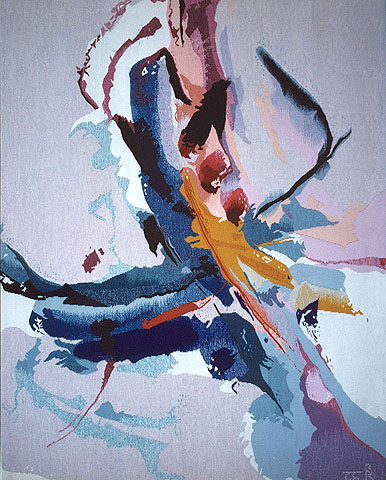
An untitled abstract by Tricia Goldberg and Bonni Boren, 1987, (bottom of page 110). This could almost be a complicated, manipulated ink blots or finger painting in blues oranges, and browns. Very dynamic. (The colors on her website are much bluer than in the book. I wonder which is true.)

"Lyrical Landscape", by Trudi Eldridge, 1989, (bottom of page 57,) is in hot colors, the mood is an abstract, more childlike version of Gaugin's Tahiti. I see a volcano at night, with large horizontal areas of blacks and blue, with yellow and orange bursting.

And "1941-Baggage", by Silvia Ptak, 1987, (page 165) shows the original collage along with the tapestry. This looks more like an interior. Two of the collage pieces are photos but others are ripped pieces of colors, in pale pinks, grays and browns.

I want to make the current piece salable if possible, so I don't intend to get too adventurous, (sticking my fat fingers through alternate 2/60 cotton is too delicate an operation for practice,) but I think I'm going to try new shapes.

I was thinking back to the time I did the first small piece back in Japan. I struggled because I couldn't get the wefts to meet up conveniently and some areas always had more or thicker wefts so I had to do weave extra rows, but in retrospect I enjoyed it. It was nice to play without having to come up with a "finished" product. I know I don't do enough of these fun things, except in excessive sampling. The current piece is beaten not with a tapestry comb but with the reed and the wefts are roughly similar in sizes so the fell has been straight so far. To my jaw-dropping, butt-falling-off-loom-bench surprise.

* * * * *

Umm... Pictures.
Obviously these are just a tiny, tiny bit of the best bits whereas the rest is wilderness. Although the temperatures are still low at times, the direction and the length of sunlight is definitely changing, and weeds and seed know this. Long-term forecast yesterday told us "real" spring is going to be slow in coming, but I'm more than OK with that. Except bugs and pollen are definitely out when I weed now. Today we have severe rain and wind warning again, but it's not so bad.

2015/08/29

You won't Believe What I'm Doing

This is the scarf I made after the wall piece. The weft is a thin, (slightly thicker than 2/60), papery silk from Mom's stash. The yarn had a starched (?) crispness, so pink from the same lot was among the wefts sampled for the wall piece. Washing, however, took away the stiffness and the fine weft all but disappeared, so not so good for a wall piece, but good for a summer scarf. And it's my kind of look, isn't it?

Except weaving this was excruciatingly boring. I had to do something for the last piece, and even though I have a love/hate relationship with the freer tapestry technique, this was the only way I could think of to put a spring in my treadling step mid-warp. Beside, I intended to try this after Kaz's Saori workshop a year ago anyway.
The weft yarns are various silks of unknown origins, some may even be Mom's hand-dyed, hand-spun singles. The draft has a short weft repeat. I gave the sett some serious thoughts, as these wefts are considerably thicker than the two previous projects, but I couldn't be bothered resleying. Below is the right half of the draft.
Four repeats took a better part of an afternoon, and made up 15cm, so this is going to be slow, but I hope gratifying. I had planned to use the same technique in the cashmere-mix warp on KLIK, so this doubles as practice before that particularly delicate warp.

My thoughts thus far is this: it's all right to delve into the spontaneous, see-what-develops way to experiment/play, but for me this is not a good way to make merchandises. I can work better if I have a piece of paper approximately the size of the finished piece, with a line indicating where I'm weaving, so I can place designs more deliberately. Learning that alone has been worth it.

* * * * *

Thursday night while Skyping with Mom, I tried to explain, more to myself, how as my weaving practice becomes more stable/constant, it has also become boring. The immediate reasons are: 1) I haven't deliberately experimented with colors of late; 2) I default to twills almost without thinking; 3) stash-busting is on my mind, and even though I have a vast choice, I'm not used to thinking yarn=>design and don a phantom straitjacket and grit my teeth; and 4) the colors in the last warp was so not me. (The wall piece is hanging on Mom's wall for now; she's going to discuss it with her students when they come back in fall, and then deliver it to the client.)

In order to keep working steadily/productively, I am not reinventing the wheel with every warp and this does contribute to less satisfaction. I don't rush, and goodness I'm still slow, but I sense, (because I can't cite instances,) a greater portion of decisions are made automatically or default to the same as a previous project. This must mean I've some experience/knowledge, which should be a good thing, and theoretically leave me free to concentrate on more interesting bits. But I haven't moved on, so I'm repeatedly taking roller coaster rides but missing out on that queasy feeling in my stomach. Because I really used to feel that when I worked.

My mind keeps wandering back to Geodyne's project a while ago and the impact it had on me, particularly the second pic. Exciting times.

2015/08/28

Hellebore Love

Ben was home for ten days. We had planned to declutter a little, garden a great deal, cook/eat well, and then go away on a road trip. We had cold weather and rain at times but rushed outside every time the sun came out to do little bits. Ben cooked delish meals and cheesecake. At times I got thoroughly sick of gardening so I read. A good deal, as it turned out. But the house and garden is slightly in a better shape. The only thing is, we didn't do the road trip.

The trip, and in fact the timing of Ben's holiday, was planned around my favorite hellebore grower, Clifton Homestead's annual open house weekend. But when I rechecked the map midweek, I was shocked to find they were way down the bottom of South Island, not in the middle just south of Christchurch, as I had misremembered from other years I checked contemplating a road trip. This would add at least another day of driving, and as we haven't been on long road trips in several years, we weren't keen on making a quick trip to where there may even be snow or ice on the road. We haven't driven on those elements since we came to New Zealand; we are so spoiled in Nelson. Maybe next year.

I fell in love with hellebores when I saw my first one about 15 years ago; I think it was a burgundy/pink single orientalis, but I can't be sure because it died, along with a light yellow green, and a greeny white, among others I planted in the shade as instructed. Having learned that in New Zealand, "shade" pertaining to plants mean "don't need 24/7 sun", I moved the few survivors to another part of the garden, just outside the kitchen window, a few years ago, and they have been doing splendidly. Encouraged by the success, I've been adding two, four or six a year thanks to Clifton.

This year, though, in search of darker grays/purples/blues, I started to read about these flowers seriously and bought seeds from Europe. Because I am in the southern hemisphere, seeds from the north are, um, out of whack with our seasons so I don't know how this will work. And then I read Japanese growers have unique flowers, so they are on next year's wishlist. I've also been pollinating regularly. The only one gray/purple I have is pollinated with itself, but other purples and clarets are cross-pollinated with the gray. I'm not going to collect them but let them come up naturally.

Hellebores are a little like weaving; it takes a long time for seeds to show any signs of life, (up to a year?) and then up to a couple of years for a plant to flower. And new hybrids aren't stable, (is that the right word?) so one never knows how the next generation will look if I cross-pollinate.

The slowness of hellebore growing made me come to terms with gardening being on-going. Unless we go the concrete/paving way. I'm not pleased; I wished I could work really hard for a while and be finished for a while, but one of the reasons we came to New Zealand was we wanted a garden all those years ago, in our misguided relative-youth and I don't mind the work. I just wished I didn't have to do so much of it. Oh, dear.
One of two strenii, this is called Clifton. It needs to move to a sunnier spot after the seedpods mature.
I'm also supposed to have purple picottees, (white with purple edges,) but they are not too evident.
From above,  I can't tell the difference between these purples and the gray, but from below the I can see the difference.
The only gray, (sometimes called slate?), which is really very dark purple, and my favorite. From above it's not as saturated purple but more purple gray.
The clarets are much bigger and have two to three dozen flowers on each plant. They self-seed robustly.
Some time ago when I couldn't sleep, I doodled on the software and came up with this drat. I'm calling it Hellebore Love, but now I think it looks more like pansies; never mind, I love them, too.

2015/08/17

Nor Wall Pieces

Because I find it hard impossible to make them square/rectangular/perpendicular/parallel. It drives me mad. Nevertheless, one reaches a point where there's no use rehemming or redoing the casings, and I've reached it this morning. So this is done. And my eyes are dry.
It's not a big piece, but adequate for, as I keep saying, a small Japanese house or apartment.
I like the 3D-ness. The colors are truest in the top photo; this was taken under brilliant sun yesterday.
Also yesterday, I got this shot by chance, half in the sun, half in shade, though not as dark as the thumbnail suggests; silk sparkles in the sun, the 3D-ness is brought to the fore in the shade, so interesting in different lights, which was one of my goals. (This last pic is click-worthy if I may say so myself.)

I used pine dowels because I had two in just the right length already.

I've been weaving a scarf using a very thin, papery-in-texture straw-colored silk from Mom's stash. I'll show it to you in the next few days.

2015/08/11

I don't Do Tapestries

But it's no use telling that to a septuagenarian client or an octogenarian mom. They kept waiting for "The Tapestry" commissioned when I was in Japan two years ago, to the month. So here's the wall piece.
It is 43cm wide and 109cm long plus casings on top and bottom. It took such a long time to thread, but weaving was fast. I'm going to get dowels or slats before I make the casings, trim and press again.

The warp is alternate 2/20 and 2/60 cottons, 17 colors, AbAb-bCbC-CdCd-dEdE and so forth. 80EPI. The weft is slippery, shiny silk, slightly skinnier than 2/20 cottons, in pale pink, dark peach, and screamy orange, with very little twists. The close sett and the thread combination made the hand stiffer than what I'd like in a scarf, which is perfect for a wall thing.
Backlit, it's not as hole-y/lacy as I wanted because the 2/20 cottons fulled very well. Instead it created deep texture, the bumps.
Under artificial light, the wefts shine.

The overall looks is fussy and delicate, which is good for a small Japanese house or apartment, but it makes the piece boring for my place as there is no big visual interest visible from a distance.

I have enough warp left for two scarves. I toyed with the idea of making another wall piece, but maybe not. I don't know. It's too... umm... sedate for Nelson.

2015/08/01

July was a Very Long Month

In the last little while I observed a shift in my weaving focus, the word "mediocre" floated in and out of my consciousness. It didn't demand examination or reflection, just insisted on letting its presence known to me.

Like many, when I started to weave, I wanted to be a great weaver. Or exquisite or expert or "The Best". I don't remember how I defined these words, how I would verify becoming one, but validation was to come from without; sale, prices, accolade, and the like. Then I started to worry more about pleasing myself and I sought greatness within each piece.

The more I wove, I've come to see my cloths more objectively and I suppose critically, which was a rude realization as I had imagined I would weave better and therefore would love my work more passionately. My sloppy technique is at the core of the problem, of course, but I noticed something else. 

Though my life is good, it turned out quite different to how I imagined. My everyday life in Nelson is like a holiday, but it is hard for us to go on a "real" holiday and I miss big cities. I always wanted to live in a tidy, stylish house, (and garden if I had one,) but it tuns out I don't have a good eye for design nor energy to make our place nice, and moreover, I'd rather weave. We could save money if we studied power/telco/insurance/bank options, but I can't be bothered. And our greedy right wing government keeps ruining this lovely country.

But it is what it is. If I kept thinking about injustices/inconveniences, if I keep trying to be well-informed, I won't have any life left. I am not built for a multi-faceted broad life. Growing up for me has meant discarding the unnecessary, concentrating on what I do best, and living a small but manageable life. Even if my best is mediocre.

What surprised me was how this understanding/acceptance/resignation became part of my psyche without a fanfare. Such a seemingly monumental revelation, I seem to recall, would have entailed drama in the past, but maybe I'm discarding some of that, too. Which, I guess, is nice in a way as I can do without emotional upheavals, but also sad as I feel the colors of my life are fading. 

As if I needed to revise, I had an abridged reminder. Early this week, between sleep and being awake, I had a thought: there are lives spent flying on helicopters extinguishing forest fires, or travelling around the world photographing art and architecture, but my life is spent in a cold, dark basement. 
The tone was not a regretful, "If I had chosen a different life, I could have..." variety, but most decidedly the "It is what it is" kind. And when I was awake, I had to remember step by step that I like what I do, that it was the best among all practicable choices, and there was even a certain inevitability to how I got here. It was cut and dry, no sadness, no regrets, but also not the usual enthusiasm, either.

While I threaded this warp, (which I finished at long last,) I listened to the Discworld story in which Sam Vimes realizes he is no longer a night watchman but has become a mere "manager" and feels his physical aging, then is sent back 20 years to train, as John Keel, his younger self. I'm not finished so I don't know what happens, but coincidentally Hiroshima Day coming up marks 20 years since I first threw a shuttle. (Well, it was a stick shuttle in a rigid heddle so I gingerly passed it.)

July was a long month. We had some rain, I got out some days, then we had a cold spell and wet ground. While I didn't want August to arrive, because that's the end of our winter, I kept wondering if August 1 had arrived for the last ten days. It was a strange month, this July. 

2015/07/24

Farewell, My Friends

In spite of perceived weather-weirdness, (and I can't tell if this has been a particularly cold winter, if we had more cold days but not at significantly lower temperatures, or if it's just me,) I've been making steady progress in the garden. That's steady, as in I go out and do stuff, but so far this winter it's been limited to the "outside my kitchen window" area, which is about one-seventh of our vast estate. (It used to take a couple of days to tidy this area Pre-Convolvulous.)

Nevertheless I had a mini goal of finishing this little patch by a certain date, the third or fourth revised date having been today. Then yesterday morning, my beloved 17-year-old leather boots decided to retire and let me know by allowing two of my left toes to slip outside the boot while I perched on a slope lifting a few unsmall citrus/camellia/name-unknown branches/trunks we pruned last November and left on the ground to rot; they prevented surface weeds smartly but not the C-word, so I've been moving them to a temporary heap and digging all week.

When I got a small hole in one of the soles I bought some expensive, bouncy insoles which made these boots the heavenly, never-before experienced comfortable footwear, and watertight. When I got a small tear near my left big toe, I brought it to the local shoe wizard to have it resoled, but the leather on the sides were too far gone for repairs. Still, they lasted further six-to-nine months until the recent up-and-down with heavy load. Channeling a little VvG.
I got these when I had an office job and a cold office. The first year I wore them at work, the second year, as they started to get scuff marks, all the time, and by the third, I wore them everywhere but work. At some point, especially since the third pair of gum boots intended for garden work that didn't fit, these became my Go To guys. The leather is now so soft I can sit down on the ground the way Japanese ladies do in their kimonos, on my knees. And I can't conceive of throwing them away. But I need a new pair so I can climb the slope without half of my left foot coming out of the boot.

Never did I wished I could drive like yesterday morning; I could have gotten a new pair and carry on as if nothing happened, even though new ones would have been rather stiff. Or I could have carried on, finished yesterday's job, then gone into town. Heck, I could have done the morning's job, as I did, then taken the bus to go into town, and then I wouldn't be posting pictures on a blog this morning but would be nearly finished with this patch by now.

But I didn't. I was tired yesterday afternoon, so planned to go into town with Ben this morning, but had I done so, I would have watched a movie, walked around town, and wasted a whole day as I tend to on these occasions, so I changed my mind; that I could have gone into town, gotten a new pair, taken the bus home and get back in the garden by 11AM did not occur to me. So I sat at the kitchen table pining to haul half-rotting tree trunks and dig nasty roots, thinking of how many centimeters in which direction to move one seedling that is too near another, and planning how to proceed with the next patch.

Oh, well, we'll probably go into town tomorrow, get boots, maybe brunch or coffee and pastry, check out the bookshops, maybe the Saturday Market, maybe get some herb seedlings, and gypsum at the hardware store.

It's not that I haven't worked at all, but the house has been too cold most mornings ergo the steady gardening. Plus things haven't gone as planned.
I started threading a cotton warp, alternate 2/20 and 2/60, intended for a commission wall piece, (in spite of my repeatedly telling the client I don't do wall pieces,) but I keep changing my mind about the sett and now I think it'll be too narrow for a wall piece. It'll make a few interesting scarves, but now I may need a new warp for the said commission, and I've felt a little discouraged, let's just say, to keep warping the 1424 ends, half of which I can barely see.
I threaded a cashmere/angora/something warp of alternating native and overdyed-with-walnut-shells pale pink camel, and it was so so so fuzzy my eyes and sinuses had a hard time just with the threading, so I'm dreading the weaving. This is for one commission, one Thank You, and one merchandise. If I live to tell the tale, it should make wonderfully fluffy pieces, if not somewhat shed-y.

And I found a somewhat new obsession in the form of hellebores, but that's for another post.

2015/07/11

More Words

We've established inexperience/ignorance, fear, laziness/expediency are why I judge my weaving based on technique in the first instance.

It dawned on me my appraisal of technique may have inflamed my perception of the chasm between art and craft. Though I still don't like post-1980's (??) art education that produces work heavy on concept/theory and light on technique/execution.

After my second and third viewing of Agnes Martin's vid, I didn't know why/where I thought she and I shared so much sentiment towards making. Initially even her vocabulary seemed to overlap with mine, but now I'm not sure. I think she said, though, painting is how she spends her life, the purpose for which she lives, and I feel the same way about weaving.

One of the biggest difference between what she said and how I work is I don't receive/execute inspirations like her and many writers. (It's incredible how many writers claim they only took down what not-they dictated.) I pick up/out starting points, sometimes visually, sometimes in stories, but from there I work out how I can make these idea seeds into cloth.

Material and structure are so integral to what we do we can't disregard them when discussing weaving, but discussions of paintings are sometimes divorced from their materiality, instead focusing on the painter's intentions, their place in various isms, (which are named/assigned in retrospect, sometimes against the painter's will,) or larger social/historical context. We're not often asked what we'd hoped to express with our weaving, are we? I must not forget, however, paintings do have physical attributes and this is why I can't really experience a painting from JPGs, posters, or even heavy, expensive art books.

I also need to remind myself I often talk directly to weavers and textile artists, or read what they wrote, whereas I read what art critics and historians wrote about painters and paintings more often than not. And we know they are very different stuff.

* * * * *

What, then, do I mean when I say weaving? Some of the components/factors, with some overlap, are:

  • Purpose of the piece - what is it?
  • Shape/size/dimension of the piece;
  • Fibers used and their characteristics and/or suitability to the purpose, (including using unsuitable fibers for non-utilitarian reasons;)
  • Hues/values/intensity or saturation/sheen of constituent yarns, proportion, and overall look/effect/mood;
  • Shape of the constituent yarns, (straight, slub, bouclé, etc), proportion, and physical depth, (flat vs 3D) of the finished piece;
  • Weave structure, scale, combination with hue/value/intensity/sheen, and overall visual impact; 
  • Hand/drape;
  • Main visual elements, (lines, shapes, motif, scale, proportion, balance, hues/values/intensity) and the overall impact/impression;
  • Sometimes price;
  • Sometimes even the suitability of the washing instructions;
  • What else can you think of?? 

(When I use write "impact", I don't necessarily mean a strong impact is better, and I wondered if effect or visual outcome were better. Like intensity of colors, I think the most desirable impact depends on the purpose and the taste of the piece.)

But this doesn't exhaust what constitute weaving/cloth; I would add:

  • My emotional reaction. Is this the same as taste?
  • Mood;
  • Historical/ethnic/traditional context if any;
  • The maker and her/his story;
  • Overall technique and the maker's knowledge. I don't mean, necessarily, selvedge, etc, but I cannot help being impressed when a knowledgeable maker sheds much to concentrate on/highlight a few elements. This is when the piece stands out as a whole rather than the sum, (sublime?) but I don't feel it necessarily means less is more; 
  • Suitability of the piece to the purpose, because let's face it, good exhibition pieces can look like cousins thrice removed by four marriages, and 30 years younger than my fav cashmere; 
  • The piece and the physical surrounds, especially in shops and exhibitions;  
  • Inevitably, in the appropriate context, value for money;
  • What else can you think of, even if only paraphrasing??

Why is this discourse important to me? Well, for one I had thought I wasn't getting enough creative pleasure out of stash-busting making, but I was wrong; I so enjoyed the brown pieces, (the outcome was wonderful,) but not so much weaving with my default yarns. So I'm not so sure what activity/result give me pleasure these days. I also need to not feel so bad about the limitations of my technique, so excuses or not, I need to cultivate a new perspective. But perhaps it's time I lift my game some, to make something a little better than before, or at least please me just a bit more.

With that in view, what do I aim for with my weaving?

  • Not the approval of experienced weavers, not any more. I know this is as extrinsic to the object as it is intrinsic, and technically I can never meet the old school approval; 
  • I am looking for that one person who wants to wear/hang a piece I made and experience gushing joy or unexpected solace. If I can make a few folks giggle with excitement on the way, that's an added bonus;
  • I want to please/surprise/astound myself with what I can make. At the end of my time, I hope to feel my life had been worthwhile making a few pretty things, that I see some were indeed pretty. I want to know I've worked hard and the effort/result pleases me. In the end, I hope I can approve of myself. 

Enough words; now I weave.

* * * * *

This warped/twisted spiderweb keeps coming back just outside the kitchen window. The first two were blown away in the recent gale winds and this is the third, smaller and less intricate than the first two. A wink/nod my way?

* * * * *

Young Annie came over on Wednesday and we powwowed for five hours non-stop. She had tuition from a wonderful weaver, and Annie's knowledge/technique/competence (hemstitching! spinning! dyeing!) are miles ahead of me. Wonderful!

EDIT: Annie was confronted with, "But is it art?" in her first year of weaving; she's better equipped than I, having been to art school, and I wished I remember how she said she responded. I was also a little surprised she's stayed, so far, on fabric-weaving track, as we discussed the art/textile art track as well before we got started. That feels like years ago and just a few months ago at once.