Ben told me this past weekend that there is a new element added to the perioeic table. It surprised me that we're still finding... new stuff! Other than deep down in the ocean, because that, I hear, is still so under-explored.
Clare Plug's "Look South" catalog is available in the US from Studio Art Quilt Associates bookstore. The cost is US$20 + shipping. Clare add, "I should warn you it is not just a series of images of every work in the show, rather includes 3 substantial essays, historical & modern antarctic related photos as well as of course some of the artworks. :-)" For NZ and Australia, and elsewhere, contact HBMAG.
Clare is teaching a weekend textile design course (not a quilting course) at HBMAG on October 17 & 18. The cut off was either 12 or 15 students, but as of June 2 they already had four signed up, so if you're sure you can go, I'd contact Pam Joyce soon. For more information, click here
and go nearly to the bottom of the page.
While I was working on Clare's post on Saturday, Ben received a request for a new Flickr contact so he visited this man's Flickr, which I was glancing at through the corner of my eye. Something about them looked so familiar and I asked if they were, by any chance, pics from Antarctica, and they were!! So here is Kenneth Klassy's blog and here are his photos. He emailed me back to say he's visiting Nelson around October so there may be more Antarctica posts here; in fact I understand he emailed me from McMurdo!
And here (9:40 AM) is a Saturday Morning/Kim Hill interview with Dr Colin Bull, who lead New Zealand's earlier expeditions from Victoria University of Wellington, and who, among other things, made it possible for women to participate. This interview, even if you're not at all interested in Antarctica, is a cracker; I don't know anyone in real life who speaks like Dr Bull.
And I told you my neighbor Neil did nine months on the ice as an engineer, didn't I? I've an American friend in Nelson who worked at McMurdo and met her Kiwi husband down the icy road. They are all around us!!
2009/06/15
Going Through the Motion of an Artist?
 Here's something I started in mid-May, because I thought it sounded like the kind of thing artists do these days. It started a few days later I finished the SSVE scarf and was feeling liberated about doing things "not me".
I found two shawls with moth damage in March. These were woven in 2005 or 2006, were exhibited once, may have done their time in a gallery, but more or less sat in my stash room for at least a year. I did have, a little lower on my list, mending these pieces. One cold morning in May, when most of my "proper" pieces were in the "to be handwashed" basket, I grabbed one of these. It was amazingly light and soft and warm and I decided to keep this one. At first I thought I should mend it before the damage worsens, but I decided against it.
Don't "artists" nowadays make a big deal of these things and mend them badly and wear them and mend them again or damage then intentionally and in the end exhibit them? I thought of ancient porcelain in museums which are mended with white, beige or pink clay clearly marking which parts were authentic and which restored; I thought to mend this piece in such a way that the restoration would stand out from the original piece. Let it be more tattered before I mend it badly, in other words... And I took this to Wellington and Napier, damage and all.
But after having decided my next goal was "authenticity", and this kind of recycled/process "art" being so not my thing, I'm undecided once again. I don't find an obviously-mended (badly) piece attractive and if I do that I'd be embarassed to wear it, and yet the process is so "out there" that I might learn or experience something new, like the SSVE scarf.
It's been draped somewhere since I returned from Napier. I hate to damage it more, but don't know what to do with it.
Napier and Textile Lunch II Debrief
My conversation with Christine Keller, my experience at Clare Plug's exhibition, and my report of the weekend to the Textile Lunch group on the following Friday and their feedback told me these things.
1. That I shouldn't try to make things to please others, e.g. exhibition selectors, (except perhaps in case of commission,) because I can never second-guess what others like, and I won't be happy making something I think, hope, someone else would like. I even hazard to guess this is where my detachment from my work originates?
2. By making what I like, my work will be more "authentic", another key word I take is in vogue. My work will come from within me, rather than a more calculated (?) marketing-research like manner. Though I haven't yet figured out how the "authentic" research differs from the way I've worked in the past.
3. I must experiment more, sample more, and take longer to resolve my work. The nature of weaving, the warp numbers, size/sett, threading, etc., doesn't yield as easily to spontaneous sampling as some other art/craft, but still, there are stages where I narrow down my options from knowledge/experience, or to make the sampling stage go quicker. While this may be good for gallery stock, as I only need to find the best option within a predicted/anticipated set, for exhibition pieces, I would be discarding chances for something possibly spectacular without a proper look.
4. Next step, I would like to learn about design, because a nice big design tool kit looks like necessary in including my thinking/emotion/meaning into my work; that's the stuff that's before/outside technical planning, the stuff that's supposed to come from within me.
For a few days, I felt a heavy load lifting, because I'm back to weaving what I want to weave. And authenticity sounds so much easier (at this point) than second-guessing. We'll see.
1. That I shouldn't try to make things to please others, e.g. exhibition selectors, (except perhaps in case of commission,) because I can never second-guess what others like, and I won't be happy making something I think, hope, someone else would like. I even hazard to guess this is where my detachment from my work originates?
2. By making what I like, my work will be more "authentic", another key word I take is in vogue. My work will come from within me, rather than a more calculated (?) marketing-research like manner. Though I haven't yet figured out how the "authentic" research differs from the way I've worked in the past.
3. I must experiment more, sample more, and take longer to resolve my work. The nature of weaving, the warp numbers, size/sett, threading, etc., doesn't yield as easily to spontaneous sampling as some other art/craft, but still, there are stages where I narrow down my options from knowledge/experience, or to make the sampling stage go quicker. While this may be good for gallery stock, as I only need to find the best option within a predicted/anticipated set, for exhibition pieces, I would be discarding chances for something possibly spectacular without a proper look.
4. Next step, I would like to learn about design, because a nice big design tool kit looks like necessary in including my thinking/emotion/meaning into my work; that's the stuff that's before/outside technical planning, the stuff that's supposed to come from within me.
For a few days, I felt a heavy load lifting, because I'm back to weaving what I want to weave. And authenticity sounds so much easier (at this point) than second-guessing. We'll see.
2009/06/14
Napier, Part 2: Clare Plug and "Look South"


Undoubtedly the best part of my weekend in Napier was meeting Clare Plug and seeing her "Look South" exhibition at Hawke's Bay Museum and Art Gallery.
Clare is a Napier textile artist and her technique of choice is quilting, although she does a lot of dyeing and known for discharge work as well. She was one of the Artists in Antarctica in 2006, a two-week residency sponsored by Creative New Zealand and Antarctica New Zealand, and this exhibition, 30 months in the making, is the fruit of that experience.
What I loved about her work is, at first glance they are clear, clean, predominantly monochrome pieces which appear simple and straight forward, but can stand repeated, longer viewing. For example, the three-dimensional, crinkled appearance of her dye work was so real I almost reached out to touch. Instead, I looked at them from the sides to find they are indeed flat. The perception of depth/three-dimensionality is enhanced by up to five or six colors of stitching, and in the first instance, the eyes follow wherever Clare leads us. This is why I had to return again and again to see what else were in each work.
Clare's work is not a new style, multi-media textile/fiber art, (nothing wrong with them, but we know I can't bring myself to make them,) but fall within what I know to be the definition of traditional quilting, the only possibly disputable point being that they are machine-stitched. Each piece is well-thought-out, not only in the technical planning, but every piece is loaded with her thoughts, emotions and meaning. Soon after I walked into the gallery for the first time, I sensed the presence of these things which differentiate art from ordinary craft, however we define these.
The experience was further enhanced by husband Arie Plug’s subtle but somewhat “other worldly” compilation of sound clips Clare gathered during her stay. Because of the unobtrusive in between long periods of absence of sounds, the viewer is nudged towards silence, to reflect, or make room to soak in Clare’s work effortlessly.
There is a beautiful catalog produced in conjunction with the exhibition, in which HBMAG curator Lucy Hammonds writes fluently about Clare’s art as contemporary art and the climate of craft.
I spent hours pouring over Clare's work, soaking up her creative energy and feeling encouraged to stay on course and trying to pursue cloth that is art, instead of diverting towards what I think is the more popular textile/fiber art. Or, as Clare told me, "Follow your 'ara'."
"Look South" is held at the Hawke's Bay Museum and Art Gallery in Napier until the start of November, and then it travels to Palmerston North & Christchurch and possibly other venues.
For Google Image search result for Clare, click here. For another review of “Look South”, click here.
Photographs and text posted with help and permission from Clare Plug.
2009/06/13
Never Been One to Stay Inside the Lines...
 We started working on differently prepared surfaces, such as smooth vs rough gesso or acrylic primer paint. So far I've worked with conte on gesso, but we're now getting to the point of bringing in our own prepared surfaces, and for next week I'm looking forward to preparing cloth and paper with strange, uneven gesso markings, e.g. brush marks, bubble wrap marks and saran wrap folds.
The drawing class is fun but I don't see much improvement over the year, particularly in proportion. But I like experimenting with composition a lot, and I'm a little more comfortable with tones. Staying inside the lines, (in this case, the gesso is applied inside the green tapes,) well, that's another problem altogether...
Marlborough Weavers Join Weavolution
We'd like to think we have a few revolutionaries among us, so Marlborough Weavers joined Weavolution. See? And started a group called Downunder Weavers, open to all. (That means, please join us, particularly if you live Downunder.)
Honestly, though, this Blog Mum is not sure if she's just doubled her workload...
Honestly, though, this Blog Mum is not sure if she's just doubled her workload...
Word of the Day
megrim \MEE-grim\, noun:
1. A migraine.
2. A fancy; a whim.
3. In the plural: lowness of spirits -- often with 'the'.
I was in a bad spot all week last week, accomplishing very little, so today's Word of the Day is apt in many ways. Ben's just played a few Star Trek music very loudly so I am charged and ready to start attacking the stash again. (At least that's the story I'm sticking to.)
I hope you all have a good weekend.
1. A migraine.
2. A fancy; a whim.
3. In the plural: lowness of spirits -- often with 'the'.
I was in a bad spot all week last week, accomplishing very little, so today's Word of the Day is apt in many ways. Ben's just played a few Star Trek music very loudly so I am charged and ready to start attacking the stash again. (At least that's the story I'm sticking to.)
I hope you all have a good weekend.
2009/06/09
Blogging Hiatus??
I've heaps I want to write about, including about artist Clare Plug's exhibition "Look South" in Napier, but I have until next Sunday afternoon-ish to sort out my stash room, streamline my work flow and reorganize my studio at the other end of the house, besides finding all the bits and pieces spread out all over the house.
We had our bedroom carpeted yesterday, you see, and the bed is still in the living room, but the bedroom is right next to the stash room. So it makes sense to use the empty floor to spread out everything and reorganize. I've been hoping to do this since mid-2006-ish (?) so the task is a long time coming, but I've felt overwhelmed at the enormity and procrastinated. I needed a catalyst and this one is as good as any, I keep telling myself. Once I get started, (as in, once I stop drinking endless pots of tea and get off the computer), I'm sure I'll enjoy it. I've also been telling myself that.
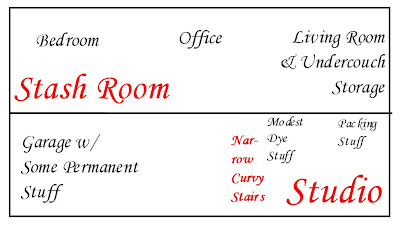 This is my attempt at a 3-dimensional-in-my-mind map of where I remember putting my weaving- and art-related stuff since 2006-ish. Ben's going to put stuff on TradeMe (NZ version of eBay) if I decide to part with anything.
We had our bedroom carpeted yesterday, you see, and the bed is still in the living room, but the bedroom is right next to the stash room. So it makes sense to use the empty floor to spread out everything and reorganize. I've been hoping to do this since mid-2006-ish (?) so the task is a long time coming, but I've felt overwhelmed at the enormity and procrastinated. I needed a catalyst and this one is as good as any, I keep telling myself. Once I get started, (as in, once I stop drinking endless pots of tea and get off the computer), I'm sure I'll enjoy it. I've also been telling myself that.
 This is my attempt at a 3-dimensional-in-my-mind map of where I remember putting my weaving- and art-related stuff since 2006-ish. Ben's going to put stuff on TradeMe (NZ version of eBay) if I decide to part with anything.
2009/06/06
What Do We Do?
This via Dr John Maeda, Prez of RISD's, via someone else's Tweet. (How on earth does one make a coherent, gramattically respectable sentence out of this one?)
This was also one of the topics at our Fibre Art Lunch yesterday. Dr Maeda also asks what's outside the circles.
This was also one of the topics at our Fibre Art Lunch yesterday. Dr Maeda also asks what's outside the circles.
2009/06/04
Napier, Part 1
The city of Napier was as pretty as ever; if anything, it had been prettied up even more since 1996. Napier has attractive fashion, design and antique (with an emphasis on Art Deco, of course) stores, many charming cafes where food is scrumptious, and possibly the best natural food store in New Zealand.
 The aptly-named Objects of My Affection
 Cafe Ujazi, Tennyson Street
The Symposium itself was intriguing. As usual, I was bombarded by wonderful visuals, which was exciting, but I admit I didn't enjoy this year as much as others. The theme was "Empire", and there is a good reason Hawke's Bay Museum and Art Gallery director Douglas Lloyd-Jenkins chose this; last year he read a paper on the identity crisis evident in the way young Pakeha (European-descent) boys dress, and he wanted to continue along this line, he said.
The majority of the 20 papers, though unmistakably about textiles and costumes, pertained to the British Empire, emitting strong Kiwi Love-Vibes for The Mother Country, which I found suffocating. I can't explain, but can only liken the atmosphere to the slight but persistent stale smell of an older relative's home. Or as Dolly Parton eloquently explained in Nine to Five, "I felt like a bastard at a family reunion." I mean no offense to Kiwis who feel this Love, but the sentiment is more corporeal and demanding than the regular Anglophilia I knew in the US or Japan. Afterwards, though, Douglas commented on how the New Zealand attitudes have changed, citing the number of times and where the audience laughed or giggled during the presentations.
There were perhaps a couple of papers on other empires, and only two from the Maori perspective. As a citizen of a nation that still has an Emperor, I should have thrown in a paper on just about anything Japanese for variety's sake, but the other presenters are academics and curators for the most part, and I wouldn't have felt comfortable. Besides, I'm a "tourists" at these symposia, just looking in form the outside.
Administratively, the HBMAG staff did a cracker of a job. These symposia are run smoothly every time, but this year delegates were treated to goodie bags with special rosettes which entitled us to free entry to the rest of the museum during the weekend. As my present, I got a knitting pattern and a set of self-cover buttons; the latter was serendipitous because just minutes earlier, I was gazing through an antique shop window at a navy blue silk dress with tiny silk-covered buttons.
 My Goodie Bag
After the official part of the program, we were treated to a patchwork of old film clips from New Zealand Film Archive, with live piano accompaniment. All clips related to fashion, but the most memorable piece was on manufacturing of nylon stockings in the 50's (?) which stated all workers, including Kiwi blokes, were manicured so as not to catch the fine threads!!
The whole country was going through (and still is) a severe cold spell. Some Napier members said it was the coldest in somewhere between two to 40 years (depending on the age of the speaker) in Napier. As a result, one of the other attraction of the symposia, of watching other delegates don their special garment or fashion, was a little disappointing, but I still managed find a few pieces where I had to ask if I could photograph.
I live in Nelson, which is a small city. And while I love living here, I miss the anonymity of big cities, and every year I've sat in the dark and contemplated textiles with the presentation running in the background the way grownups talk in the Peanuts cartoons. I work hard not to make friends. So you have got to see the humor in what happened this weekend; I had a German room mate.
I had booked a room to myself at the backpacker across the street from the museum months in advance. When I arrived, Owner Doug asked if I would mind sharing the room with another person coming to the conference, that I could halve my cost, though if I didn't, it wouldn't be a problem as there was plenty of rooms left. I didn't want to, but I have a hard time saying no, (I'm Japanese after all,) so I agreed. And so I met Christine Keller, of Hamburg, and now Academic Leader - Textiles, Otago Polytechnic, Dunedin.
I wasn't very friendly the first couple of days, but we ended up having dinner together the last night, giggled our way through Mamma Mia!, and talked textiles for more than a few hours on the last day. Christine is not only a professionally-trained, talented weaver/designer, but she also spent years in Canada studying Jacquard, has knowledge of exhibitions and contests in Europe, and is a natural mentor, even though she is, as she stated at one point, "much younger" than me. I was struck by the depth of her thoughts and encouraged by her opinion, and ended up promising to keep in touch. And so we will.
I must add, Christine was just as amused but more sympathetic to the Love. One of quite a few things we had in common was growing up in Post-WWII Germany/Japan, we both "learned" patriotism was undesirable except in specific contexts, and subtly discouraged, so neither of us feel the kind of Love towards our own countries.
 Christine Keller explaining the components of Art Deco geometric motifs in comparison to Pacific geometric motifs.
 The aptly-named Objects of My Affection
 Cafe Ujazi, Tennyson Street
The Symposium itself was intriguing. As usual, I was bombarded by wonderful visuals, which was exciting, but I admit I didn't enjoy this year as much as others. The theme was "Empire", and there is a good reason Hawke's Bay Museum and Art Gallery director Douglas Lloyd-Jenkins chose this; last year he read a paper on the identity crisis evident in the way young Pakeha (European-descent) boys dress, and he wanted to continue along this line, he said.
The majority of the 20 papers, though unmistakably about textiles and costumes, pertained to the British Empire, emitting strong Kiwi Love-Vibes for The Mother Country, which I found suffocating. I can't explain, but can only liken the atmosphere to the slight but persistent stale smell of an older relative's home. Or as Dolly Parton eloquently explained in Nine to Five, "I felt like a bastard at a family reunion." I mean no offense to Kiwis who feel this Love, but the sentiment is more corporeal and demanding than the regular Anglophilia I knew in the US or Japan. Afterwards, though, Douglas commented on how the New Zealand attitudes have changed, citing the number of times and where the audience laughed or giggled during the presentations.
There were perhaps a couple of papers on other empires, and only two from the Maori perspective. As a citizen of a nation that still has an Emperor, I should have thrown in a paper on just about anything Japanese for variety's sake, but the other presenters are academics and curators for the most part, and I wouldn't have felt comfortable. Besides, I'm a "tourists" at these symposia, just looking in form the outside.
Administratively, the HBMAG staff did a cracker of a job. These symposia are run smoothly every time, but this year delegates were treated to goodie bags with special rosettes which entitled us to free entry to the rest of the museum during the weekend. As my present, I got a knitting pattern and a set of self-cover buttons; the latter was serendipitous because just minutes earlier, I was gazing through an antique shop window at a navy blue silk dress with tiny silk-covered buttons.
 My Goodie Bag
After the official part of the program, we were treated to a patchwork of old film clips from New Zealand Film Archive, with live piano accompaniment. All clips related to fashion, but the most memorable piece was on manufacturing of nylon stockings in the 50's (?) which stated all workers, including Kiwi blokes, were manicured so as not to catch the fine threads!!
The whole country was going through (and still is) a severe cold spell. Some Napier members said it was the coldest in somewhere between two to 40 years (depending on the age of the speaker) in Napier. As a result, one of the other attraction of the symposia, of watching other delegates don their special garment or fashion, was a little disappointing, but I still managed find a few pieces where I had to ask if I could photograph.
I live in Nelson, which is a small city. And while I love living here, I miss the anonymity of big cities, and every year I've sat in the dark and contemplated textiles with the presentation running in the background the way grownups talk in the Peanuts cartoons. I work hard not to make friends. So you have got to see the humor in what happened this weekend; I had a German room mate.
I had booked a room to myself at the backpacker across the street from the museum months in advance. When I arrived, Owner Doug asked if I would mind sharing the room with another person coming to the conference, that I could halve my cost, though if I didn't, it wouldn't be a problem as there was plenty of rooms left. I didn't want to, but I have a hard time saying no, (I'm Japanese after all,) so I agreed. And so I met Christine Keller, of Hamburg, and now Academic Leader - Textiles, Otago Polytechnic, Dunedin.
I wasn't very friendly the first couple of days, but we ended up having dinner together the last night, giggled our way through Mamma Mia!, and talked textiles for more than a few hours on the last day. Christine is not only a professionally-trained, talented weaver/designer, but she also spent years in Canada studying Jacquard, has knowledge of exhibitions and contests in Europe, and is a natural mentor, even though she is, as she stated at one point, "much younger" than me. I was struck by the depth of her thoughts and encouraged by her opinion, and ended up promising to keep in touch. And so we will.
I must add, Christine was just as amused but more sympathetic to the Love. One of quite a few things we had in common was growing up in Post-WWII Germany/Japan, we both "learned" patriotism was undesirable except in specific contexts, and subtly discouraged, so neither of us feel the kind of Love towards our own countries.
 Christine Keller explaining the components of Art Deco geometric motifs in comparison to Pacific geometric motifs.
Subscribe to:
Posts (Atom)